
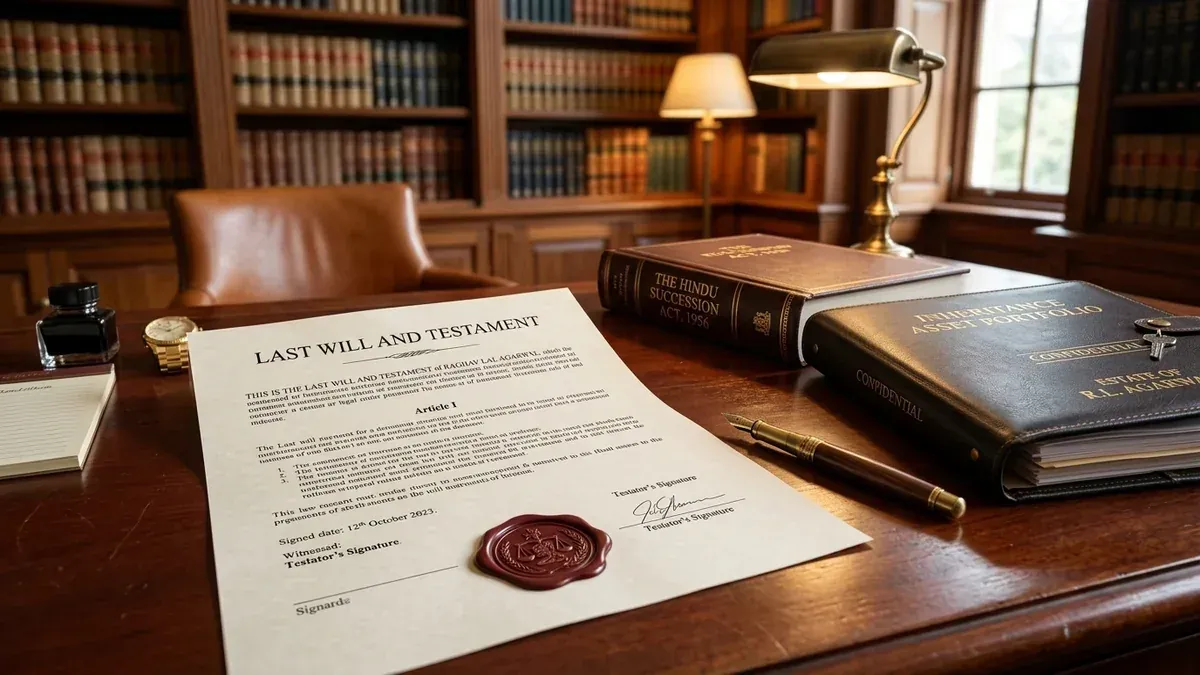
A Will is one of the most solemn and legally sensitive documents known to civil jurisprudence. Unlike ordinary commercial conveyances, sale deeds, or partnership agreements that take effect during the lifetime of the executing parties, a Will speaks exclusively from the grave. When a testamentary instrument is propounded in a court of probate or challenged in a partition suit, the one person whose intentions and state of mind are in dispute—the testator—is permanently unavailable to verify their signature, confirm testamentary capacity, or explain why natural legal heirs were excluded.
Recognizing the acute vulnerability of testamentary succession to fraud, undue influence, coercion, and forgery, the legislature established rigorous evidentiary safeguards. Under Section 63(c) of the Indian Succession Act, 1925, a Will is not legally executed unless it is attested by two or more credible witnesses who observed the testator sign or received personal acknowledgment. Furthermore, under Section 68 of the Bharatiya Sakshya Adhiniyam, 2023 (BSA)—which replaces Section 68 of the Indian Evidence Act, 1872 (IEA)—a Will cannot be received in evidence until at least one attesting witness is formally examined in open court.
A common and dangerous misconception among testators and family members is that registration before the Sub-Registrar cures all defects. The Supreme Court of India has repeatedly declared that registration does not dispense with the mandatory requirement of proving execution through an attesting witness. Navigating the evidentiary gauntlet laid down in H. Venkatachala Iyengar v. B.N. Thimmajamma and Janki Narayan Bhoir v. Narayan Namdeo Kadam is vital for any propounder seeking to establish a Will or any caveator seeking to invalidate a suspicious disposition.
Under Section 68 of the Bharatiya Sakshya Adhiniyam, 2023 (BSA / Section 68 IEA), a Will cannot be admitted in evidence unless at least one attesting witness testifies. As ruled in Janki Narayan Bhoir, the witness must prove both witnesses signed in the testator's presence. Registration does not dispense with this proof.
1. Substantive Execution Mandate: Section 63(c) Indian Succession Act
Before evaluating evidentiary rules under the Bharatiya Sakshya Adhiniyam, 2023, one must examine the foundational statutory requirements for executing an unprivileged Will codified in Section 63 of the Indian Succession Act, 1925:
Section 63(c), Indian Succession Act, 1925:
"The Will shall be attested by two or more witnesses, each of whom has seen the testator sign or affix his mark to the Will or has seen some other person sign the Will, in the presence and by the direction of the testator, or has received from the testator a personal acknowledgement of his signature or mark, or the signature of such other person; and each of the witnesses shall sign the Will in the presence of the testator, but it shall not be necessary that more than one witness be present at the same time, and no particular form of attestation shall be necessary."
From this statutory definition, four mandatory legal elements emerge:
- Minimum Two Attesting Witnesses: A Will attested by only one witness is void ab initio. No amount of oral evidence can cure the absence of a second attesting witness.
- Animus Attestandi: An attesting witness must sign with the explicit intention of verifying the execution of the document (animus attestandi). A person who signs merely as a scribe, draftsperson, or identifying witness before a registrar cannot automatically be treated as an attesting witness unless they signed in the presence of the testator with testamentary intention.
- Signatures in the Presence of the Testator: While both witnesses do not need to be present simultaneously, each witness must sign the Will in the physical presence of the testator. A witness who takes the Will home and signs it later does not satisfy Section 63(c).
- Personal Acknowledgment: If a witness did not see the testator physically sign, the testator must have personally acknowledged their signature to that witness before the witness attested the document.
2. Section 68 BSA (Old Section 68 IEA): The Mandatory In-Court Examination
The procedural mechanism for proving an attested document in legal proceedings is codified in Section 68 of the Bharatiya Sakshya Adhiniyam, 2023 (mirroring Section 68 of the Indian Evidence Act, 1872):
Section 68, Bharatiya Sakshya Adhiniyam, 2023:
"If a document is required by law to be attested, it shall not be used as evidence until one attesting witness at least has been called for the purpose of proving its execution, if there be an attesting witness alive, and subject to the process of the Court and capable of giving evidence:
Provided that it shall not be necessary to call an attesting witness in proof of the execution of any document, not being a Will, which has been registered in accordance with the provisions of the Registration Act, 1908, unless its execution by the person by whom it purports to have been executed is specifically denied."
Notice the critical statutory proviso: Wills are explicitly excluded from the exemption granted to registered documents! While a registered sale deed or mortgage deed does not require the examination of an attesting witness unless specifically denied, a Will—even if registered before the Sub-Registrar with biometric photographs—MUST be proved by examining at least one attesting witness in open court.
3. The Janki Narayan Bhoir Landmark: The Dual-Proof Evidentiary Standard
The most lethal pitfall in testamentary litigation occurs when counsel calls only one attesting witness who merely testifies: "The testator signed in my presence, and I signed in the testator's presence." Such testimony fails the statutory test and results in the total rejection of the Will!
The Supreme Court laid down the golden benchmarks for proving testamentary succession under Section 68 of the Evidence Act (Section 71 BSA). The propounder must affirmatively establish the testator's sound disposing mind, valid attestation by two witnesses, and satisfactorily dispel all suspicious circumstances surrounding the execution of the Will before judicial probate or letters of administration can issue.
In the landmark Three-Judge Bench decision in Janki Narayan Bhoir v. Narayan Namdeo Kadam (2003) 2 SCC 91, the Supreme Court clarified the exact evidentiary burden resting on the single attesting witness:
Supreme Court Dual-Proof Standard in Janki Narayan Bhoir:
"Section 68 of the Evidence Act permits proof of execution of a Will by examining at least one attesting witness. But that one witness must not only prove his own attestation and the testator's signature; he must also testify that the other attesting witness was also present and signed the Will in the presence of the testator. If the witness examined fails to prove that the second witness signed in the testator's presence, the mandatory requirement of Section 63(c) of the Succession Act is not satisfied, and the Will cannot be held proved."
If the single witness examined in court cannot testify to the simultaneous or subsequent execution by the second attesting witness, the propounder must summon and examine the second attesting witness. Failure to do so is fatal to probate.
4. Fallback Proof: Sections 69 and 71 BSA when Witnesses Die or Turn Hostile
Testamentary litigation frequently reaches trial decades after the testator's demise. In many cases, attesting witnesses have passed away, cannot be traced, or are bribed by rival caveators to deny their signatures. The Bharatiya Sakshya Adhiniyam provides robust statutory fallback mechanisms:
| Factual Contingency | Governing Statutory Section | Required Evidentiary Proof |
|---|---|---|
| Both Attesting Witnesses are Dead or Untraceable | Section 69 BSA (Old Section 69 IEA) | Prove: (1) death certificates or proof of search, (2) the handwriting of at least one attesting witness through relatives or bank records, and (3) the signature of the testator. |
| Attesting Witness Denies Signature or Turns Hostile | Section 71 BSA (Old Section 71 IEA) | Execution may be proved by other evidence—e.g., examining the document scribe, the registering Sub-Registrar, or examining a handwriting expert under Section 45 BSA. |
| Witness Suffers Memory Loss / Senility | Section 71 BSA | Where a witness states they "cannot recollect," the court allows cross-examination and accepts corroborative testimony from other persons present. |
In Babu Singh v. Ram Sahay (2008) 14 SCC 754, the Supreme Court emphasized that Section 71 is an equitable safeguard designed to prevent dishonest attesting witnesses from colluding with dissatisfied heirs to destroy a genuine Will. However, Section 71 can only be invoked after the propounder has exhausted attempts to examine the attesting witnesses under Section 68.
5. Dispersing Suspicious Circumstances: The Venkatachala Iyengar Doctrine
Proving formal execution under Section 68 BSA is only half the legal battle. In the foundational judgment of H. Venkatachala Iyengar v. B.N. Thimmajamma (1959) Supp (1) SCR 426, Justice P.B. Gajendragadkar laid down the permanent legal doctrine governing the conscience of the probate court:
- The Propounder's Onus: The burden of proof rests squarely on the propounder of the Will. The propounder must prove: (i) that the testator signed the Will, (ii) that the testator was in a sound and disposing state of mind (sound health and memory), and (iii) that the testator understood the nature and effect of the dispositions.
- The Doctrine of Suspicious Circumstances: If the caveator establishes suspicious circumstances surrounding the Will, the court will not grant probate unless the propounder offers a completely convincing, natural explanation:
- A shaky or trembling signature inconsistent with the testator's normal handwriting.
- Feeble, bedridden, or mentally incapacitated physical condition of the testator near death.
- Disinheriting natural legal heirs (e.g., leaving entire estate to a distant relative while cutting off a dependent wife or daughter) without any rational explanation in the text of the Will.
- The propounder taking a prominent, active part in the execution of the Will (e.g., drafting the Will, hiring the lawyer, arranging the witnesses, and receiving the lion's share of the estate).
- The Conscience of the Court: In Jaswant Kaur v. Amrit Kaur (1977) 1 SCC 369 and Shivakumar v. Sharanabasappa (2021) 11 SCC 277, the Supreme Court reiterated that unless the conscience of the court is fully satisfied that the Will represents the free, conscious, and unconstrained testamentary volition of the deceased, probate will be refused.
6. Probate Trial Tactics: Cross-Examining the Attesting Witness
In cross-examining an attesting witness in a testamentary suit, caveator counsel must structure questions around physical contemporaneous facts rather than abstract legal conclusions:
- Exact Physical Location and Timing: Question the witness regarding the exact room, seating arrangement, table, and lighting where the execution occurred. Discrepancies between the witness and scribe on where the testator was sitting fatally undermine credibility.
- The Physical Act of Signing: Ask whether the testator signed before or after the witnesses, what pen or ink was used, and whether the pages were read out aloud in the testator's mother tongue. In Niranjan Umeshchandra Joshi v. Mrudula Jyoti Rao (2006) 13 SCC 433, failure to prove that a regional-language testator understood an English-drafted Will destroyed the propounder's case.
- Subpoenaing Hospital ICU Registers: If the testator was hospitalized, subpoena the hospital indoor case papers, Glasgow Coma Scale (GCS) charts, and intensive care drug charts. If hospital records show the patient was comatose or administered continuous morphine infusions on the date of execution, the attesting witness's testimony that the testator was "fully conscious and laughing" will be dismissed as perjurious.
By combining Section 68 and Section 71 BSA requirements with the Janki Narayan Bhoir dual-proof standard and eliminating suspicious circumstances under Venkatachala Iyengar, litigators can secure unassailable probate decrees or decisively expose fraudulent Wills.