
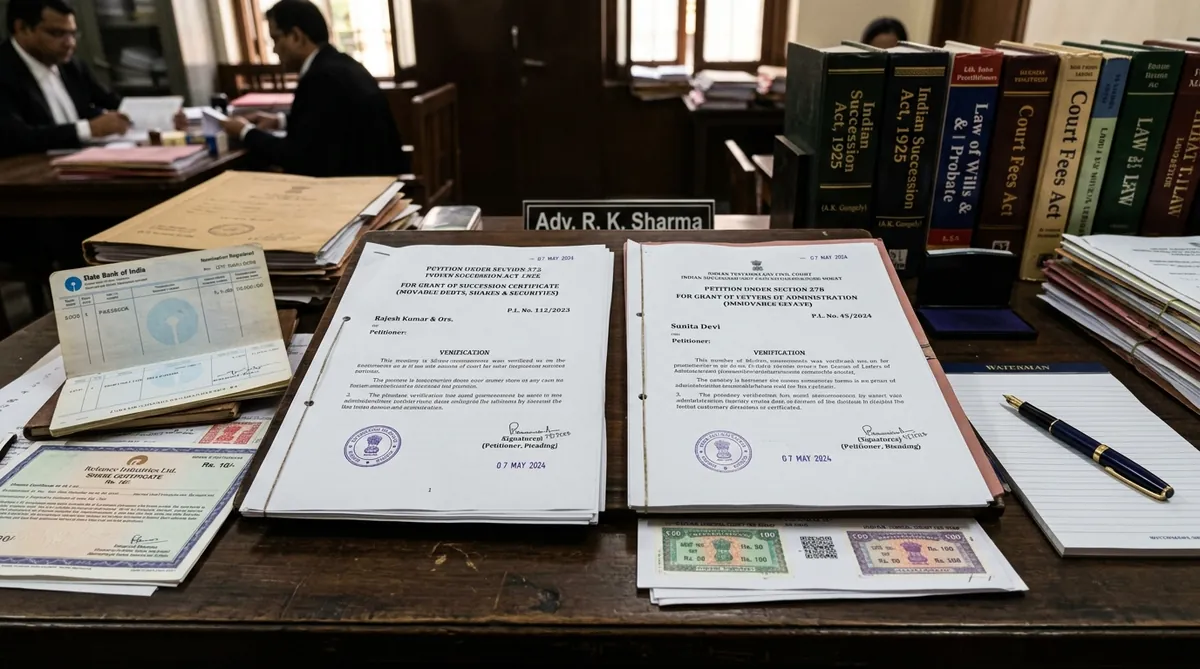
When an individual passes away intestate—meaning without having executed a valid, binding will—their surviving family members face immediate practical and administrative paralysis. Bank managers refuse to liquidate fixed deposits, housing societies refuse to transfer membership shares, mutual fund registrars freeze investment portfolios, and prospective real estate buyers demand authenticated court documentation establishing title before entering into sale deeds.
To resolve this deadlock, Indian succession law provides statutory mechanisms through the civil courts: Letters of Administration (LOA) and a Succession Certificate. However, there is widespread confusion among litigants, property owners, and even practicing advocates regarding which judicial certificate is applicable. A catastrophic error frequently committed by legal heirs is applying for a Succession Certificate to inherit agricultural land, commercial plots, or residential flats—only to discover, after years of litigation, that a Succession Certificate under Section 370 of the Indian Succession Act, 1925 is statutorily incapable of conferring title over immovable property. Understanding the distinction between Letters of Administration and Succession Certificates is essential for administering intestate estates without procedural bottlenecks.
Moreover, as Indian families accumulate multi-asset portfolios spanning real estate across multiple states, dematerialized equity accounts, company shares, and foreign bank deposits, selecting the wrong testamentary vehicle can result in complete procedural dismissal, forfeiture of hefty court fees, and protracted multi-year litigation delays.
When a person dies intestate without a will, legal heirs must obtain Letters of Administration under Section 218 of the Indian Succession Act 1925 to administer immovable properties. Unlike a Succession Certificate—which is strictly restricted to debts and movable securities—Letters of Administration confer full legal authority over the estate.
1. Letters of Administration vs. Succession Certificate: The Core Statutory Distinction
The Indian Succession Act, 1925 establishes separate pathways for managing the assets of an intestate deceased:
"Under Section 218 of the Indian Succession Act, if the deceased has died intestate and was a Hindu, Muhammadan, Buddhist, Sikh or Jaina, administration of his estate may be granted to any person who, according to the rules for the distribution of the estate applicable in the case of such deceased, would be entitled to the whole or any part of such deceased’s estate."
In sharp contrast, Part X of the Act (Sections 370 to 390) governs Succession Certificates:
"Section 370(1): A succession certificate shall not be granted under this Part with respect to any debt or security to which a right is required by section 212 or section 213 to be established by letters of administration or probate..."
| Key Feature | Letters of Administration (Without Will) | Succession Certificate |
|---|---|---|
| Statutory Provision | Sections 218 & 278, Indian Succession Act, 1925. | Sections 370 to 380, Indian Succession Act, 1925. |
| Asset Scope | Covers BOTH immovable properties (land, flats, commercial buildings) AND movable assets. | Strictly restricted to "debts and securities" (bank balances, shares, provident funds). ZERO immovable assets. |
| Nature of Right Conferred | Confers full representative title to administer, recover, manage, and divide the estate of the deceased. | Grants a limited indemnity to debtors to pay debts to the certificate holder; does not adjudicate complex title. |
| Court Jurisdiction | Principal District Judge or High Court exercising Ordinary Original Civil Jurisdiction. | Senior Civil Judge / District Judge having jurisdiction over the deceased's residence or assets. |
| Administration Bond & Surety | Mandatory under Section 291 ISA (Bond with one or more sureties for the full estate valuation). | Discretionary under Section 375 ISA; court may require an indemnity bond depending on objections. |
2. Judicial Precedents: The Absolute Prohibition on Immovable Property in Succession Certificates
The principle that a Succession Certificate cannot govern real estate has been reaffirmed across High Courts for over a century. In State of Himachal Pradesh v. Prem Chand ((AIR 1997 HP 67)), the High Court struck down an order granting a succession certificate over agricultural land, holding that:
The Supreme Court laid down the golden benchmarks for proving testamentary succession under Section 68 of the Evidence Act (Section 71 BSA). The propounder must affirmatively establish the testator's sound disposing mind, valid attestation by two witnesses, and satisfactorily dispel all suspicious circumstances surrounding the execution of the Will before judicial probate or letters of administration can issue.
"A succession certificate under Part X of the Indian Succession Act can only be granted in respect of debts and securities. The expression 'debt' does not include immovable property. Land, houses, and tenements cannot form the subject matter of an application under Section 372."
Similarly, in Muthia v. Ramasami ((ILR 20 Mad 320)) and Ambika Prasad v. Padmaavathi ((AIR 1992 Kar 230)), the courts settled that when legal heirs require a judicial instrument to establish representative title over real estate to deal with municipal authorities, land revenue collectors, or prospective buyers, their sole statutory recourse is a petition for Letters of Administration under Section 278.
Furthermore, as held in Jogendra Nath v. Jagabandhu ((ILR 14 Cal 518)), the grant of Letters of Administration does not decide final questions of title between competing claimants; it merely appoints an administrator to represent the estate in law, collect assets, discharge liabilities, and distribute the net residue according to the applicable personal law (e.g., Sections 8 to 13 of the Hindu Succession Act, 1956).
In Ramji Dayawala & Sons v. Invest Import ((1981) 1 SCC 80), the Supreme Court emphasized that judicial orders granting administrative representation are orders in rem, vesting legal control in the administrator to sue for recovery of debts and protect estate property against third-party trespassers.
3. Procedural Framework: Filing for Letters of Administration in Court
Obtaining Letters of Administration for an intestate deceased involves a structured judicial trajectory before the competent District Court or High Court:
- Drafting the Petition (Section 278 ISA): The petition must specify: (a) the time and place of the deceased's death, (b) the family pedigree detailing all Class I legal heirs, (c) a comprehensive schedule of assets (Schedule A: Movables; Schedule B: Immovables) with certified market valuations, and (d) an affirmative averment that due search was made and no will has been found.
- Issuance of Citations & Public Notice: The court issues individual judicial citations to all surviving legal heirs. Additionally, a general citation is published in two widely circulated newspapers (one English, one vernacular) in the district where the deceased resided and where properties are located, inviting objections within 30 days.
- No-Objection Affidavits (NOCs) vs. Contested Caveats: If all legal heirs file affidavits consenting to the administration by the petitioner, the matter proceeds ex parte to formal evidence. If an heir files a caveat under Section 284 ISA, the proceedings are converted into a contested testamentary suit governed by the Code of Civil Procedure, 1908.
- Administration Bond & Sureties (Section 291 ISA): Upon passing the order granting LOA, the petitioner must execute an Administration Bond with one or two solvent sureties, pledging to faithfully administer the estate, exhibit a true inventory within six months, and file an account of administration within one year under Section 317 ISA.
- Payment of Ad Valorem Court Fees: Letters of Administration are engrossed on stamp paper upon deposit of the requisite state court fees, which vary significantly across jurisdictions (e.g., maximum cap of ₹75,000 in Maharashtra, vs. percentage slabs without caps in several other states).
4. The Administration Bond Challenge: Practical Bottlenecks and Waiver Applications
The single greatest hurdle faced by ordinary citizens seeking Letters of Administration is Section 291 of the Indian Succession Act, which mandates that the administrator must furnish an administration bond with sureties. In high-value metropolitan estates (e.g., a Delhi or Mumbai bungalow valued at ₹15 Crores), finding third-party sureties willing to pledge solvent property or solvency certificates matching the estate valuation is virtually impossible.
Judicial Pathways for Bond and Surety Dispensation
High Courts have exercised inherent equitable jurisdiction to alleviate this hardship when all surviving legal heirs are unanimous:
- Sole Beneficiary Exemption: Where the petitioner is the sole surviving Class I legal heir (e.g., the only child of a deceased widower), the Delhi High Court and Bombay High Court have consistently held that requiring a person to furnish sureties to protect their own inheritance is an exercise in futility. In such cases, courts allow personal bonds without external sureties.
- Unanimous Consent Waiver: Where all adult Class I heirs appear and explicitly waive the requirement of third-party sureties, courts permit the execution of a simple personal undertaking.
- Valuation Disputes: Revenue authorities often attempt to inflate stamp duty by assessing property at commercial market rates rather than notified circle rates. The administrator has the right to challenge arbitrary revenue valuations before the District Judge under Section 19-H of the Court-fees Act, 1870.
- Reduction of Surety Amount: Under Order 28 of High Court Original Side Rules, judges retain judicial discretion to reduce the surety penalty to a fraction of the gross estate value if debts are negligible.
5. Strategic Litigation Checklist: Choosing the Correct Succession Vehicle
Before drafting pleadings, advocates and estate administrators must evaluate the nature of the estate assets:
- Scenario A (Only Bank Accounts, Shares & Mutual Funds): Apply for a Succession Certificate under Section 372 ISA. It is faster, summary in nature, involves lower court fee ceilings in many states, and eliminates the need to prove administration of physical real estate.
- Scenario B (Any Real Estate / Flat / Land): You MUST file a petition for Letters of Administration under Section 278 ISA. A Succession Certificate will be summarily rejected by the Land Registry, DDA, or Housing Society.
- Scenario C (Will Exists, but No Executor Named): Where a deceased leaves a valid will but neglects to name an executor, or the named executor dies or renounces probate, legal heirs must apply for Letters of Administration with the Will Annexed under Sections 232 and 234 ISA.
- Scenario D (Assets Spread Across Multiple States): Ensure that the petition explicitly prays for an order operating throughout the territory of India under Section 273 ISA, avoiding the nightmare of filing separate ancillary petitions in every district.
State Court Fees & Fiscal Planning for Letters of Administration
The fiscal cost of obtaining Letters of Administration varies drastically across Indian states. In the State of Maharashtra, the Bombay Court-fees Act, 1959 prescribes an upper statutory ceiling of ₹75,000 under Schedule I, Article 11, regardless of whether the estate is valued at ₹5 Crores or ₹500 Crores. Conversely, in the National Capital Territory of Delhi, court fees on probate and Letters of Administration are levied ad valorem at approximately 4% of the net estate valuation without an upper monetary cap. Litigants must carefully scrutinize whether liabilities, mortgages, and outstanding income-tax debts can be statutorily deducted from the gross valuation under Section 19-B of the Court-fees Act, 1870 to legitimately optimize the stamp duty liability prior to the grant of administration.