
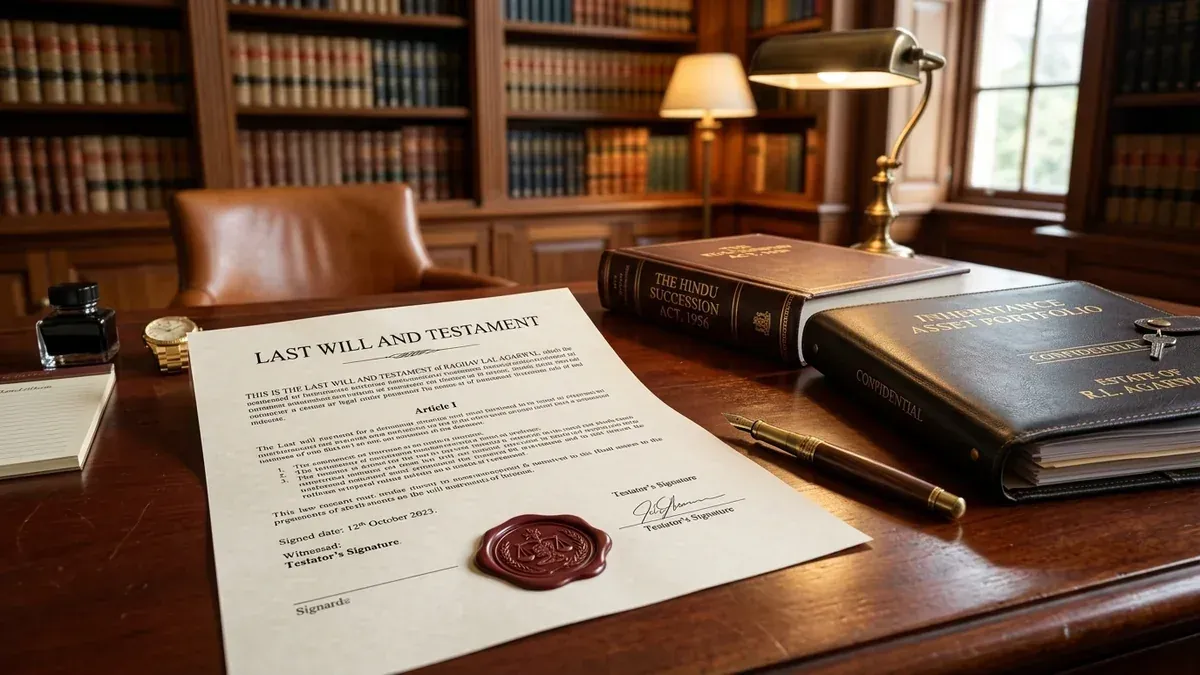
Few statutory provisions in Indian property and succession law generate as much recurring confusion, bureaucratic friction, and unnecessary litigation as Section 213 of the Indian Succession Act, 1925. Across municipal corporation offices, land revenue registries, Delhi Development Authority (DDA) desks, and nationalized banks, citizens seeking mutation of inherited real estate are routinely rebuffed by administrative officers demanding a "Court Probate" before processing title transfers.
However, under Indian law, probate is not universally mandatory throughout the geographical territory of India. The statutory mandate compelling executors and legatees to obtain probate is severely restricted by historical, colonial-era territorial limits embedded in Section 213 read with Section 57 of the Indian Succession Act. While probate remains an absolute statutory prerequisite in the former Presidency towns of Mumbai, Kolkata, and Chennai, it is completely optional and non-mandatory in Delhi, Punjab, Haryana, and the rest of Northern India. Dissecting the precise statutory wording, constitutional jurisprudence, and High Court precedents is critical to preventing administrative coercion and avoiding tens of thousands of rupees in unwarranted court fees.
This bizarre geographic asymmetry frequently catches estate planners and NRI families by surprise. A property owner residing in New Delhi who executes a will bequeathing ancestral land in Haryana and an apartment in South Mumbai will discover that identical clauses in the same document face two totally different legal hurdles: completely exempt from probate in Gurgaon and Delhi, yet legally unenforceable in Mumbai without a formal grant of probate from the Bombay High Court!
Under Section 213 read with Section 57 of the Indian Succession Act 1925, probate is mandatory for Hindu wills executed within or covering immovable properties in Mumbai, Kolkata, and Chennai. Conversely, probate is not statutorily mandatory in Delhi, Punjab, Haryana, or Uttar Pradesh, as confirmed by the Supreme Court.
1. Deconstructing the Statutory Mechanism: Section 213 Read with Section 57
To determine whether a will requires compulsory probate, one must read Section 213(1) in conjunction with the statutory exceptions carved out in Section 213(2) and the geographical classifications of Section 57:
"Section 213(1): No right as executor or legatee can be established in any Court of Justice, unless a Court of competent jurisdiction in India has granted probate of the will under which the right is claimed, or has granted letters of administration with the will or with a copy of an authenticated copy of the will annexed."
If Section 213(1) stood alone, every will in India would require probate. However, Section 213(2) explicitly restricts its application:
"Section 213(2): This section shall only apply—(i) in the case of wills made by any Hindu, Buddhist, Sikh or Jaina where such wills are of the classes specified in clauses (a) and (b) of section 57..."
Turning to Section 57 of the Act, we find the critical geographical nexus:
- Clause (a): Wills made on or after 1 September 1870 within the territories which at that date were subject to the Lieutenant-Governor of Bengal or within the local limits of the ordinary original civil jurisdiction of the High Courts of Judicature at Madras and Bombay.
- Clause (b): All such wills made outside those territories and limits so far as relates to immovable property situated within those territories or limits.
- Clause (c): Wills made on or after 1 January 1927 to which clauses (a) and (b) do not apply. Crucially, Section 213(2) mentions only clauses (a) and (b), deliberately omitting clause (c)!
Because Section 213(2) deliberately omitted clause (c) of Section 57, Parliament manifested an unambiguous legislative intent: wills made outside the historical Presidency towns and not dealing with properties located in those towns are entirely liberated from the mandatory embargo of Section 213(1).
2. Territorial Matrix: Where is Probate Mandatory vs Where is it Optional?
By virtue of this statutory cross-referencing, India is bifurcated into two distinct legal regimes regarding testamentary succession for Hindus, Buddhists, Sikhs, and Jains:
| Territory / Jurisdiction | Statutory Mandate | Legal Effect on Property Mutation |
|---|---|---|
| Presidency Towns: Mumbai, Kolkata, Chennai | STRICTLY MANDATORY | No executor or legatee can establish right in any court, bank, or land registry without probate or LOA with will annexed. |
| National Capital Territory of Delhi | NOT MANDATORY (OPTIONAL) | Will is fully operative upon testator's death. Beneficiaries can sue, mutate property with DDA/MCD, and claim bank funds without probate. |
| Punjab, Haryana, Uttar Pradesh, Rajasthan | NOT MANDATORY (OPTIONAL) | Covered under Section 57(c); Section 213 bar does not apply. Title passes directly under the executed will. |
| Property in Mumbai/Kolkata, but Will Made in Delhi | STRICTLY MANDATORY | Under Section 57(b), because the immovable asset is located within the presidency limits, probate is compulsory. |
3. Landmark Precedents: Clarence Pais & Kanta Yadav v. Om Prakash Yadav
The territorial dichotomy has been repeatedly challenged and upheld by the highest judiciary. In the landmark Constitution Bench ruling of Clarence Pais v. Union of India ((2001) 4 SCC 325), the constitutional validity of Section 213 was challenged on grounds of discrimination under Article 14:
The Supreme Court laid down the golden benchmarks for proving testamentary succession under Section 68 of the Evidence Act (Section 71 BSA). The propounder must affirmatively establish the testator's sound disposing mind, valid attestation by two witnesses, and satisfactorily dispel all suspicious circumstances surrounding the execution of the Will before judicial probate or letters of administration can issue.
"The Supreme Court held that the classification between wills made in Presidency towns and those made in other parts of India has historical roots and does not violate Article 14. Section 213 applies only to wills made within the territories of Bengal, Madras, and Bombay, or wills relating to immovable property situated therein. For wills made outside these areas, obtaining probate is purely optional."
Any lingering doubt regarding Delhi and Haryana was decisively put to rest by the Supreme Court in Kanta Yadav v. Om Prakash Yadav ((2020) 14 SCC 102). Affirming the long-standing Full Bench judgment of the Punjab & Haryana High Court in Behari Lal Ram Charan v. Karam Chand Sahni ((AIR 1968 P&H 108)), the apex court held:
"The requirement of obtaining probate or letters of administration under Section 213 of the Succession Act does not apply to wills made by Hindus in the State of Haryana, Punjab, or the Union Territory of Delhi. A legatee can maintain a civil suit or establish rights without obtaining probate."
This position has been consistently applied by the Delhi High Court in landmark rulings including Pam Chow Sanker v. State, Rajinder Kumar v. Shanti Devi, and Mukul Gupta v. Municipal Corporation of Delhi, where the court firmly rebuked municipal bodies for withholding property mutation on the pretext of probate.
4. Countering Unlawful Administrative Demands: DDA, Banks & Municipal Corporations
Despite settled Supreme Court jurisprudence, legal heirs in Delhi and NCR frequently receive rejection letters from sub-registrar offices, housing societies, or banks demanding probate. Beneficiaries have established legal mechanisms to overcome this administrative inertia:
- Formal Legal Notice with Landmark Judgments: Serve a formal legal notice through counsel citing Kanta Yadav v. Om Prakash Yadav ((2020) 14 SCC 102) and Clarence Pais ((2001) 4 SCC 325), formally alerting the authority that Section 213 does not apply in Delhi/Haryana.
- Submission of Standard Indemnity & NOCs: Under statutory circulars of the Reserve Bank of India (RBI) and DDA guidelines, where probate is not statutorily mandatory, authorities must process mutation upon receiving: (a) the original or certified will, (b) death certificate, (c) legal heir affidavit, (d) No-Objection Certificates from excluded heirs, and (e) an indemnity bond executed by the beneficiary.
- Writ Petition under Article 226: If a public body (DDA, L&DO, Municipal Corporation) arbitrarily refuses mutation without probate, the High Court will issue a Writ of Mandamus directing immediate mutation along with exemplary litigation costs against the defaulting officer.
5. When Should You Opt for Voluntary Probate in Delhi or Non-Presidency Areas?
While probate is not legally mandatory outside Presidency towns, obtaining voluntary probate under Section 276 ISA is often highly strategic:
Strategic Advantages of Voluntary Probate
- Disputed or Estranged Family: If siblings are hostile or likely to file a partition suit in the future, obtaining probate conclusively establishes the will's authenticity in rem, shutting down future collateral attacks.
- High-Value Real Estate Sale: Institutional buyers, corporate entities, and banks financing purchasers of multi-crore properties routinely demand probate to guarantee unencumbered, marketable title.
- Foreign Assets or NRI Heirs: Foreign probate courts and cross-border banks require an exemplified, authenticated probate order from an Indian High Court before releasing overseas assets under private international law.
- Preventing Limitation Pitfalls: Under Article 137 of the Limitation Act, 1963, probate petitions do not have a rigid three-year limitation clock starting from death; however, filing promptly prevents evidence destruction.
The Special Rule for Indian Christians & Parsis under Section 213
Historically, Indian Christians were subjected to mandatory probate regardless of geography. Following severe constitutional challenges alleging discrimination under Article 14, Parliament enacted the Indian Succession (Amendment) Act, 2002 (Act 26 of 2002), amending Section 213(2) to expressly exempt Indian Christians from the compulsory probate mandate across the country. Today, Indian Christian wills executed in Delhi, Kerala, Goa, or Punjab are governed under the exact same non-mandatory regime as Hindu wills outside Presidency towns. Parsis executing wills within the ordinary original civil jurisdiction of the High Courts, however, remain subject to the requirement of probate.
For property buyers in Delhi/NCR purchasing properties from legatees under an unregistered or unprobated will, the prudent title due diligence standard requires securing registered Relinquishment Deeds or registered Family Settlement Agreements from all Class I legal heirs who would have inherited the property in the event of intestacy, thereby eliminating any risk of future revocation suits.
Where property mutation is withheld arbitrarily by sub-registrars or revenue tehsildars under the pretext of demanding probate in non-presidency states, the aggrieved party should immediately initiate action under Section 166 of the Bharatiya Nyaya Sanhita, 2023 for public servant disobeying law with intent to cause injury, alongside filing a civil contempt or writ petition. Trial courts in Delhi and Punjab have consistently held that an unprobated will can be marked as an exhibit and admitted in evidence in partition or injunction suits to establish possessory rights and demonstrate title prima facie.