
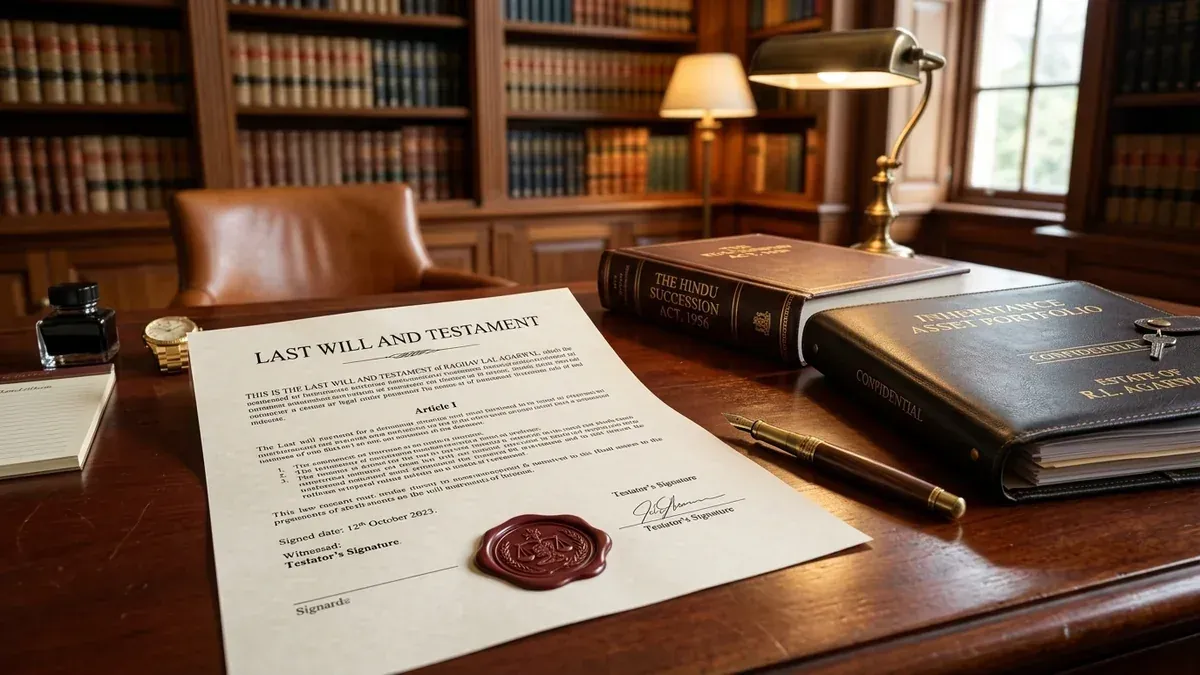
Among the rigorous forensic and medical grounds upon which testamentary dispositions are assailed in Indian civil courts, an allegation attacking the testator's mental capacity—specifically invoking dementia, Alzheimer's disease, senile decay, or delirium—is the most potent and fiercely litigated. When disinherited legal heirs discover that an elderly patriarch or matriarch has bequeathed multi-crore ancestral or self-acquired estates to a single caregiver, sibling, or outsider, their primary legal weapon in a probate or partition suit is almost invariably an assertion of testamentary incapacity under Section 59 of the Indian Succession Act, 1925.
However, establishing or refuting mental incapacity is fraught with profound legal and clinical complexities. In civil jurisprudence, "testamentary capacity" is a specialized legal standard, not an absolute clinical diagnosis. An individual suffering from bodily infirmity, terminal cancer, or mild memory loss may still possess adequate legal capacity to execute a binding will, provided they understand the character of the document and the assets being distributed. Navigating these high-stakes disputes requires mastering the interplay between statutory mandates, psychiatric assessments, doctor cross-examinations, and the century-old common law tests that remain the bedrock of Indian succession trials.
Furthermore, as life expectancy has increased in urban India, a vast percentage of wills are executed by octogenarians and nonagenarians suffering from chronic ailments like hypertension, diabetes, mild strokes, or vascular dementia. In this high-conflict landscape, the boundary between normal biological forgetfulness and complete legal incapacity becomes the decisive battleground where entire family fortunes are won or lost in testamentary courts.
Under Section 59 of the Indian Succession Act 1925, proving testamentary capacity requires establishing that the testator understood the nature of testamentary dispositions and affected assets. Allegations of dementia or Alzheimer's are rebutted through contemporaneous medical fitness certificates, treating doctor depositions, cognitive evaluations, and unimpeached testimony of attesting witnesses.
1. The Statutory Test: Section 59 Indian Succession Act, 1925
The core statutory threshold governing who is competent to execute a testamentary bequest is codified in Section 59 of the Indian Succession Act, 1925:
"Section 59: Every person of sound mind not being a minor may dispose of his property by will.
Explanation 1.—A married woman may make a will of any property which she could alienate by her own act during her life.
Explanation 2.—Persons who are deaf, or dumb, or blind, are not thereby incapacitated for making a will if they are able to know what they do by it.
Explanation 3.—A person who is ordinarily insane may make a will during an interval in which he is of sound mind.
Explanation 4.—No person can make a will while he is in such a state of mind, whether arising from intoxication, or from illness, or from any other cause, that he does not know what he is doing."
Crucially, Explanation 3 and Explanation 4 establish the legal reality of "lucid intervals." A medical diagnosis of psychiatric illness or cyclical mental disorientation does not automatically incapacitate an individual from making a will. If the propounder can establish that on the specific afternoon or morning the will was drafted, approved, and executed, the testator experienced a lucid interval and possessed an adequate understanding of their actions, the will remains completely valid in law.
In Indian trial practice, courts consistently distinguish between general insanity and testamentary incapacity. A person may be declared medically incapable of running a complex commercial corporation or managing day-to-day accounts, yet possess sufficient testamentary capacity to decide that their residential home should pass to their devoted daughter rather than an estranged son. The legal inquiry is task-specific: did the testator possess the requisite mental grasp to comprehend the testamentary disposition at the precise instant of signing?
2. The Banks v. Goodfellow Doctrine & Supreme Court Precedents
Indian courts have uniformly imported the classic common law doctrine of testamentary capacity articulated by Chief Justice Cockburn in Banks v. Goodfellow ((1870) LR 5 QB 549). To possess testamentary capacity, the testator must satisfy a tripartite cognitive test:
The Supreme Court laid down the golden benchmarks for proving testamentary succession under Section 68 of the Evidence Act (Section 71 BSA). The propounder must affirmatively establish the testator's sound disposing mind, valid attestation by two witnesses, and satisfactorily dispel all suspicious circumstances surrounding the execution of the Will before judicial probate or letters of administration can issue.
- Understanding the Nature of the Act: The testator must comprehend that they are executing a will that will take effect upon their death and irrevocably govern the succession of their worldly goods.
- Recollection of the Estate: The testator must understand the extent and value of the property they possess; they need not remember every bank account number, but must appreciate the general magnitude and character of their assets.
- Appreciation of Moral Claims: The testator must be able to comprehend and appreciate the natural claims of persons who would normally expect to inherit (spouses, dependent children), and their mind must be free from any insane delusion that distorts their natural affections.
In Surendra Pal v. Saraswati Arora ((1974) 2 SCC 600), the Supreme Court held that the propounder must show that the will was signed by the testator in a sound and disposing state of mind. However, the apex court in Madhukar D. Shende v. Tarabai Aba Shedage ((2002) 2 SCC 85) drew a vital judicial demarcation between physical weakness and mental incapacity:
"The test of a sound disposing mind is not that the testator must be in perfect health. A person may be physically debilitated, bedridden, or advanced in age, but so long as their mental faculties are alert and capable of exercising independent judgment regarding their property and beneficiaries, testamentary capacity cannot be denied."
This principle was reinforced in Leela Rajagopal v. Kamala Menon Cocharan ((2014) 15 SCC 570), where the Supreme Court observed that mere tremors, old-age infirmities, or hearing impairments do not justify nullifying a registered testamentary bequest if the surrounding witness depositions establish that the testator understood the document. Similarly, in Kavita Kanwar v. Pamela Mehta (2020), the Court reiterated that while physical frailty alone does not invalidate a will, if combined with cognitive obscurity and beneficiary dominance, it casts an indelible cloud of suspicion.
3. Clinical Reality: Dementia, Alzheimer's & Evidentiary Proof in Trials
Dementia and Alzheimer's disease present unique progressive neurological challenges. Unlike sudden traumatic brain injuries, dementia progresses through mild cognitive impairment (MCI), moderate decline, and severe neurological deterioration. In probate trials, caveators frequently produce hospital discharge summaries mentioning "altered sensorium," "disorientation," or "Parkinsonian dementia" to invalidate a will:
- Contemporaneous vs. Retrospective Medical Evidence: A medical certificate issued by a physician who examined the testator on the day of execution carries immense probative weight. Conversely, a retrospective affidavit submitted by a medical expert who never treated the deceased but merely reviewed clinical charts years later is treated merely as advisory opinion under Section 45 of the Evidence Act / Section 39 of BSA.
- Mini-Mental State Examination (MMSE): In modern estate litigation, standardized cognitive assessments such as the MMSE (scoring out of 30) or MoCA (Montreal Cognitive Assessment) are scrutinized. A score above 24 generally indicates preserved cognitive functioning, scores between 18–23 indicate mild-to-moderate impairment requiring corroboration, while scores below 18 raise severe judicial red flags regarding disposing capacity.
- Attesting Witness Evidence Overrides Theoretical Medical Doubts: In Gopal Swaroop v. Krishna Murari Mangal ((2010) 14 SCC 266), the Supreme Court confirmed that direct oral evidence of attesting witnesses who observed the testator's behavior, speech, and comprehension at the exact moment of execution takes precedence over vague medical theories or general hospital records regarding chronic ailments.
- The Role of Medication and Sedatives: When caveators allege that the testator was comatose or stuporous due to high doses of opioids, morphine, or psychotropic anti-anxiety medications, the nursing charts and medication administration logs (MAR) of the hospital become decisive exhibits. If the propounder demonstrates that the will was executed during morning hours before administration of evening sedatives, the plea of incapacity is neutralized.
4. Trial Tactics: Deposition & Cross-Examination of the Treating Doctor
When a doctor is summoned to the witness box in a probate trial, advocate preparation must be forensic and methodical:
| Litigant Role | Key Objectives in Examination | Critical Evidentiary Questions |
|---|---|---|
| Propounder's Counsel (Defending Will) | Establish lucid interval; isolate physical illness from mental sharpness; confirm testator recognized people and communicated rationally. | "Did the patient converse coherently? Did the administered analgesics impair cognitive awareness? Could the patient express personal preferences?" |
| Caveator's Counsel (Challenging Will) | Establish continuous cognitive decline; elicit medication side-effects (sedatives, narcotics); prove dependence and susceptibility to suggestion. | "Was the patient disoriented to time, place, and person? Were clinical notes recording hallucinations or delirium present during that week?" |
Advocates must also scrutinize hospital Admission Records (Form 1) and clinical daily progress sheets. In numerous High Court cases, wills alleged to have been executed at home were exposed as absolute fabrications because the bed-head tickets proved that on that exact date and hour, the testator was in the intensive care unit intubated on mechanical ventilation.
5. Medical Proof Protocol for Elderly Testators: Bulletproofing Future Wills
To permanently insulate a will from vexatious challenges alleging dementia or Alzheimer's, legal advisors should enforce a rigorous clinical protocol:
The 4-Step Clinical Immunity Checklist
- Formal Cognitive Assessment: Engage a Consultant Neurologist or Geriatric Psychiatrist to administer a standardized MMSE or MoCA test within 48 hours prior to the execution of the will. The signed evaluation sheet should be appended as an annexure to the will.
- Doctor as Attesting Witness: Request the evaluating physician to act as one of the two statutory attesting witnesses under Section 63(c) ISA. Having an MD Physician sign as an attesting witness obliterates 90% of subsequent claims of dementia.
- Verbal Comprehension Video Recording: Capture a continuous video recording where the drafting advocate or doctor asks open-ended questions: "Who are your children?", "What properties do you own?", "Why are you giving this house to your daughter?" This conclusively demonstrates free volition and absence of delusions.
- Preserve Pharmacy & Treatment Records: Maintain a complete file of prescription charts and doctor notes contemporaneous with the execution period to prove that the testator was not under the influence of heavy sedation or mind-altering narcotics.
- Registration at Residence under Special Commission: If the testator is too infirm to travel to the Sub-Registrar's office, apply under Section 31 of the Registration Act, 1908 for the Sub-Registrar to visit the testator's residence. The Sub-Registrar's official endorsement certifying the testator's verbal acknowledgment creates formidable statutory corroboration.