
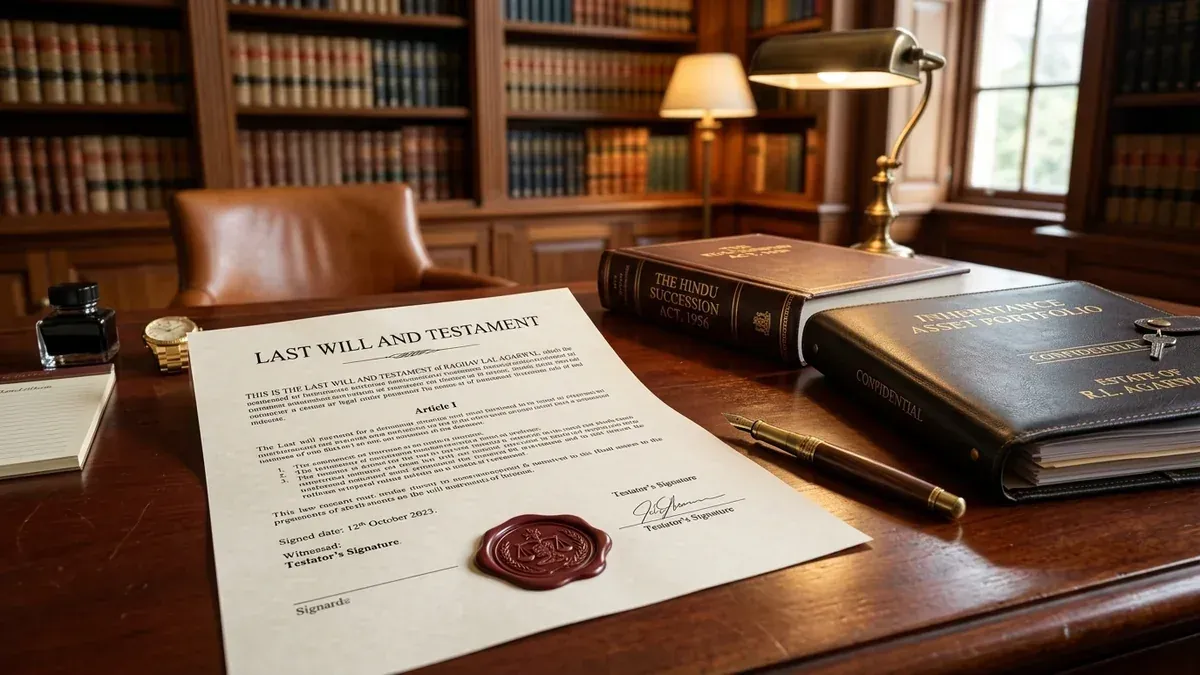
A fundamental legal characteristic of any testamentary instrument is its ambulatory nature. A Will never takes effect during the lifetime of the testator; it confers no present legal title, creates no vested commercial interest, and remains completely revocable at the sole discretion of the testator until their final breath. Even if a testator executes a solemn Will declaring that it is "irrevocable," such a clause is a legal nullity. The testator retains the unchallengeable legal freedom to alter, amend, cancel, or completely revoke their testamentary dispositions as often as they desire.
However, complex legal disputes erupt when the original Will was formally registered before the Sub-Registrar under the Registration Act, 1908, and the testator subsequently revokes it through an unregistered subsequent Will, an unregistered revocation deed, or by physically burning or tearing the original registered parchment. Disappointed beneficiaries of the earlier registered Will routinely argue in probate courts: "An unregistered scrap of paper cannot extinguish a solemn registered document maintained in the public books of the Registration Department!"
This commercial argument is fundamentally flawed under Indian succession law. Under Section 70 of the Indian Succession Act, 1925, the statutory modes of revoking an unprivileged Will are exhaustive, specific, and completely independent of registration status. The Supreme Court of India in Meenakshiammal v. Chandrasekharan (2005) 1 SCC 280 and Anil Kak v. Sharada Raje (2008) 7 SCC 695 established that an unregistered subsequent Will or physical destruction with animus revocandi legally extinguishes a prior registered Will. Understanding the statutory mechanics of Section 70 is critical to successfully defending revocations and defeating fraudulent probate petitions.
Under Section 70 of the Indian Succession Act, 1925, a registered Will can be revoked by executing a subsequent valid Will, an attested revocation deed, or by physically destroying the document with animus revocandi. Crucially, a subsequent revocation does not require registration to legally extinguish a prior registered testamentary instrument.
1. The Four Exclusive Statutory Modes of Revocation under Section 70
Section 70 of the Indian Succession Act, 1925 prescribes an exhaustive statutory code governing the revocation of unprivileged Wills:
Section 70, Indian Succession Act, 1925:
"No unprivileged Will or codicil, nor any part thereof, shall be revoked otherwise than by marriage, or by another Will or codicil, or by some writing declaring an intention to revoke the same and executed in the manner in which an unprivileged Will is hereinbefore required to be executed, or by the burning, tearing, or otherwise destroying the same by the testator or by some person in his presence and by his direction with the intention of revoking the same."
From the plain language of Section 70, the law recognizes exactly four exclusive legal mechanisms to revoke a Will:
| Revocation Mode | Statutory Mechanism | Essential Legal Requirements |
|---|---|---|
| 1. By Marriage (Section 69) | Automatic statutory revocation upon solemnization of marriage. | Applies strictly to Christians, Parsis, and Jews under ISA; explicitly exempts Hindus, Buddhists, Jains, Sikhs, and Muslims under Section 57. |
| 2. By Subsequent Will or Codicil | Executing a later valid testamentary instrument superseding prior dispositions. | Subsequent Will must be executed in accordance with Section 63 ISA (2 attesting witnesses); expressly revokes or is wholly inconsistent with earlier Will. |
| 3. By Writing Declaring Intention | Executing a formal standalone Deed of Revocation or cancellation letter. | Must be executed with the exact same formalities as a Will—signed by the testator and attested by at least two witnesses. |
| 4. By Physical Destruction | Burning, tearing, shredding, or cutting off the testator's signature. | Requires physical destruction combined with animus revocandi (intention to revoke) by testator or under their direct instruction. |
Crucially, oral revocation is a complete legal nullity. A testator who tells twenty family members that they have cancelled their Will has not revoked it in the eyes of the law.
2. Can an Unregistered Will or Writing Revoke a Registered Will?
The most fiercely contested question in probate litigation is whether an unregistered instrument can revoke a prior registered Will. Litigators defending the registered Will cite Section 17 of the Registration Act, 1908 and argue that a document of higher solemnity cannot be undone by an informal writing.
The Supreme Court of India in Meenakshiammal v. Chandrasekharan (2005) 1 SCC 280 settled this question with absolute clarity:
- Registration of Wills is Entirely Optional: Under Section 18(e) of the Registration Act, 1908, the registration of a Will is purely voluntary and optional. Registration confers a rebuttable presumption of genuineness regarding execution before the Registrar, but it does NOT alter the substantive nature of the testamentary document.
- Absence of Registration Requirement in Section 70: Section 70 of the Indian Succession Act does NOT prescribe that a revocation of a registered Will must be registered. It merely requires that the subsequent Will or revoking writing be "executed in the manner in which an unprivileged Will is hereinbefore required to be executed" (i.e., compliance with Section 63 ISA).
- The Ruling in Meenakshiammal: The Supreme Court held that if a testator executes a subsequent unregistered Will that complies with Section 63 and is proved under Section 68 of the Evidence Act (BSA), it operates as an immediate and absolute revocation of the prior registered Will. The earlier registered Will becomes a dead letter.
3. Physical Destruction: Proving 'Animus Revocandi' vs. Accidental Loss
Under the fourth mode of Section 70, a Will can be revoked by "burning, tearing, or otherwise destroying the same." However, physical destruction alone does NOT revoke a Will:
The Dual Requirement of Act and Intention:
To effectuate a valid revocation by destruction, two elements must co-exist simultaneously:
(1) Factum of destruction: Actual physical burning, tearing, or obliteration of essential parts (such as the signature or disposing clauses); and
(2) Animus revocandi: The mental intention of the testator to revoke the Will at the precise moment of destruction.
Critical legal nuances governing physical destruction include:
- Accidental Destruction or Loss: If a Will is eaten by white ants, destroyed in an accidental house fire, lost during house shifting, or shredded by an eccentric house cleaner without the testator's knowledge or consent, there is NO revocation. The propounder can prove the contents of the lost or destroyed Will through a photostat copy or secondary evidence under Section 237 of the Indian Succession Act.
- Destruction during Mental Incapacity: If a testator tears their Will while in a state of delirium, advanced dementia, intoxication, or temporary insanity, the revocation is void because animus revocandi was absent.
- Partial Tearing or Striking Out: Simply drawing pen lines or pencils across paragraphs does NOT constitute destruction under Section 70 unless the signatures are torn or obliterated with clear intention to cancel the entire instrument.
- Presumption of Revocation: In Babu Lal v. Ram Charan, courts affirmed that where a Will is traced to the physical possession of the testator during their lifetime and is found mutilated or cannot be found after death, the law raises a rebuttable presumption that the testator destroyed it with the intention of revoking it.
4. The Doctrine of Dependent Relative Revocation
The equitable doctrine of Dependent Relative Revocation is a crucial weapon used to revive seemingly destroyed Wills. Under this doctrine, if a testator destroys an earlier Will or inserts a revocation clause under the mistaken belief that a new disposition has taken effect, the law presumes that the revocation was conditional upon the validity of the new disposition:
- The Conditional Revocation Rule: If a testator executes "Will B" intending to replace "Will A", and physically tears "Will A", but "Will B" subsequently fails for lack of attestation under Section 63 or incapacity, Will A is revived. The court infers that the testator preferred the earlier Will to an intestacy and only intended to destroy the earlier Will on the condition that the new Will was legally effective.
- Supreme Court in Anil Kak v. Sharada Raje (2008) 7 SCC 695: The Supreme Court clarified that the doctrine of dependent relative revocation applies only when there is clear, unequivocal evidence that the testator's revocation was conditional upon the validity of another testamentary instrument. If the testator expressed an absolute intention to cancel the earlier Will irrespective of any replacement, the doctrine does not apply.
5. Express Revocation Clauses vs. Implied Inconsistency
When drafting a subsequent Will, legal precision is paramount to avoid multi-year civil litigation between competing heirs:
- Express Revocation Clause: The gold standard in testamentary drafting is inserting an explicit revocation clause: "I hereby revoke, cancel, and annul all my previous Wills, codicils, and testamentary dispositions made by me at any time heretofore, including my registered Will dated 15th January 2018 registered as Document No. 1234." This immediately terminates all prior dispositions without ambiguity.
- Implied Revocation by Inconsistent Disposition: Even in the absence of an express revocation clause, if a subsequent valid Will disposes of the exact same properties to completely different beneficiaries, the earlier Will is deemed impliedly revoked to the extent of the total inconsistency. However, if the subsequent Will disposes of only a newly acquired apartment, both Wills will be read together harmoniously as concurrent dispositions.
6. Litigation Tactics in Probate: Proving or Disproving Revocation
In high-stakes probate trials, the party alleging revocation carries the heavy legal burden of proof under Section 101 of the Bharatiya Sakshya Adhiniyam, 2023:
Litigation Action Checklist for Revocation Disputes:
- Subpoenaing the Registration Department Records: If the testator executed a formal Registered Cancellation Deed, obtain a certified copy from the Sub-Registrar under Section 57 of the Registration Act, 1908. While registration is not mandatory for revocation, a registered revocation deed provides unimpeachable public evidence of animus revocandi.
- Examining Attesting Witnesses of the Revoking Instrument: Just as with the original Will, the revoking instrument or subsequent unregistered Will must be proven under Section 68 BSA by calling at least one attesting witness to confirm the testator's sound disposing mind.
- Disproving Accidental Tearing: If the caveator claims the deceased destroyed the Will, lead evidence regarding where the torn fragments were recovered. If recovered from the testator's personal locked safe with discarded signatures, intentional revocation is established. If retrieved from a flooded basement or wastebasket handled by third parties, accidental loss applies.
- Challenging Late-Stage Revocations: If a registered Will in favor of devoted children is revoked days before death by an unregistered writing in favor of a caretaker, challenge the revoking instrument on grounds of fraud, isolation, and lack of testamentary capacity under the Venkatachala Iyengar doctrine.
7. Registered Cancellation Deeds vs. Subsequent Unregistered Wills
While Section 70 does not require registration, executing a formal Registered Deed of Cancellation of Will before the Sub-Registrar represents the highest degree of legal prudence:
- Elimination of Fictitious Document Claims: When a testator registers a Cancellation Deed under Section 18 of the Registration Act, 1908, the Sub-Registrar records biometric photographs and verifies mental alertness. This creates an unshakeable official record under Section 60 of the Registration Act, completely destroying any future claim by beneficiaries that the revocation was forged or procured by fraud.
- Superiority of Subsequent Testamentary Disposition: However, if a testator simply executes a later unregistered Will bequeathing their entire estate to a different beneficiary, the later Will automatically supersedes the earlier registered Will. Under the rule in Meenakshiammal v. Chandrasekharan, the probate court will grant probate to the subsequent unregistered Will upon proof of execution under Section 68 BSA, treating the earlier registered Will as completely revoked.
- Codicils and Partial Revocations: Under Section 62 of the Indian Succession Act, if a testator desires merely to alter an executor or change the bequest of a single bank deposit while keeping the remainder of the registered Will intact, they can execute an attested Codicil. The Codicil is construed as part of the original Will, revoking only the specific conflicting clauses while validating the residue.
By mastering the four statutory modes of Section 70, asserting the Meenakshiammal rule on unregistered revocations, and analyzing physical destruction with animus revocandi, litigators can effectively protect the true final intentions of the deceased.
Landmark Judicial Precedents & Statutory Authorities
Courts and appellate tribunals across Delhi NCR (Faridabad, Saket, Tis Hazari, Gurugram, High Courts) strictly apply these authoritative Supreme Court benchmarks:
The Supreme Court laid down the golden benchmarks for proving testamentary succession under Section 68 of the Evidence Act (Section 71 BSA). The propounder must affirmatively establish the testator's sound disposing mind, valid attestation by two witnesses, and satisfactorily dispel all suspicious circumstances surrounding the execution of the Will before judicial probate or letters of administration can issue.