
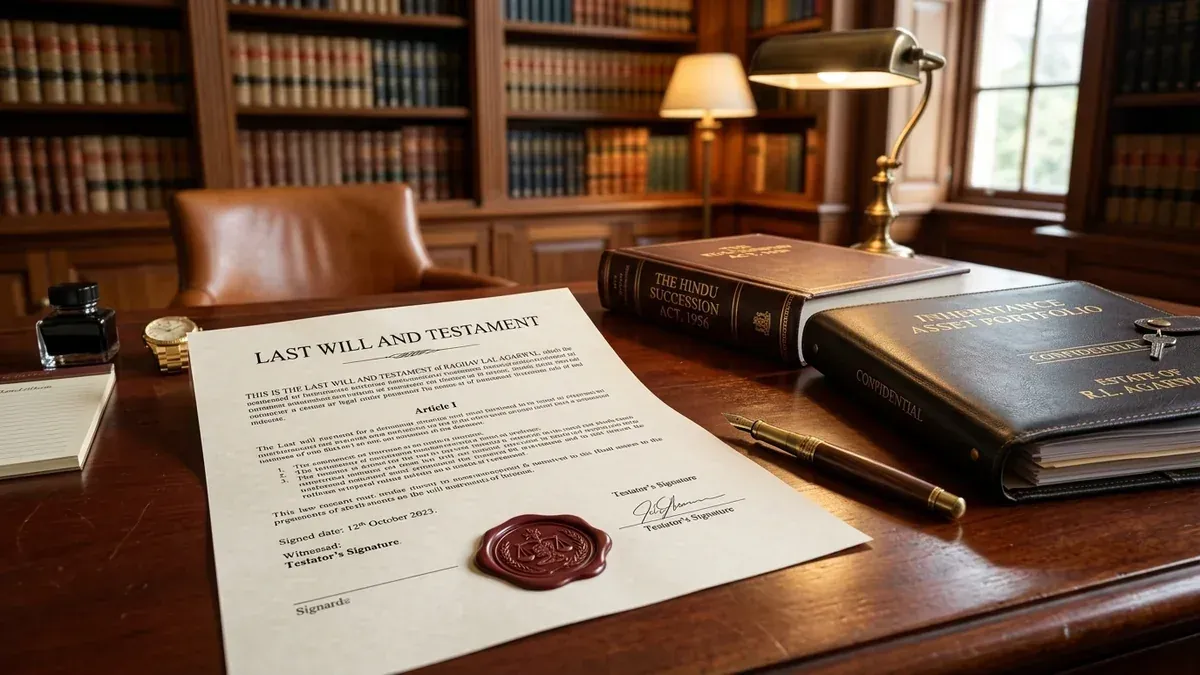
Estate planning for married couples frequently involves a delicate, twin-fold objective: ensuring that upon the death of one spouse, the surviving spouse enjoys uninterrupted ownership, dignity, and absolute financial security for the remainder of their lifetime; while simultaneously guaranteeing that upon the death of the survivor, the combined family assets devolve strictly upon their common children, rather than being diverted to a second spouse, in-laws, or outside third parties.
To achieve this reciprocal harmony, couples frequently execute Joint Wills or Mutual Wills. However, under the basic principles of the Indian Succession Act, 1925, a will is inherently ambulatory and revocable at the mere whim of the testator at any point until their last breath (Section 62 ISA). What happens when the husband passes away, the surviving wife inherits the entire family estate under their mutual understanding, and years later, influenced by an estranged child or new companion, executes a fresh will revoking the mutual arrangement?
This explosive conflict between the statutory right of revocation and equitable obligations was resolved by Indian courts through the classic doctrine of Mutual Wills and Constructive Trusts. Rooted in 18th-century English equity and authoritatively embedded into Indian jurisprudence by the Supreme Court in K.S. Palanisami v. Gopala Raja (2003), the law holds that upon the death of the first spouse, equity steps in to impose a binding constructive trust on the survivor, drastically curtailing their power to revoke or dissipate the pooled estate.
Mutual wills executed by spouses create binding reciprocal agreements governing the distribution of marital assets to agreed beneficiaries. While ordinary wills remain ambulatory and revocable during lifetime, the death of the first spouse binds the survivor in equity under a constructive trust, preventing unilateral revocation or alienation of the pooled estate.
1. Joint Wills vs. Mutual Wills: The Foundational Legal Demarcation
In testamentary drafting, advocates and spouses must distinguish between two fundamentally different concepts that are routinely confused:
| Category | Legal Definition & Structure | Revocation Rules & Enforceability |
|---|---|---|
| Joint Will | A single physical testamentary document executed by two or more testators (e.g., husband and wife) disposing of their joint or separate properties. | Operates as separate wills of each testator upon their respective deaths. In the absence of an underlying reciprocal contract, either party can revoke their part during lifetime or after the other's death. |
| Mutual Wills | Two separate wills (or one joint will) executed pursuant to an express or implied binding agreement between testators to make reciprocal bequests conferring mutual benefits. | Revocable during joint lifetimes upon mutual notice. But upon the death of the first spouse, if the survivor takes the benefit, the mutual will becomes IRREVOCABLE in equity! |
As held in Krishna Kumar Birla v. Rajendra Singh Lodha ((2008) 4 SCC 300) (the Priyamvada Birla Will controversy), the mere execution of a joint will or simultaneous wills containing identical provisions does not automatically make them "mutual wills". There must be clear, cogent evidence of an underlying contract or mutual agreement to be bound!
Under Section 67 of the Indian Succession Act, 1925, any bequest made to an attesting witness or their spouse is void. Therefore, when spouses execute a joint or mutual will, neither spouse can act as an attesting witness to the other's signature; two independent third-party witnesses must be engaged to attest both signatures.
2. The Constructive Trust Doctrine: Dufour v. Pereira & Indian Adoption
The equitable foundation of mutual wills originates from Lord Camden's historic 1769 judgment in Dufour v. Pereira ((1769) 1 Dick 419):
"The first that dies, by his death is carried into execution, so far as concerns him, the mutual agreement. The survivor, having accepted the benefit of the agreement, cannot repudiate it. Equity fastens a constructive trust upon the property in the hands of the survivor to carry out the agreement into full effect."
In the landmark ruling of K.S. Palanisami v. Gopala Raja ((2003) 1 SCC 726), the Supreme Court of India adopted and codified the modern test for mutual wills:
Core Principles Laid Down by the Supreme Court:
- A joint or mutual will is revocable at any time by either party during their joint lives, provided notice is given to the other party so that they may also alter their will.
- If one party dies without revoking the will, and the surviving testator accepts the legacy or benefit conferred upon them under the reciprocal disposition, equity will not permit the survivor to commit a breach of trust.
- The personal representative or executor of any subsequent will executed by the survivor takes the property impressed with a constructive trust in favor of the ultimate beneficiaries named in the original mutual will!
In Meenakshi Ammal v. K.V. Karuppanna Pillai ((AIR 1984 Mad 161)), the Madras High Court clarified that the survivor cannot plead Section 62 ISA (general revocability of wills) to defeat the constructive trust. While common law succession recognizes the survivor's technical legal right to execute a fresh will, courts of equity step in immediately to strip the second legatee of all beneficial ownership!
3. The Degree of Enjoyment: Life Interest vs. Absolute Estate (Dilharshankar Ruling)
A pivotal dispute in mutual wills revolves around the rights of the surviving spouse during their remaining lifetime: Can the widow sell the family bungalow to fund medical care, or is she strictly restricted to living in it as a life-estate holder?
The Supreme Court laid down the golden benchmarks for proving testamentary succession under Section 68 of the Evidence Act (Section 71 BSA). The propounder must affirmatively establish the testator's sound disposing mind, valid attestation by two witnesses, and satisfactorily dispel all suspicious circumstances surrounding the execution of the Will before judicial probate or letters of administration can issue.
In Dilharshankar C. Bhachech v. Controller of Estate Duty ((1986) 1 SCC 701), the Supreme Court conducted a masterclass in testamentary construction:
- Distinguishing Limited Life Estate from Absolute Ownership: Where the mutual will explicitly states that the survivor shall enjoy the property "with full powers of enjoyment, alienation, and sale" during their lifetime, the survivor can dispose of assets for their personal maintenance, health, and comfort. The constructive trust fastens only upon the residue remaining undisposed of at the survivor's death!
- Prohibition on Gifts & Testamentary Diversion: Even where the survivor has broad life enjoyment powers, the survivor CANNOT make gifts to outsiders, settle properties into new trusts, or execute a new will diverting the property away from the agreed family children. Such actions constitute a fraudulent breach of the constructive trust.
- Joint Tenancy vs Tenancy-in-Common: Spouses executing mutual wills regarding jointly owned real estate must clarify whether they hold as joint tenants with survivorship or as tenants-in-common with separate 50% shares. Expressly treating the pooled property as a single composite family trust fund prevents surviving spouses from claiming that the survivorship rule extinguished the mutual covenant!
4. Trial Practice: Probate Procedure when a Subsequent Conflicting Will Exists
When a surviving spouse breaches a mutual will by executing a subsequent contradictory will before death, a fascinating jurisdictional conflict arises between the Probate Court and the Civil Court:
- The Probate Court Examines Only Execution (Section 276 ISA): A probate court is a court of conscience, not a court of title or equity. Under settled law, the probate court MUST grant probate to the last executed will of the survivor, because as a matter of succession law, the last will revoked prior wills.
- The Civil Suit for Enforcement of Constructive Trust: The beneficiaries under the original mutual will must immediately institute a regular civil suit under the Specific Relief Act, 1963 for a declaration that the executor and legatees under the second will hold the property purely as constructive trustees for their benefit!
- Injunction Against Asset Dissipation: In the civil suit, the court will issue an injunction under Order 39 CPC restraining the beneficiaries of the second will from selling, mutating, or transferring the properties, and ultimately decree a conveyance of title to the mutual will beneficiaries.
- Admissibility of Parol Evidence: Under Section 92 of the Indian Evidence Act / Section 95 BSA, extrinsic oral evidence is admissible to prove the existence of an independent collateral agreement between the spouses establishing the mutual character of the instruments.
5. Strategic Drafting Checklist: Bulletproofing Mutual Wills for Couples
Estate planning attorneys drafting mutual wills for spouses must incorporate explicit structural safeguards:
Air-Tight Mutual Will Drafting Rules
- Express Recital of Mutual Agreement: Never leave the reciprocal agreement to oral inference. Explicitly state in the preamble: "This Mutual Will is executed pursuant to a binding agreement between both testators to dispose of our respective properties in the manner set forth herein, and we expressly covenant that neither of us shall revoke or alter this disposition after the demise of the first of us without the written consent of the agreed beneficiaries."
- Define the Scope of Survivor's Alienation Rights: Clearly delineate whether the surviving spouse has the power to sell immovable properties in case of medical necessity, or whether they are restricted strictly to a life estate (residence and rental income only).
- Prescribe Common Ultimate Beneficiaries: Name the specific common children, grandchildren, or charities who shall inherit the estate upon the demise of the surviving spouse, specifying their fractional shares.
- Separate Simultaneous Instruments vs Single Joint Document: While a single joint will is valid, executing two separate identical reciprocal wills referring to each other is practically advantageous for separate probate applications in District Courts.
- Joint Registration: Register both mutual wills on the exact same day before the Sub-Registrar under Section 40 of the Registration Act, ensuring the Sub-Registrar's official endorsements record the contemporaneous reciprocal execution.
- Appoint Substitute Executors and Trustees: Anticipate the contingency that both spouses may pass away in a common accident or calamity (commorientes) under Section 21 of the Hindu Succession Act, 1956, by explicitly appointing trusted alternate executors and trustees to administer the distribution to the common children without requiring separate administration petitions.
From a fiscal standpoint, assets passing to a surviving spouse and subsequently to common biological children under a mutual will do not attract inheritance tax (which remains abolished in India) or capital gains tax under Section 47(iii) of the Income Tax Act, 1961. The beneficiaries inherit the properties with a stepped-up cost basis of acquisition dating back to the original purchase by the parents, making mutual wills an extraordinarily stable, legally secure instrument for marital estate governance.