
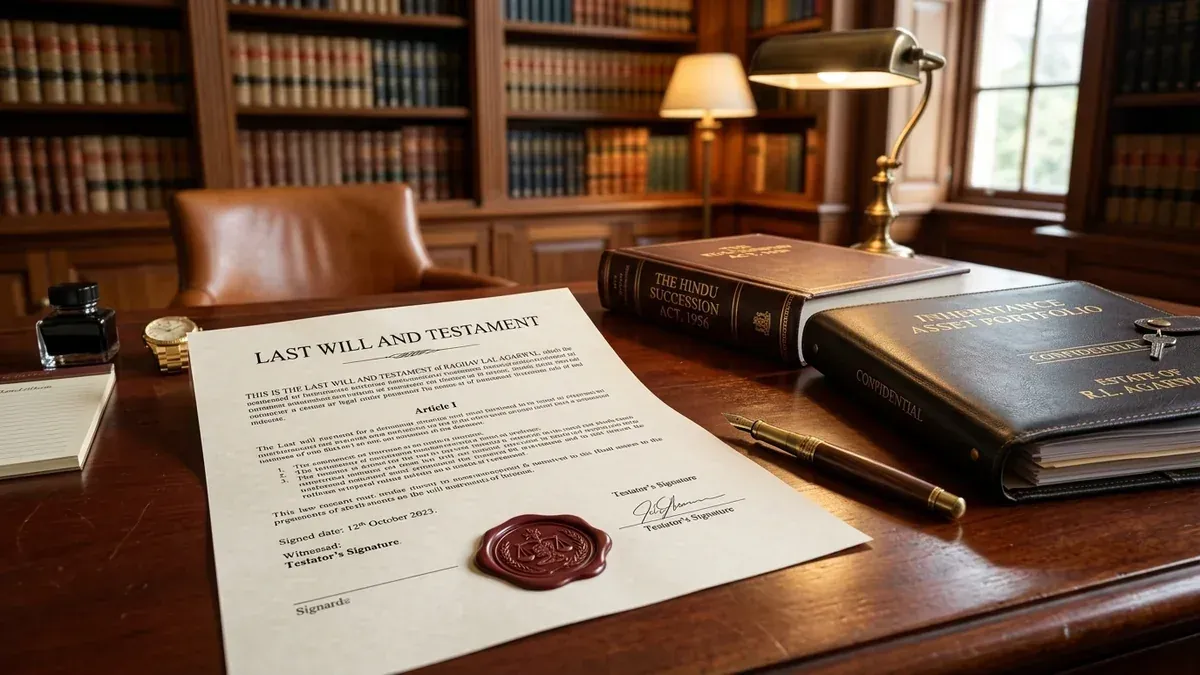
Under secular Indian succession law governed by the Indian Succession Act, 1925, an individual enjoys virtually unbridled testamentary freedom. A Hindu, Christian, Parsi, or Sikh can execute a will bequeathing 100% of their self-acquired properties to a total stranger, a charitable foundation, or one favorite child, completely cutting off surviving spouses, sons, and daughters without their consent.
In sharp and profound contrast, Islamic jurisprudence rejects the concept of unfettered testamentary discretion. Under the Shariat, the divine Quranic scheme of inheritance meticulously prescribes fixed fractional shares (Farā'id) for primary legal heirs—including surviving widows, husbands, parents, sons, and daughters. To ensure that an errant or biased patriarch cannot subvert this divine economic distribution on his deathbed, Mohammedan law imposes two strict, structural limitations upon a Wasiyat (Muslim Will): the One-Third Rule (Bequeathable Third) and the Prohibition Against Bequests to Legal Heirs without Consent.
Navigating a Muslim will in Indian civil courts requires understanding how the net estate is calculated, the sharp doctrinal divergences between the Sunni (Hanafi) and Shia schools regarding heir consent, the evidentiary standards for proving express or implied post-mortem ratification, and the catastrophic civil consequences of attempting to execute a will that violates Shariat boundaries.
Under Islamic jurisprudence and Shariat law, a Muslim cannot bequeath more than one-third of their net estate through a Wasiyat (will). Furthermore, bequests in favor of legal heirs are invalid under Sunni Hanafi law unless consented to by all other legal heirs following the testator's death, safeguarding statutory inheritance rights.
1. Theological & Statutory Architecture: Section 58 ISA & The Bequeathable Third
The secular statutory recognition of Islamic testamentary law is rooted in Section 58 of the Indian Succession Act, 1925, which expressly excludes Muslims from the testamentary rules contained in Part VI of the Act (except where a Muslim marries under the Special Marriage Act, 1954):
"Section 58(2): The provisions of this Part shall not apply to testamentary succession to the property of any Muhammadan, nor shall they apply to any will made by a Hindu, Buddhist, Sikh or Jaina, except as provided by section 57."
Instead, testamentary succession for Indian Muslims is governed by Muslim Personal Law as enforced through Section 2 of the Muslim Personal Law (Shariat) Application Act, 1937. The foundational limitation restricting bequests to one-third of the estate originates from the celebrated Hadith of Sa'd ibn Abi Waqqas:
"The Prophet (Peace Be Upon Him) visited Sa'd during his illness. Sa'd said: 'O Messenger of Allah, I have much wealth and only one daughter to inherit. Shall I bequeath two-thirds of my property in charity?' The Prophet said: 'No.' Sa'd asked: 'Half?' The Prophet replied: 'No, one-third, and one-third is much. It is better to leave your heirs rich than to leave them destitute, begging from people.'"
From this sacred foundation, Islamic law crystallized the doctrine: a Muslim can dispose of a maximum of one-third (1/3) of their net estate by will. Any bequest exceeding this fraction is invalid (ultra vires) unless voluntarily ratified and consented to by the legal heirs after the testator's death.
The policy underlying this doctrine is economic equity: testamentary bequests are designed to allow a testator to make modest charitable endowments (waqf) or provide for deserving non-heir relatives (such as orphaned grandchildren, foster children, or faithful friends), without disinheriting or impoverishing the immediate family members whose maintenance is ordained by religious law.
2. Calculating the "Net Estate": Statutory Order of Priority and Deductions
A common legal error committed in succession litigation is calculating the one-third limit against the gross market value of the testator's properties at the time of executing the will. Under Section 118 of Mulla's Principles of Mahomedan Law, the bequeathable third is calculated strictly at the time of death against the net residue after satisfying prior statutory charges:
- First Charge: Funeral & Death-Bed Expenses: Reasonable costs incurred for the burial, shroud (kafan), and funeral ceremonies of the deceased.
- Second Charge: Probate / Administration Expenses: Legitimate court fees or expenses incurred in obtaining Letters of Administration.
- Third Charge: Lawful Debts & Unpaid Mahr (Dower): All personal and commercial debts incurred by the deceased must be paid in full. Crucially, an unpaid prompt or deferred Mahr (dower) owed to the surviving widow ranks as an unsecured debt of the first magnitude and must be satisfied before calculating the net estate!
- Fourth Charge: The Bequeathable Third: The net residue remaining after deducting funeral charges, administration costs, and debts constitutes the "Net Estate." The testator's bequests (Wasiyat) can only operate upon one-third of this net residue.
- Fifth Charge: Quranic Legal Heirs (Farā'id): The remaining two-thirds (2/3) must mandatorily pass to the legal heirs according to their immutable Shariat shares.
The Marz-ul-Maut Doctrine (Gifts Made in Death-Illness)
To prevent testators from bypassing the one-third testamentary ceiling through simulated deathbed lifetime gifts, Islamic law applies the strict doctrine of Marz-ul-Maut (Death-Illness). Under Section 135 of Mulla's Mahomedan Law and the landmark Supreme Court ruling in Abdul Hafiz Beg v. Sahebbi ((1975) 1 SCC 553), if a gift is made by a donor suffering from a fatal, mortal disease accompanied by an apprehension of imminent death, that lifetime gift is legally treated as a Wasiyat! Consequently, it cannot take effect on more than one-third of the estate, and if made in favor of a legal heir under Sunni law, it is void without the consent of all other legal heirs.
3. Bequest to a Legal Heir: The Critical Sunni (Hanafi) vs. Shia Doctrinal Split
The second fundamental limitation governing Wasiyat concerns who can be a legatee. Can a father bequeath property to one specific son or daughter within the one-third limit? Here, Indian jurisprudence navigates a profound divergence between Islamic schools:
| Parameter | Sunni (Hanafi) Law | Shia (Ithna Ashari) Law |
|---|---|---|
| Bequest to a Stranger (Non-Heir) | Valid up to 1/3 without any consent. Exceeding 1/3 requires heir consent. | Valid up to 1/3 without any consent. Exceeding 1/3 requires heir consent. |
| Bequest to a Legal Heir (Son, Widow, etc.) | VOID AB INITIO even if within 1/3, UNLESS all other legal heirs consent after death! | COMPLETELY VALID up to 1/3 without requiring any consent from other heirs! |
| Timing of Heir Consent | Consent must be given AFTER the testator's death. Consent given during lifetime is legally void. | Consent can be given either during the testator's lifetime OR after death. |
In the historic Privy Council ruling in Ghulam Mohammad v. Ghulam Husain ((AIR 1932 PC 81)), the Law Lords established the authoritative principle under Hanafi law:
"Under the Muhammadan law applicable to the Hanafi sect, a bequest to an heir is not valid unless the other heirs consent to the bequest after the death of the testator. Any consent given by an expectant heir during the lifetime of the testator is a mere nullity, because no heir possesses any vested right in the estate prior to death."
This was powerfully reaffirmed by the Karnataka High Court in Narunnisa v. Shek Abdul Hamid ((AIR 1987 Kar 222)) and Patna High Court in Abdul Manan Khan v. Mirtaza Khan ((AIR 1991 Pat 154)): a will executed by a Sunni Muslim purporting to give an entire house to one son or daughter to the exclusion of other siblings is completely void in law unless the excluded siblings explicitly ratify it post-mortem.
Conversely, in Shia law (governing Ithna Ashari and Ismaili communities), the rule is far more flexible. As held in Husaini Begam v. Muhammad Mehdi ((ILR 49 All 547)), a Shia testator can bequeath property to one heir up to the one-third limit without asking for anyone's permission. Only bequests that exceed one-third require heir consent.
4. Trial Practice: Proving Express vs. Implied Consent of Legal Heirs
When a contested probate or partition suit involves a Sunni Wasiyat, the central evidentiary battleground is whether the legal heirs consented to the bequest:
- Consent Need Not Be in Writing: Indian courts have held that consent of legal heirs under Mohammedan law can be either express (formal registered affidavit, written endorsement) or implied from conduct.
- Implied Consent through Passive Acquiescence: If the excluded legal heirs were fully aware of the will and permitted the legatee to take exclusive physical possession of the bequeathed house, pay municipal property taxes, construct alterations, or collect rents for a long duration (e.g., 5–10 years) without raising any objection, the court will infer implied consent by conduct (estoppel).
- Partial Consent by Specific Heirs: Consent is individual. If a Sunni Muslim leaves three sons, and bequeaths property to one son, and only Son B consents while Son C objects, the bequest is valid only to the extent of Son B's share in the property! Son C is entitled to recover his full statutory fractional inheritance as an intestate heir.
- Bequest to an Unborn Person: Under Sunni law, a bequest to a person not in existence at the time of the testator's death is void. A bequest to a child in the womb is valid only if born within six months of the will's execution. In Shia law, a child born within ten months is entitled to inherit.
5. Strategic Drafting & Estate Planning Checklist for Muslim Testators
Estate planners advising Muslim clients must avoid applying Hindu or Western testamentary models to avoid catastrophic probate dismissals:
Air-Tight Islamic Estate Planning Guidelines
- Distinguish Between Hiba and Wasiyat: If a client wishes to give 100% of their property to a daughter or favorite child, advise them to execute a Hiba (Gift) during their lifetime with complete delivery of possession. An attempt to achieve this through a Wasiyat post-mortem is legally doomed under Sunni law.
- Incorporate Prior Debt Deductions: Explicitly articulate the discharge of funeral costs, debts, and outstanding Mahr in the preamble of the Wasiyat to clarify the calculation of the bequeathable third.
- Secure Post-Mortem Ratification Deeds: If bequeathing property to an heir under Sunni law, prepare draft Ratification & Consent Affidavits to be executed by all surviving heirs immediately upon the testator's demise before applying for property mutation.
- Execution under Special Marriage Act, 1954: If a Muslim individual marries or registers their marriage under the Special Marriage Act, 1954, Section 21 of that statute completely supplants Islamic personal law; the individual is governed exclusively by the Indian Succession Act, 1925 and acquires 100% testamentary freedom, totally liberating them from the one-third limitation!
- Oral Wasiyat Caveats: While an oral Wasiyat is valid under Islamic law, proving it before Indian civil judges requires testimony of two credible witnesses who were present together and heard the exact Arabic or vernacular words of bequest. Drafting a registered written Wasiyat eliminates devastating evidentiary disputes.
Landmark Judicial Precedents & Statutory Authorities
Courts and appellate tribunals across Delhi NCR (Faridabad, Saket, Tis Hazari, Gurugram, High Courts) strictly apply these authoritative Supreme Court benchmarks:
The Supreme Court laid down the golden benchmarks for proving testamentary succession under Section 68 of the Evidence Act (Section 71 BSA). The propounder must affirmatively establish the testator's sound disposing mind, valid attestation by two witnesses, and satisfactorily dispel all suspicious circumstances surrounding the execution of the Will before judicial probate or letters of administration can issue.