
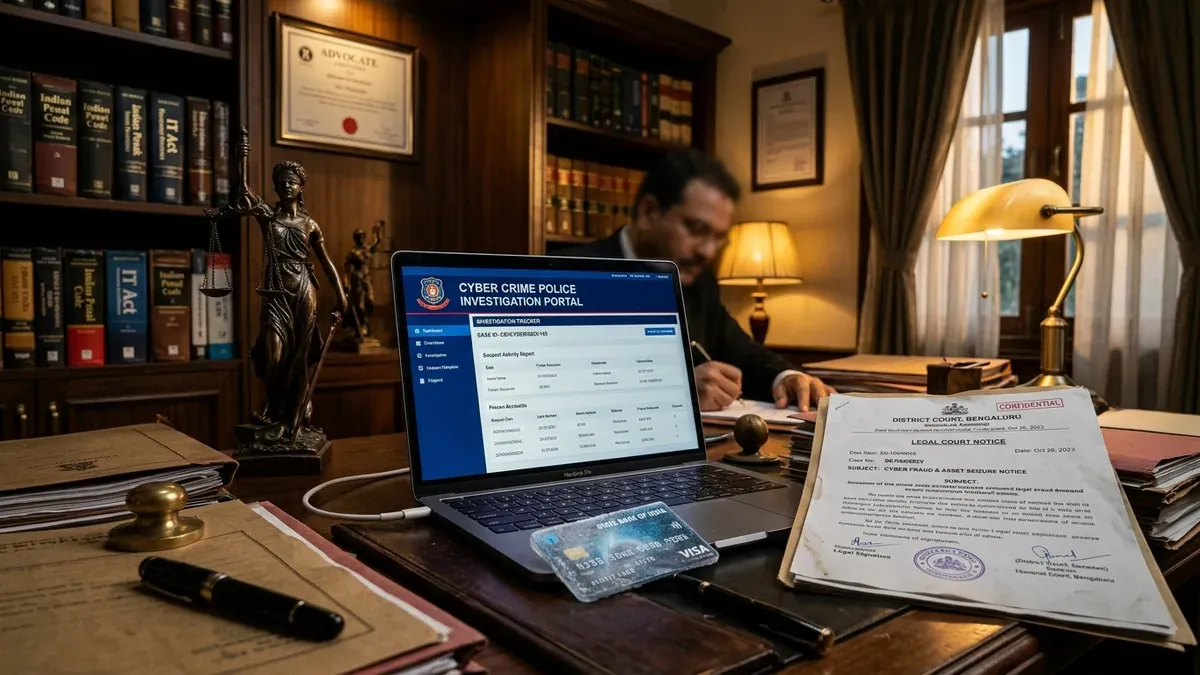
The exponential proliferation of digital net banking, Unified Payments Interface (UPI) systems, mobile banking applications, and credit card gateways in India has triggered a catastrophic surge in sophisticated cyber financial crimes. Innocent bank customers—ranging from tech-savvy corporate executives to vulnerable senior citizens—find their lifetime savings wiped out within minutes through sophisticated SIM-swap frauds, malware injection, voice phishing (vishing), spoofed banking portals, remote device access scams (AnyDesk, TeamViewer), and unauthorized international payment gateway bypasses that siphon money without generating domestic One-Time Passwords (OTPs).
When devastated victims report these unauthorized electronic debits to their commercial banks, bank managers almost universally disclaim institutional liability. Banks issue boilerplate rejection letters asserting that the transactions were authenticated through valid credentials or two-factor authentication (2FA), shifting the entire financial loss onto the customer by alleging negligence. This institutional evasion runs directly contrary to the binding Reserve Bank of India (RBI) Master Circular on Customer Protection – Limiting Liability of Customers in Unauthorised Electronic Banking Transactions (2017) and a formidable line of Supreme Court and NCDRC precedents. Under Indian consumer protection law, banks operate as fiduciaries of deposited wealth, and the legal burden of proving customer negligence rests squarely upon the financial institution.
Under Reserve Bank of India (RBI) customer protection directives, bank account holders enjoy zero liability for unauthorized electronic transactions caused by bank deficiency or third-party phishing breaches reported within three working days. Furthermore, the legal burden of proving customer negligence rests entirely upon the bank under established consumer court deficiency jurisprudence.
1. The RBI Master Circular Architecture: Zero Liability vs. Limited Liability Slabs
The definitive regulatory bedrock governing unauthorized electronic banking transactions in India is the Reserve Bank of India's binding directive: RBI Circular DBR.No.Leg.BC.78/09.07.005/2017-18 dated July 6, 2017. Issued under Section 35A of the Banking Regulation Act, 1949, this circular is statutory law binding on all scheduled commercial banks, regional rural banks, and payment banks.
The circular categorizes customer liability into three unambiguous statutory tiers:
- Zero Liability (Section 6 of RBI Circular): A customer incurs ZERO liability in two critical scenarios:
- Contributory Fraud/Deficiency by the Bank: Fraud, negligence, or deficiency on the part of the bank (irrespective of whether or not the transaction is reported by the customer).
- Third-Party Breach with Prompt Notification: A third-party breach where the deficiency lies neither with the bank nor with the customer, but elsewhere in the digital ecosystem (e.g., merchant server hacking, telecom SIM-swap, sophisticated malware), and the customer notifies the bank within three (3) working days of receiving the transaction alert.
- Limited Liability (Section 7 of RBI Circular): Where the deficiency lies elsewhere in the system and the customer reports the unauthorized transaction between four (4) to seven (7) working days, the customer's maximum liability is strictly capped:
- Basic Savings Bank Deposit (BSBD) Accounts: Maximum liability ₹5,000.
- Savings Bank Accounts, Current Accounts, and Credit Cards with limit up to ₹5 Lakhs: Maximum liability ₹10,000.
- Current / Overdraft Accounts of MSMEs and Credit Cards with limit above ₹5 Lakhs: Maximum liability ₹25,000.
- Beyond 7 Working Days: If reported beyond seven working days, liability is determined per the bank's Board-approved policy, subject to scrutiny by Consumer Commissions.
"Under Section 9 of the RBI Circular, once a customer reports an unauthorized electronic transaction, the bank is legally obligated to credit the shadow reversal (re-credit the disputed amount) into the customer's account within ten (10) working days, even before the cyber investigation concludes."
This framework was further tightened by the RBI Master Direction on Digital Payment Security Controls (2021/2024 Updates). Under Section 14 to 18 of these Directions, banks are mandated to implement multi-factor authentication (MFA) that incorporates device binding, behavioral biometric anomaly detection, and automated IP geolocation tracking. If a net banking login originates from a foreign IP address or unrecognized device while the customer's registered SIM is actively connected to a domestic telecom tower in Delhi or Mumbai, the bank's automated security protocols must immediately block the transaction. The failure to deploy automated transaction declines in anomalous circumstances constitutes direct, actionable institutional deficiency.
2. The Statutory Reversal of Burden of Proof & Evidentiary Status of OTPs
In standard civil litigation, the burden of proving an assertion rests upon the party who affirms it. In cyber financial crimes, banks attempted to exploit this rule by demanding that the defrauded customer prove who hacked their account, how their OTP was intercepted, and prove that they never shared credentials.
The RBI decisively dismantled this unfair burden under Section 12 of the Master Circular:
"Section 12. Burden of Proof: The burden of proving customer liability in case of unauthorized electronic banking transactions shall lie on the bank."
In landmark consumer rulings including State Bank of India v. P.V. George (NCDRC) and HDFC Bank Ltd. v. Jesna Jose (2021) CPJ 152 (NC), the National Commission established that a bank cannot satisfy this burden merely by producing internal IT logs showing that an SMS OTP was generated. The bank must lead conclusive forensic evidence proving that:
- The customer deliberately and knowingly communicated the OTP or passwords to the fraudster.
- The bank's internal fraud monitoring systems (FMS) were fully operational, and there was no system compromise, man-in-the-middle attack, or security breach in the bank's digital server architecture.
- If the bank fails to produce affirmative evidence of customer complicity or gross negligence, the presumption of deficiency in service under Section 2(11) CPA 2019 operates conclusively against the bank.
Furthermore, under Section 43A of the Information Technology Act, 2000 and the SPDI (Reasonable Security Practices and Procedures and Sensitive Personal Data or Information) Rules, 2011, banking institutions are statutory data fiduciaries. When a bank fails to maintain end-to-end encryption or allows unauthorized API integrations that expose customer account balances and phone numbers to malicious scrapers, the bank is strictly liable for corporate compensation under both IT Act Adjudicating Officers and Consumer Commissions.
In Punjab National Bank v. Leader Valves Ltd. (2020), the NCDRC held that an automated SMS dispatch notification does NOT constitute conclusive legal proof that the SMS reached the customer's mobile device or that the customer authorized the debit. Where telecom network outages or clone attacks intercept messages, the risk of transmission failure remains with the electronic banking system operated by the bank.
3. Anatomy of Digital Frauds: SIM Swap, Vishing & Fraud Monitoring System Lapses
Modern cyber financial fraud rarely involves simple customer carelessness; it involves sophisticated multi-layered cyber syndicates exploiting structural vulnerabilities in the digital banking ecosystem:
- SIM Swap Frauds: Cyber criminals procure duplicate 4G/5G SIM cards using forged identity documents. When the genuine customer's network goes dead, the fraudsters trigger net banking password resets and intercept OTPs. In Punjab National Bank v. Leader Valves Ltd. (NCDRC), the Commission held that banks are legally bound to implement telecom API checks that detect recent SIM swaps within 48 hours and automatically freeze high-value transactions.
- Bypassing Velocity and Pattern Checks: Commercial banks maintain mandatory Fraud Monitoring Systems (FMS) designed to detect abnormal velocity. If a savings account that historically conducted transactions of ₹2,000 suddenly conducts twenty successive transactions of ₹50,000 to newly added international beneficiaries at 2:00 AM, the bank's automated algorithms are under a statutory fiduciary duty to flag and freeze the account. Failure of the FMS constitutes gross deficiency in banking service.
- International Card Not Present (CNP) Transactions: International e-commerce portals (such as Uber USA or foreign merchants) do not require two-factor SMS OTP authentication. Where credit or debit cards are debited abroad without domestic 2FA, the bank cannot claim the customer authorized the payment.
4. Actionable Deficiency under CPA 2019: Failure to Block Accounts Post-Intimation
Under Section 2(11) of the Consumer Protection Act, 2019, "deficiency" means any fault, imperfection, shortcoming or inadequacy in the quality, nature and manner of performance which is required to be maintained by or under any law or under a contract.
In cyber banking litigation, the most blatant deficiency occurs when a customer immediately contacts the bank's 24x7 emergency helpline (or visits a branch) to report an unauthorized debit, but the bank:
- Fails to freeze the net banking portal or hotlist debit/credit cards immediately, allowing successive transactions to occur hours later.
- Fails to communicate with the beneficiary bank or payment aggregator to freeze the stolen funds in the destination account before withdrawal at an ATM.
- Refuses to register a formal fraud incident docket number or delays issuing written acknowledgments.
In Standard Chartered Bank v. Dr. Vinod Kumar Bhalla (NCDRC), the Commission held that where a bank delayed hotlisting a credit card by four hours after receiving an emergency phone call from the customer, the bank was solely liable to absorb the entire loss resulting from subsequent fraudulent charges, along with exemplary compensation for mental agony.
Furthermore, under Section 18 of the Payment and Settlement Systems Act, 2007 (PSSA), payment aggregators and prepaid payment instrument (PPI) issuers (such as Razorpay, Paytm Payments Bank, PayU, and PhonePe) are regulated financial entities. Where stolen bank funds are routed through digital payment gateways into bogus merchant accounts created without proper video-KYC or commercial verification, the payment aggregator is jointly and severally liable with the bank for failing to freeze the payout escrow upon receipt of police or consumer fraud alerts.
5. Practical Victim Checklist: Step-by-Step Recovery of Stolen Bank Funds
Victims of cyber phishing, net banking fraud, or unauthorized UPI debits must execute this rapid-response legal checklist within the critical 72-hour golden window:
- Report to National Cyber Crime Portal Immediately (Within 2 Hours): Dial the national cyber crime helpline 1930 or register an online complaint at cybercrime.gov.in. The 1930 system triggers an automated 'Citizen Financial Cyber Fraud Reporting and Management System' (CFCFRMS) alert, directing recipient banks to freeze the stolen money in beneficiary accounts before cash withdrawal.
- Issue Written Intimation to Bank within 3 Working Days: Send an immediate registered email to your bank's branch manager, nodal officer, and cyber fraud desk. Explicitly state: "This is formal intimation of unauthorized transactions under Section 6 of the RBI Master Circular 2017. I claim complete ZERO LIABILITY as I am reporting within 3 working days."
- Demand Mandatory Shadow Reversal within 10 Days: In your written demand, quote Section 9 of the RBI Circular demanding that the bank credit the shadow reversal of the stolen principal within ten working days pending internal investigation.
- Escalate to RBI Banking Ombudsman: If the bank rejects your claim or fails to reverse the debit within 30 days, file an online complaint before the RBI Integrated Ombudsman Scheme (cms.rbi.org.in). The Ombudsman is empowered to award compensation up to ₹20 Lakhs for financial loss and ₹1 Lakh for mental harassment.
- Institute Consumer Complaint under Section 35 CPA 2019: If the Ombudsman or bank fails to grant complete restitution, file a consumer complaint before the District Commission. Pray for 100% refund of stolen funds, 12% commercial interest from the date of debit, and exemplary damages for financial trauma and banking deficiency.
Landmark Judicial Precedents & Statutory Authorities
Courts and appellate tribunals across Delhi NCR (Faridabad, Saket, Tis Hazari, Gurugram, High Courts) strictly apply these authoritative Supreme Court benchmarks:
The Supreme Court established that statutory authorities and commercial real estate developers fall strictly within the jurisdiction of Consumer Protection Forums for deficiency of service. In Experion Developers, the Court ruled that one-sided builder-buyer agreements containing punitive forfeiture clauses constitute unfair trade practices, entitling homebuyers to full refund with commercial interest upon unreasonable possession delays.