
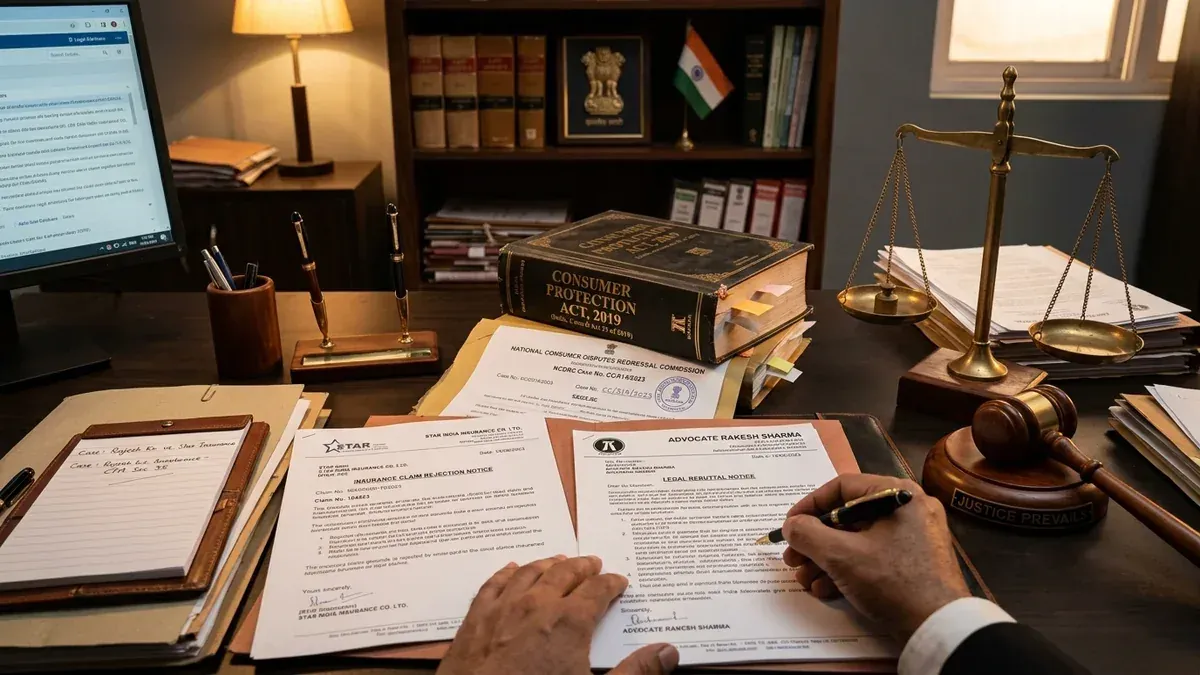
The Consumer Protection Act, 2019 was conceived by Parliament as an expeditious, summary dispute resolution mechanism designed to deliver affordable and rapid justice to aggrieved consumers without the crippling procedural delays characteristic of traditional civil suits. However, this statutory benefit is counterbalanced by a strict, jurisdictional temporal threshold embodied in Section 69 of the Consumer Protection Act, 2019 (which replaced Section 24A of the repealed 1986 Act). Section 69 enacts a rigid two-year period of limitation, mandating that neither the District Commission, the State Commission (SCDRC), nor the National Commission (NCDRC) shall admit any consumer complaint unless it is instituted within two years from the exact date on which the cause of action arose.
For consumer litigants, identifying the precise date of "cause of action" is frequently complex. In commercial scenarios involving delayed real estate handovers, protracted insurance claim negotiations, defective automobiles undergoing recurrent workshop repairs, or lingering banking disputes, opposite parties routinely raise preliminary objections asserting that the consumer's claim is dead on arrival due to the two-year statutory bar. To prevent corporate adversaries from weaponizing this limitation clause, Indian consumer jurisprudence has evolved the vital equitable doctrines of "Continuous Cause of Action" and "Recurring Breach of Contract," supported by the statutory condonation mechanism under Section 69(2).
Section 69 of the Consumer Protection Act 2019 bars complaints filed beyond two years from the cause of action. However, where a builder fails to deliver possession or an insurer delays formal repudiation, a continuous cause of action arises, extending the limitation period until the breach or final refusal crystallizes.
1. Statutory Mandate of Section 69 CPA 2019 & Jurisdictional Bar
Section 69 of the Consumer Protection Act, 2019 establishes an express statutory bar against entertaining stale or belated claims. The provision reads:
"Section 69. Limitation period.— (1) The District Commission, the State Commission or the National Commission shall not admit a complaint unless it is filed within two years from the date on which the cause of action has arisen.
(2) Notwithstanding anything contained in sub-section (1), a complaint may be entertained after the period specified in sub-section (1), if the complainant satisfies the District Commission, the State Commission or the National Commission, as the case may be, that he had sufficient cause for not filing the complaint within such period: Provided that no such complaint shall be entertained unless the National Commission, the State Commission or the District Commission, as the case may be, records its reasons for condoning such delay."
In the seminal ruling of State Bank of India v. B.S. Agriculture Industries (2009) 5 SCC 121, the Supreme Court of India analyzed the legislative architecture of this limitation bar. The Court held that the provision is peremptory, mandatory, and jurisdictional in nature. A Consumer Forum has no legal authority to admit a complaint filed after the expiry of two years unless the complainant files a formal application explaining the delay and the Commission records its reasons in writing condoning the delay under sub-section (2).
Justice R.M. Lodha observed that the phrase "shall not admit a complaint" casts an affirmative duty upon the Consumer Commission to examine the limitation question at the threshold, even if the opposite party has failed to raise limitation as a preliminary defense in their written version. If a complaint is admitted on merits without an application for condonation of delay and without recorded reasons, the resulting decree is jurisdictional error and liable to be quashed in revision.
2. The Doctrine of Continuous Cause of Action: Builder Delays & Unperformed Promises
While the two-year statutory clock is inflexible once the cause of action crystallizes, the critical legal determination centers on when the cause of action actually arose. In continuing contractual obligations, the law recognizes the doctrine of a "continuing wrong" or "continuous cause of action" under Section 22 of the Limitation Act, 1963.
This doctrine has found its most expansive application in real estate disputes. Defaulting real estate developers frequently argue that if the Flat Buyer Agreement stipulated possession within 36 months (e.g., by December 2020), the limitation period expired two years later in December 2022, thereby barring complaints filed in 2024 or 2025. The Supreme Court decisively repudiated this deceptive defense in Lata Construction v. Rameshchandra Ramniklal Shah (2000) 1 SCC 586 and reaffirmed it in Meerut Development Authority v. Mukesh Kumar Gupta (2012) SCC OnLine SC 1128.
- Continuing Breach of Delivery: The failure to deliver physical possession of an apartment or execute a registered conveyance deed is a continuing wrong. So long as the builder retains the consumer's hard-earned purchase money without offering lawful possession supported by a valid Occupancy Certificate (OC), the breach continues on a day-to-day basis.
- No Limitation Bar for Refund/Possession: The National Commission in Navin Sharma v. Unitech Reliable Projects Pvt. Ltd. (2016) held that home-buyers possess a continuous cause of action to seek either delayed possession or a complete refund with interest, and the two-year limitation period under Section 69 cannot be computed from the original contractual delivery date.
- Rejection of False Promises: Where the builder issues periodic updates, construction delay updates, or assurance letters promising revised handover dates, each revised promise constitutes a fresh acknowledgment of liability under Section 18 of the Limitation Act, renewing the temporal clock.
3. Insurance Repudiations: Crystallization of Cause of Action upon Formal Rejection
In insurance disputes—whether involving health mediclaim, commercial fire policies, marine transit losses, or motor accidents—insurance companies frequently engage in prolonged claim assessments spanning months or years. Insurers frequently issue repeated requests for supplementary documents, surveyor queries, and investigator clarifications. When the claim is finally repudiated, insurers brazenly argue that limitation must be computed from the original date of loss (e.g., the date of the factory fire or the date of hospitalization), rendering the consumer court complaint time-barred.
The Supreme Court of India dismantled this predatory tactic in National Insurance Co. Ltd. v. Hindustan Safety Glass Works Ltd. (2017) 5 SCC 776. The Court ruled that where an insured lodges a timely claim and the insurer engages in protracted correspondence, appoints multiple surveyors, or fails to take a definitive decision, the cause of action does not arise on the date of the physical peril. Instead, the cause of action crystallizes on the date when the insurance company formally conveys its final decision of repudiation:
"An insurer cannot keep a claim pending for years under the guise of surveyor investigations and then take refuge behind the statute of limitations. The cause of action means every fact which it would be necessary for the plaintiff to prove to support his right to a judgment. Until the claim is formally repudiated, the insured has no reason to approach the consumer forum. The limitation of two years commences from the date of the letter of repudiation, not from the date of the underlying accident or peril."
However, consumer advocates must recognize a critical legal caveat: mere repeated unilateral representations or reminders sent by the consumer do not extend the limitation period if the insurer has already issued an unambiguous, unconditional letter of repudiation. As held in Kandimalla Raghavaiah & Co. v. National Insurance Co. (2009) 7 SCC 768, once a claim has been unequivocally rejected, subsequent mercy appeals or review petitions addressed to the insurance ombudsman or grievance officers will not stop the Section 69 clock unless the insurer officially re-opens the claim file for active reconsideration.
4. Drafting Section 69(2) Condonation Applications & Section 14 Exclusions
When a consumer complaint is instituted beyond the strict two-year window from the initial crystallization of the dispute, the complaint is legally defective unless accompanied by an explicit, standalone Application for Condonation of Delay under Section 69(2) of CPA 2019, supported by a verifying affidavit.
The test of "sufficient cause" under Section 69(2) is analogous to Section 5 of the Limitation Act, 1963, but must be construed with due regard to the consumer welfare objectives of the statute. In Collector, Land Acquisition, Anantnag v. Mst. Katiji (1987) 2 SCC 107 and Esha Bhattacharjee v. Managing Committee of Raghunathpur Nafar Academy (2013) 12 SCC 649, the Supreme Court synthesized the governing principles for condoning delay:
- Substantial Justice over Technical Forfeiture: When substantial justice and technical considerations are pitted against each other, the cause of substantial justice deserves to be preferred, for the other side cannot have a vested right in injustice done because of a non-deliberate delay.
- Day-to-Day Explanation: The applicant is not required to explain every single day's delay with pedantic mathematical perfection; rather, the explanation must demonstrate bona fide conduct, lack of gross negligence, and absence of deliberate indolence.
- Recognized Grounds of Sufficient Cause: Legitimate grounds routinely accepted by Consumer Commissions include prolonged medical incapacitation, serious family bereavement, delayed receipt of certified institutional records, bona fide pursuit of administrative remedies before an Ombudsman or regulatory body, and active fraudulent concealment of facts by the opposite party.
Equally vital is the application of the equitable principles embodied in Section 14 of the Limitation Act, 1963. In the landmark authority of Laxmi Engineering Works v. P.S.G. Industrial Institute (1995) 3 SCC 583, the Supreme Court held that where a consumer has been diligently prosecuting a bona fide legal proceeding before an inappropriate civil court, high court writ jurisdiction, or specialized regulatory forum (such as RERA, the Banking Ombudsman, or Insurance Ombudsman) with due diligence, the entire duration spent prosecuting that earlier proceeding shall be excluded when calculating the two-year limitation period under the Consumer Protection Act. If a civil court returns a plaint under Order VII Rule 10 CPC for presentation before the Consumer Commission, the complainant is entitled to the complete benefit of Section 14 exclusions upon establishing absence of mala fides.
The Commission must record specific reasons for condoning delay in its order sheet. An order condoning delay without assigning reasons is legally vulnerable and frequently set aside in revision petitions before the State Commission or NCDRC.
5. Practical Trial Checklist: Overcoming Limitation Objections
To effectively inoculate consumer complaints against dismissal on the grounds of limitation under Section 69 CPA 2019, litigators must execute this systematic procedural checklist:
- Map the Timeline of Actionable Events: Prepare a chronological index dividing events into: (a) Date of initial contract/booking, (b) Contractual date of performance, (c) Dates of ongoing correspondence, partial deliveries, or repair attempts, (d) Date of unequivocal denial/repudiation, and (e) Date of filing.
- Plead Continuous Cause of Action Expressly in Paragraph 1: In the preliminary paragraphs of the complaint, specifically plead that the dispute involves a continuing wrong or recurring breach under Section 22 of the Limitation Act, citing Lata Construction or Hindustan Safety Glass Works.
- File an Ex Abundanti Cautela Condonation Application: Even if you firmly believe the cause of action is continuous, always file an application for condonation of delay under Section 69(2) ex abundanti cautela (out of abundant caution). This prevents the Commission from summarily rejecting the complaint at the admission stage.
- Attach Corroborative Documentary Evidence to the Affidavit: If the delay was caused by medical treatment, attach hospital admission summaries and discharge certificates. If caused by lockdown or administrative delay, attach official gazette notifications or tracking slips.
- Oppose Preliminary Dismissals without Merits Hearing: Insist that where limitation is a mixed question of fact and law (such as determining whether repairs constituted acknowledgment of defect), the issue must be decided along with the final adjudication of the complaint rather than at the ex-parte admission stage.
Landmark Judicial Precedents & Statutory Authorities
Courts and appellate tribunals across Delhi NCR (Faridabad, Saket, Tis Hazari, Gurugram, High Courts) strictly apply these authoritative Supreme Court benchmarks:
The Supreme Court established that statutory authorities and commercial real estate developers fall strictly within the jurisdiction of Consumer Protection Forums for deficiency of service. In Experion Developers, the Court ruled that one-sided builder-buyer agreements containing punitive forfeiture clauses constitute unfair trade practices, entitling homebuyers to full refund with commercial interest upon unreasonable possession delays.