
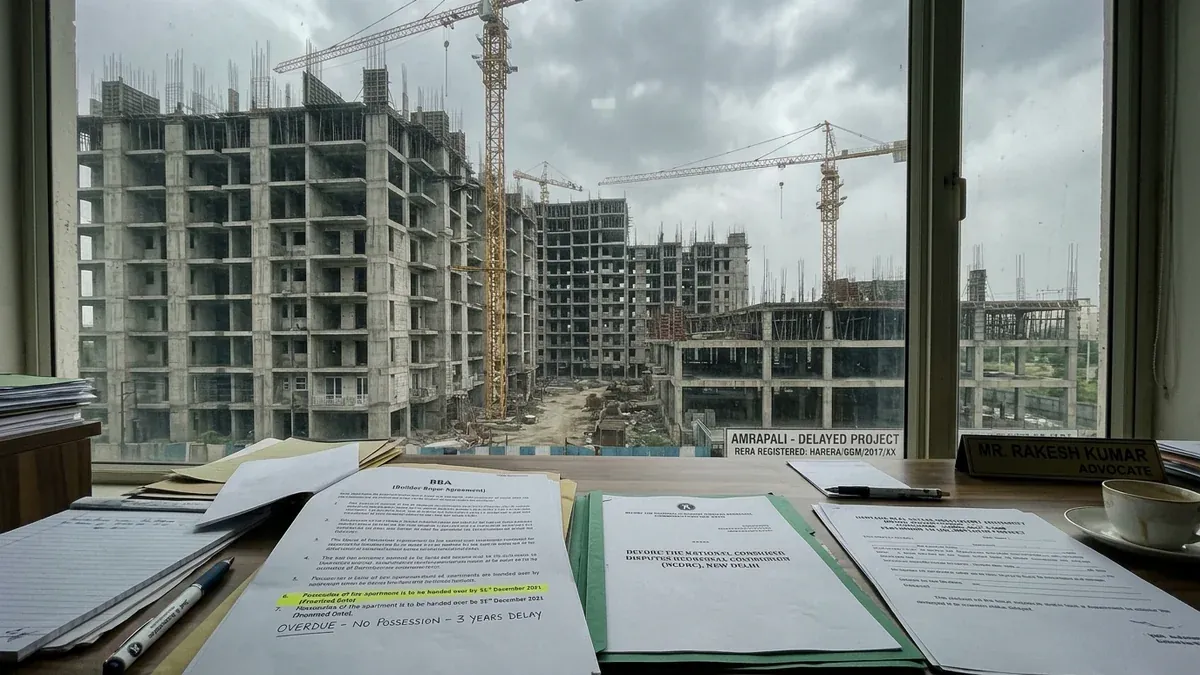
For over a decade, real estate litigation in India has represented the single largest category of high-stakes disputes before Consumer Disputes Redressal Commissions. Aggrieved homebuyers who invested life savings in residential housing projects across NCR (Gurgaon, Noida, Greater Noida), Mumbai MMR, Bangalore, Pune, and Kolkata found their flat deliveries stalled for four, seven, or even ten years past the promised contractual possession dates. When homebuyers approach Consumer Commissions seeking physical delivery, compensation for delay, or a complete refund of their deposited money with commercial interest, the preliminary procedural battleground invariably centers on Pecuniary Jurisdiction.
The Consumer Protection Act, 2019 introduced a seismic revolution in the computation of pecuniary thresholds. Under the repealed 1986 Act, pecuniary jurisdiction was calculated based on the total value of goods/services plus the compensation claimed, enabling buyers to artificially inflate claims to leapfrog directly into the National Commission (NCDRC). Under CPA 2019, as amended by the landmark Pecuniary Jurisdiction Notification of December 30, 2021, jurisdiction is computed strictly on the basis of "the value of the goods or services paid as consideration." Navigating these revised thresholds—District Commission (up to ₹50 Lakhs), State Commission (₹50 Lakhs to ₹2 Crores), and NCDRC (exceeding ₹2 Crores)—is vital to prevent summary jurisdictional rejections and secure swift refunds under the historic Pioneer Urban doctrine.
Under the Consumer Protection Act 2019, pecuniary jurisdiction is determined strictly by the actual consideration paid by the consumer, not the total project value. District Commissions entertain claims up to fifty lakh rupees, State Commissions handle up to two crore rupees, and the National Commission exercises original jurisdiction exceeding two crore rupees.
1. The Pecuniary Revolution: "Consideration Paid" vs. Old Total Project Value
Under Section 11, 17, and 21 of the repealed Consumer Protection Act, 1986, pecuniary jurisdiction was governed by the phrase "the value of the goods or services and compensation, if any, claimed." In the historic Full Bench ruling of Ambrish Kumar Shukla v. Ferrous Infrastructure Pvt. Ltd. (2016) CPJ 1 (NC), the National Commission interpreted this to mean that the total agreed value of the flat plus the compensation demanded determined the forum. Consequently, a homebuyer who had paid only ₹20 Lakhs for a ₹1.2 Crore apartment could invoke the original jurisdiction of the NCDRC directly.
Parliament fundamentally overhauled this formula in the Consumer Protection Act, 2019. Under Sections 34(1), 47(1)(a)(i), and 58(1)(a)(i) of CPA 2019, the legislature deliberately omitted the words "and compensation claimed," enacting a single, uniform test: "the value of the goods or services paid as consideration."
"In M/s Pyaridevi Chabiraj Steels Pvt. Ltd. v. National Insurance Co. Ltd. (2020) and affirmed in landmark real estate rulings, the NCDRC held that under CPA 2019, pecuniary jurisdiction is determined solely by the actual consideration paid by the consumer to the opposite party. The total sale agreement price and speculative compensation prayers for mental agony cannot be added to inflate pecuniary jurisdiction."
Therefore, if a homebuyer purchases a luxury apartment worth ₹3 Crores but has paid installment consideration totaling ₹1.2 Crores to date, the complaint lies exclusively before the State Consumer Disputes Redressal Commission (SCDRC), because the consideration paid is between ₹50 Lakhs and ₹2 Crores. Filing such a matter before the NCDRC results in immediate dismissal for lack of pecuniary jurisdiction.
2. Current Statutory Thresholds & The RERA vs. CPA Concurrent Remedy Interplay
When CPA 2019 was initially notified in July 2020, Parliament enacted extremely high pecuniary thresholds: District Commissions handled up to ₹1 Crore, State Commissions up to ₹10 Crores, and the NCDRC handled claims exceeding ₹10 Crores. This caused immediate chaos: District Commissions were overwhelmed with complex multi-crore disputes, while the NCDRC was rendered largely inaccessible to individual consumers.
Exercising powers under the Act, the Ministry of Consumer Affairs issued the Consumer Protection (Jurisdiction of the District Commission, the State Commission and the National Commission) Rules, 2021 on December 30, 2021, radically rationalizing the pecuniary tiers:
- District Commission (Section 34): Entertains complaints where the value of goods or services paid as consideration does not exceed ₹50 Lakhs.
- State Commission (Section 47): Entertains complaints where consideration paid exceeds ₹50 Lakhs but does not exceed ₹2 Crores.
- National Commission - NCDRC (Section 58): Entertains complaints where consideration paid exceeds ₹2 Crores.
In the milestone constitutional judgment of Neena Aneja v. Jai Prakash Associates Ltd. (2022) 2 SCC 161, the Supreme Court of India settled the intense debate regarding retrospectivity. Justice D.Y. Chandrachud held that the change in pecuniary jurisdiction under CPA 2019 is purely procedural and prospective. Pending consumer complaints instituted prior to the notification of CPA 2019 under the old 1986 Act thresholds shall continue to be heard by the forums where they were originally instituted and shall NOT be transferred down to lower commissions.
Crucially, builders frequently plead that the enactment of the Real Estate (Regulation and Development) Act, 2016 (RERA) bars consumer courts from entertaining homebuyer complaints. The Supreme Court crushed this defense in Imperia Structures Ltd. v. Anil Patni (2020) 10 SCC 783 and M/s Newtech Promoters and Developers Pvt. Ltd. v. State of U.P. (2021):
"The remedies available to allottees under the Consumer Protection Act are in addition to, and not in derogation of, the provisions of RERA. Section 79 of RERA bars the jurisdiction of civil courts, but does not oust the jurisdiction of specialized Consumer Commissions created under a parallel welfare statute. An aggrieved allottee has the unfettered statutory election of remedies to approach either RERA or the Consumer Commission."
Furthermore, in Ireo Grace Realtech Pvt. Ltd. v. Abhishek Khurana (2021) 3 SCC 241, the Supreme Court drew an important distinction: where the builder has obtained an Occupancy Certificate (OC) prior to the filing of the consumer complaint, an allottee seeking delayed possession is entitled to reasonable delay compensation at 9% p.a.; but where no OC exists on the date of filing, the buyer has the absolute right to terminate the contract and claim 100% refund with interest.
3. The Pioneer Urban Doctrine: Full Refund with 9% to 12% Commercial Interest
Once proper pecuniary jurisdiction is established, the substantive right of homebuyers to seek delayed possession or a 100% monetary refund is governed by the landmark jurisprudence of Pioneer Urban Land & Infrastructure Ltd. v. Govindan Raghavan (2019) 5 SCC 725. In this historic judgment, the Supreme Court struck down one-sided builder agreements:
"A builder cannot compel a homebuyer to wait indefinitely for possession of an apartment. Where the builder fails to deliver possession within the contractual period stipulated in the agreement, the homebuyer is fully entitled to repudiate the contract and claim a complete refund of all deposited amounts along with reasonable interest. Clauses in flat buyer agreements imposing 18% penal interest on buyer defaults while restricting builder delay compensation to ₹5 per square foot per month are starkly one-sided, unfair, and unenforceable under consumer law."
This doctrine was further reinforced in Wing Commander Arifur Rahman Khan v. DLF Southern Homes Pvt. Ltd. (2020) 16 SCC 512 and Fortune Infrastructure v. Trevor D'Lima (2018) 5 SCC 442. The Supreme Court laid down that an allottee cannot be compelled to take delayed possession after a protracted lapse of years. If the buyer chooses to terminate the contract, the Commission will direct a 100% refund of principal money with 9% to 12% interest per annum from the respective dates of deposit until actual realization, without any forfeiture of earnest money.
The absolute supremacy of homebuyer rights was further affirmed in the watershed ruling of Supertech Ltd. v. Emerald Court Owner Resident Welfare Association (2021) 10 SCC 1 (the landmark Noida Twin Towers demolition case). The Supreme Court ordered the demolition of two 40-storey residential towers constructed in illegal collusion with planning authorities, directing the developer to refund 100% of the amounts deposited by all allottees with 12% compound interest. The Court established that where developer illegality or chronic delay destroys the core foundation of the housing bargain, full restitution with commercial interest is an uncompromisable judicial imperative.
4. Class Actions under Section 35(1)(c): Aggregating Claims for NCDRC Jurisdiction
Where multiple individual homebuyers in the same stalled housing tower have each paid between ₹40 Lakhs and ₹1 Crore—which individually would fall within the jurisdiction of the District or State Commission—they can pool their claims together to invoke the direct, original jurisdiction of the National Commission at New Delhi by filing a Class Action Complaint under Section 35(1)(c) of CPA 2019.
Under Section 35(1)(c) (analogous to Order I Rule 8 CPC), one or more consumers can institute a joint complaint on behalf of, or for the benefit of, numerous consumers having the same interest in the goods or services:
- Same Interest & Common Grievance: The complainants must belong to the same residential project or phase, holding flat buyer agreements containing identical or substantially similar possession clauses and facing delay from the same developer.
- Pecuniary Aggregation: In Ambrish Kumar Shukla and post-2019 rulings, the NCDRC affirmed that when a class action under Section 35(1)(c) is instituted with the formal permission of the Commission, the total consideration paid by all participating class members is aggregated. If twenty homebuyers who each paid ₹50 Lakhs join together, their aggregate consideration reaches ₹10 Crores, placing the complaint comfortably within the original jurisdiction of the NCDRC.
- Public Notice: The Commission issues a public gazette and newspaper notice inviting other allottees of the project to join the class action, ensuring that the final decree binds all similarly situated purchasers.
5. Practical Trial Checklist: Structuring Real Estate Consumer Complaints
Homebuyers and real estate litigators filing delay complaints before State Commissions or the NCDRC should execute this strategic trial blueprint:
- Audit Total Consideration Paid: Collate every payment receipt, bank statement entry, TDS certificate, and GST invoice. Calculate the exact rupee sum transferred to the developer to determine the correct pecuniary forum (≤₹50L: District; ₹50L-₹2Cr: State; >₹2Cr: NCDRC). Do not add compensation figures to determine jurisdiction.
- Calculate the Contractual Possession Due Date: Scrutinize the Flat Buyer Agreement. Locate the possession clause (e.g., "36 months + 6 months grace period from the date of agreement or excavation"). Identify the exact date the grace period expired.
- Neutralize "Force Majeure" Boilerplate: Anticipate the builder's standard force majeure excuses (COVID-19 lockdowns, NGT construction bans, farmer agitations, raw material shortages). Plead that temporary disruptions cannot explain multi-year chronic defaults, citing DLF Home Developers Ltd. v. Capital Greens Flat Buyers Association.
- Formulate Clear Alternative Prayers: Frame your prayer with precision: (a) Primary Prayer: Immediate refund of the entire principal consideration (e.g., ₹1,45,00,000/-) with 12% interest per annum from each payment date, OR (b) Alternative Prayer: Immediate physical possession with a legal Occupancy Certificate (OC) plus delayed possession compensation at 9% per annum from the promised delivery date.
- Demand Return of Bank Subvention Interest: If the purchase was under a builder-subvention bank loan scheme, pray for an order directing the builder to directly settle the outstanding bank mortgage loan and indemnify the buyer against any recovery notices issued by housing finance companies.
Landmark Judicial Precedents & Statutory Authorities
Courts and appellate tribunals across Delhi NCR (Faridabad, Saket, Tis Hazari, Gurugram, High Courts) strictly apply these authoritative Supreme Court benchmarks:
The Supreme Court established that statutory authorities and commercial real estate developers fall strictly within the jurisdiction of Consumer Protection Forums for deficiency of service. In Experion Developers, the Court ruled that one-sided builder-buyer agreements containing punitive forfeiture clauses constitute unfair trade practices, entitling homebuyers to full refund with commercial interest upon unreasonable possession delays.