
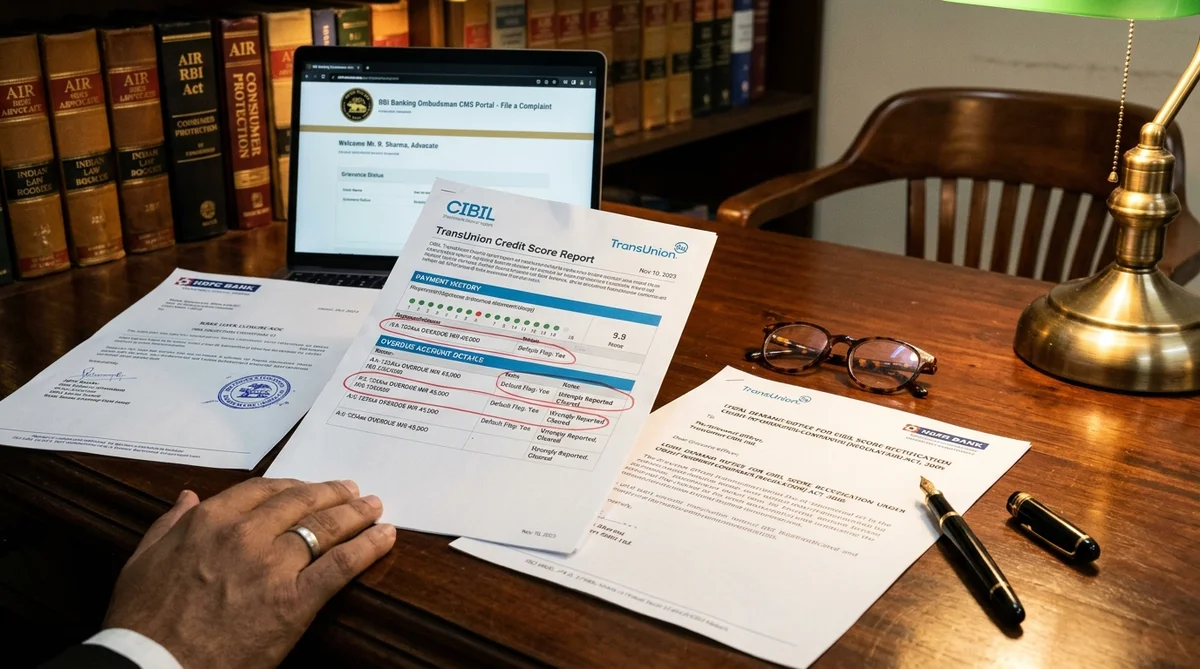
In an era where personal credit scores govern every significant economic transaction, an erroneous blacklisting on the CIBIL database does not merely constitute a clerical error; it inflicts severe, irreparable trauma on an individual's professional standing, commercial viability, and social dignity. When a negligent bank falsely reports a paid-up loan as a "wilful default", loans are rejected, business lines of credit are abruptly frozen, and employment opportunities requiring financial vetting are destroyed.
Indian jurisprudence has recognized that reporting false financial delinquencies to public credit rating bureaus amounts to actionable civil defamation, tortious breach of duty of care, and severe deficiency in banking services. Aggrieved citizens and business entities are increasingly pursuing substantial compensation claims—ranging from several lakhs to crores of rupees—against careless financial institutions before Consumer Disputes Redressal Commissions, Civil Courts, and High Courts. Understanding the evidentiary architecture required to prove credit defamation and quantify financial damages is essential for securing restorative justice.
Erroneous reporting of loan defaults by careless banks constitutes actionable defamation, tortious negligence, and deficiency in banking services. Victims of wrongful CIBIL degradation can recover substantial compensation before Consumer Commissions, Civil Courts, or the Banking Ombudsman for lost commercial opportunities, mental agony, denial of credit, and severe damage to business reputation.
1. Legal Foundations: Credit Degradation as Actionable Defamation
To succeed in a claim for damages arising from wrongful credit reporting, the claimant must anchor their action within recognized legal doctrines:
- Tortious Defamation: Under the common law of torts, publishing a false statement to a third party that lowers the reputation of a person in the estimation of right-thinking members of society constitutes defamation. Publishing an un-owed default to TransUnion CIBIL—where it is viewed by dozens of financial institutions—satisfies the requirement of malicious publication.
- Deficiency in Banking Service (Section 2(11) CPA, 2019): Under the Consumer Protection Act, 2019, a bank owes a fiduciary duty of care to maintain accurate ledgers. Falsely reporting an active default despite timely loan closure represents egregious deficiency in service.
- Breach of Statutory Duty under Section 19 CICRA: Section 19 of the Credit Information Companies (Regulation) Act, 2005 statutorily obligates lenders to ensure data accuracy. A breach of this statutory duty gives rise to a direct civil cause of action for damages.
2. Landmark Judicial Precedents Awarding Substantial Damages
Consumer Commissions and High Courts across India have repeatedly penalized reckless banks for ruining customers' creditworthiness:
The Supreme Court upheld the constitutional validity of the SARFAESI Act, 2002, while guaranteeing that secured borrowers possess an efficacious statutory remedy under Section 17 before the Debt Recovery Tribunal (DRT). In Satyawati Tondon, the Court held that High Courts should refrain from entertaining Article 226 writ petitions in commercial banking recovery matters when an alternate statutory remedy is available under the RDDBFI or SARFAESI Acts.
"When a bank carelessly reports a clean customer as a defaulter, it destroys their creditworthiness across the entire banking system. The victim suffers humiliation, mental anguish, and denial of financial liberty. Banks cannot hide behind computer software errors to escape tortious liability." — State Bank of India v. Dr. P. Gopalam (NCDRC)
| Landmark Case | Bank Negligence / Error | Relief & Damages Awarded |
|---|---|---|
| HDFC Bank v. Amit Kumar Sharma (NCDRC) | Bank continued reporting closed credit card as overdue, leading to rejection of complainant's home loan application. | NCDRC awarded ₹5 Lakhs compensation for mental agony, loss of reputation, and escalating property costs. |
| Canara Bank v. C.V. Joseph (Kerala HC) | Erroneous CIBIL reporting of commercial loan default causing cancellation of overseas export business contracts. | High Court upheld substantial civil damages for commercial defamation and lost business profits. |
| Standard Chartered v. N. Velusamy (Madras HC) | Reckless reporting of credit card default despite full settlement; humiliated in social circles upon loan refusal. | Substantial compensation awarded along with mandatory directive to issue published apology letter. |
3. Heads of Damages: How to Quantify and Prove Your Claim
To maximize financial recovery in a CIBIL defamation lawsuit, the claim must be structured across specific heads of damages with documentary substantiation:
- Direct Financial Loss (Special Damages): Evidence of home loan, vehicle loan, or business credit rejection letters specifically citing "low CIBIL score" or "active default with Bank X". Include increased interest costs incurred by taking loans from alternative high-rate NBFC lenders.
- Loss of Commercial Contracts & Business Opportunities: For commercial enterprises, demonstrate cancelled dealership agreements, loss of vendor tenders, or forfeiture of earnest money deposits directly attributable to frozen credit lines.
- General Damages for Defamation & Loss of Reputation: Compensation for the stigma of being branded a financial delinquent before bankers, peer institutions, and business partners.
- Damages for Mental Agony & Harassment: Statutory compensation under Section 39(1)(d) of the Consumer Protection Act for the continuous stress, humiliation, and administrative frustration caused by bank stonewalling.
4. Trial Roadmap: Instituting a High-Value Damages Suit
Executing a successful damages claim against a careless bank requires a strategic litigation roadmap:
- Step 1 - Build the Documentary Foundation: Secure copies of the loan sanction letter, full repayment receipts, bank account statements proving debits, the final No Dues Certificate, and dated CIBIL reports showing the false default.
- Step 2 - Issue Comprehensive Cease & Desist Legal Notice: Dispatch a detailed legal notice demanding: (a) immediate rectification within seven days, (b) a written letter of apology, and (c) payment of damages. Failure of the bank to rectify after notice establishes conscious malice.
- Step 3 - Forum Selection Strategy:
- District / State Consumer Commission: Ideal for claims up to ₹50 Lakhs (District) or ₹2 Crores (State Commission). Fast-track adjudication, low court fees, and strong pro-consumer relief powers.
- Original Civil Suit: Necessary for corporate entities or high-net-worth claims exceeding ₹2 Crores where extensive oral cross-examination on commercial losses is required.
- Step 4 - Claim Punitive Costs: Seek punitive damages under the Consumer Protection Act to deter the financial institution from subjecting other consumers to similar systemic recklessness.