
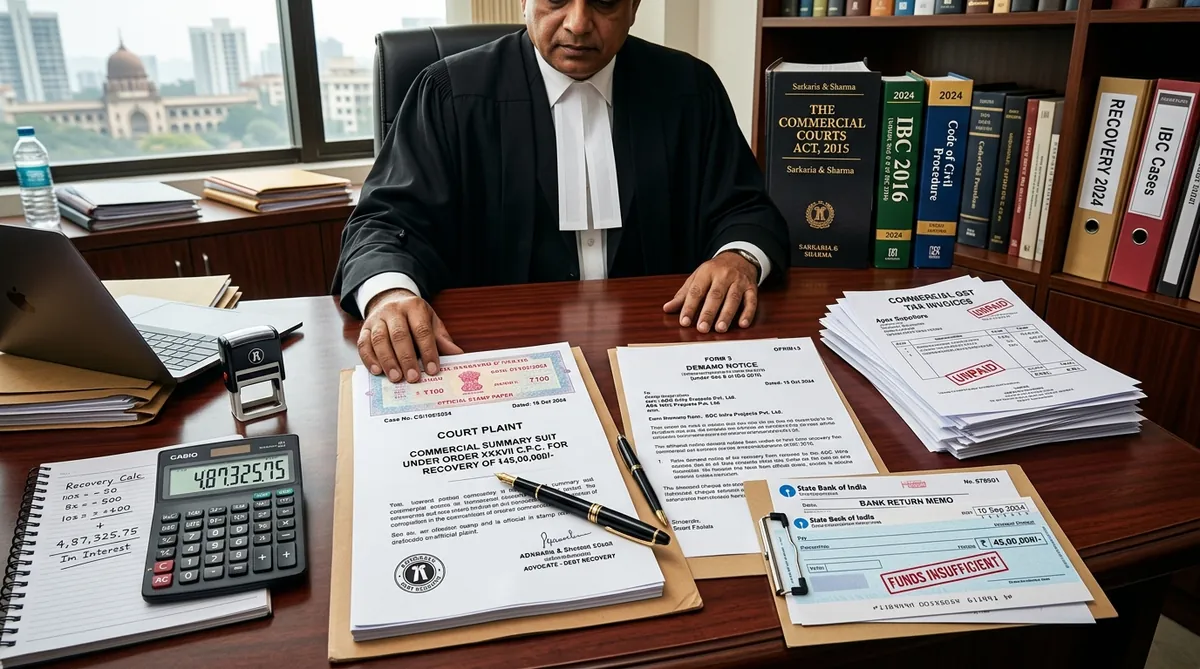
When a bank or financial institution seeks to recover outstanding dues exceeding ₹20 Lakhs, it institutes an Original Application (OA) under Section 19 of the Recovery of Debts and Bankruptcy Act, 1993 (RDB Act) before the jurisdictional Debts Recovery Tribunal (DRT). An OA is a full-fledged civil recovery suit that culminates in the issuance of a Recovery Certificate having the force of an un-appealable money decree.
However, institutional lenders frequently commit fatal legal errors when prosecuting OAs: sleeping over non-performing accounts until the debt becomes time-barred under the Limitation Act, 1963, relying on forged or unsigned balance confirmation letters, capitalizing penal interest in gross violation of the Constitution Bench ruling in Central Bank of India v. Ravindra, and failing to account for borrower counter-claims. A defendant borrower or guarantor equipped with a sophisticated procedural defense can effectively defeat bank recovery suits, secure substantial interest write-offs, or force advantageous settlements.
In bank recovery proceedings under Section 19 of the Recovery of Debts and Bankruptcy Act 1993, banks must institute Original Applications within the statutory three-year limitation period. Borrowers can successfully defeat recovery suits by establishing unacknowledged time-barred debts, unauthorized compound interest capitalizing penal charges, or by setting up comprehensive counter-claims.
1. The 3-Year Limitation Defense: When Bank Claims are Time-Barred
Under Section 24 of the RDB Act, the provisions of the Limitation Act, 1963 apply strictly to all applications made to a Debts Recovery Tribunal. A bank cannot recover a debt, no matter how genuine, if the OA is instituted beyond the statutory period of limitation:
- Three-Year Limitation Period (Articles 19 and 55): For money lent or breach of contract, the limitation period is three years from the date of default or when the right to sue accrued.
- Twelve-Year Limitation for Mortgages (Article 62): Where the bank seeks enforcement of payment of money secured by a mortgage of immovable property, the limitation period is twelve years from when the money became due. Crucially, if the personal decree against the borrower/guarantor is time-barred after 3 years, recovery is confined strictly to the mortgaged asset.
- Section 18 Limitation Act - Acknowledgement of Debt: To restart the 3-year limitation clock, the bank must prove an acknowledgement of liability made in writing and signed by the borrower before the expiration of the prescribed period.
- Section 19 Limitation Act - Payment on Account: Part-payment made towards debt or interest restarts limitation only if evidenced in handwriting or signed acknowledgement by the person making it.
"Section 3 of the Limitation Act mandates that every application made after the prescribed period shall be dismissed, although limitation has not been set up as a defense. If the bank fails to prove a valid, timely acknowledgement in writing, the OA must be dismissed as time-barred." — State Bank of India v. B.S. Agricultural Industries (2009)
2. Challenging Illegal Penal Interest & Compounding: The Ravindra Doctrine
A primary ground of defense in every DRT trial is the bank's calculation of compound and penal interest. In the historic Constitution Bench decision of Central Bank of India v. Ravindra (2002) 1 SCC 367, the Supreme Court established definitive boundaries governing bank interest:
- Prohibition on Capitalizing Penal Interest: A bank can charge penal interest for default, but penal interest cannot be capitalized (i.e., merged into the principal) to compound further interest. Any compounding of penal interest is illegal, unconscionable, and contrary to public policy.
- Distinction between Principal Sum and Interest: The phrase "principal sum adjudged" under Section 34 CPC and Section 19(20) RDB Act means the actual principal disbursed plus lawful contractual interest up to the date of suit, completely excluding capitalized penal charges.
- Mandatory Statement of Account Certification: Under the Bankers' Books Evidence Act, 1891, the bank must produce properly certified accounts. If the ledger reveals unauthorized charges, processing fees, or non-disclosed inspection levies, the DRT must order a forensic recalculation.
3. Setting Up Aggressive Counter-Claims & Set-Off under Section 19
Under Section 19(8) of the RDB Act, a defendant in an Original Application may, in addition to their right of pleading a set-off under Section 19(6), set up by way of counter-claim against the claim of the applicant bank any right or claim in respect of a cause of action accruing to the defendant.
| Ground for Counter-Claim | Legal Basis under Law | Judicial Effect in DRT Trial |
|---|---|---|
| Failure to Disburse Sanctioned Limits | Breach of contract; lender liability for strangling commercial enterprise. | Damages claimed by borrower can extinguish or substantially reduce bank claim. |
| Wrongful CIBIL Reporting | Tortious injury, defamation, and breach of statutory duty under CICRA 2005. | Compensation can be adjusted against adjudicated loan ledger balance. |
| Loss of Mortgaged Title Deeds | Breach of bailee duties under Section 151 Contract Act; market devaluation. | DRT can award substantial damages and withhold issuance of Recovery Certificate. |
4. Trial Roadmap: Drafting the Written Statement & Evidence Affidavit
A systematic defense before the DRT requires rigorous evidence management:
- Specific Denials in Written Statement (WS): Under DRT procedure, vague denials are treated as admissions. Deny each paragraph specifically, particularly loan balance confirmations and signatures on revival letters.
- Challenging Blank Signed Loan Forms: Highlight if the bank obtained signatures on blank printed loan documents, promissory notes, or guarantee deeds, rendering them void for material alteration under Section 87 of the Negotiable Instruments Act.
- Cross-Examination of Bank Officers: While DRT proceedings are summary, where serious allegations of fraud, fabricated balance confirmations, or ledger tampering are raised, file an application under Rule 12(6) of DRT Rules for oral cross-examination of the bank's Authorised Officer.
- Section 19(25) Inherent Powers: Invoke the DRT’s inherent powers to prevent abuse of process and direct independent chartered accountant audits of the loan account before any final certificate is issued.
Landmark Judicial Precedents & Statutory Authorities
Courts and appellate tribunals across Delhi NCR (Faridabad, Saket, Tis Hazari, Gurugram, High Courts) strictly apply these authoritative Supreme Court benchmarks:
The Supreme Court upheld the constitutional validity of the SARFAESI Act, 2002, while guaranteeing that secured borrowers possess an efficacious statutory remedy under Section 17 before the Debt Recovery Tribunal (DRT). In Satyawati Tondon, the Court held that High Courts should refrain from entertaining Article 226 writ petitions in commercial banking recovery matters when an alternate statutory remedy is available under the RDDBFI or SARFAESI Acts.