
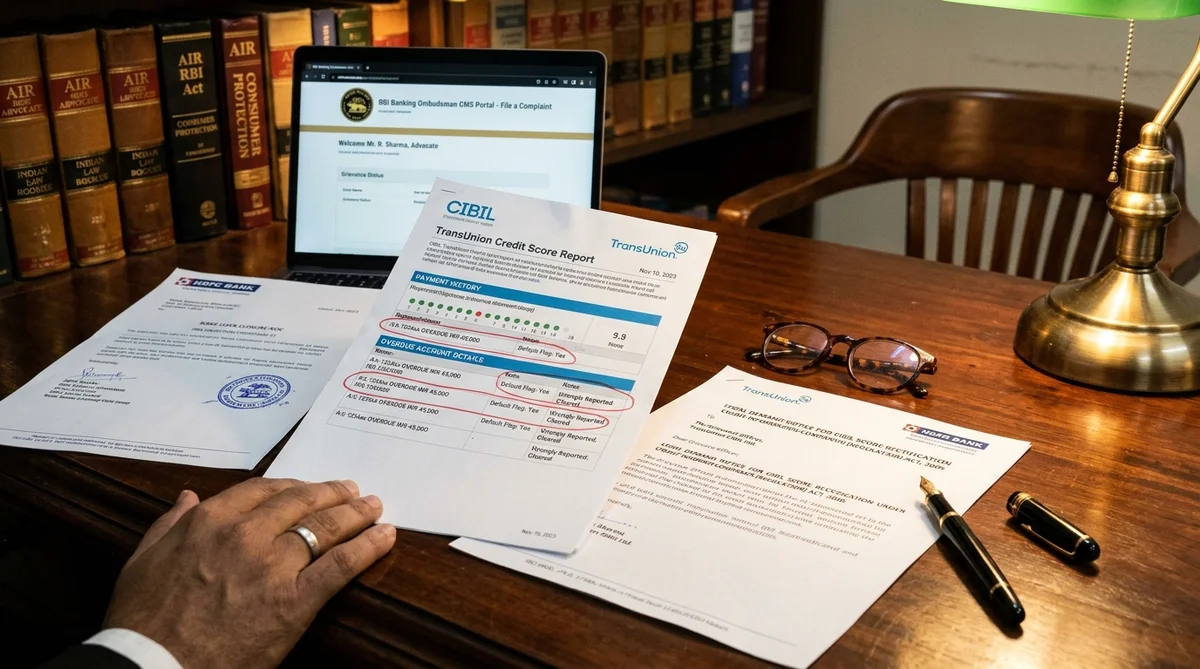
In modern India's digital economy, an individual's or commercial enterprise's credit history is their most critical financial passport. Credit scores maintained by credit information companies—predominantly TransUnion CIBIL, Equifax, Experian, and CRIF High Mark—determine eligibility for home mortgages, business working capital loans, corporate guarantees, and credit cards.
Unfortunately, the credit reporting ecosystem is plagued by severe systemic inaccuracies: settled loans wrongfully classified as "Written Off" or "Wilful Default", identity mix-ups resulting in strangers' delinquent loans appearing on innocent citizens' reports, and careless banks failing to update credit bureaus after receiving full payment. When credit scores collapse due to bank negligence, borrowers find themselves financially paralyzed. The Credit Information Companies (Regulation) Act, 2005 (CICRA) and the Credit Information Companies Rules, 2006 establish an enforceable statutory mechanism to compel banks and credit bureaus to purge inaccurate defaults, backed by strict RBI compensation mandates.
Under Section 21 of the Credit Information Companies (Regulation) Act 2005 read with Rule 20 of CIC Rules, individuals possess a statutory right to dispute inaccurate credit reporting. Credit institutions and bureaus like TransUnion CIBIL must investigate and resolve data disputes within thirty days, or face statutory penalties and civil liability.
1. Statutory Architecture of Credit Reporting: CICRA, 2005
The Credit Information Companies (Regulation) Act, 2005 (CICRA) was enacted to regulate credit reporting while safeguarding consumer data accuracy. Key statutory rights codified under CICRA include:
- Statutory Duty of Accuracy (Section 19): Every credit institution (bank/NBFC) and credit information company (CIBIL) must ensure that the credit information collected and furnished is accurate, complete, and duly protected.
- Right of the Borrower to Dispute Data (Section 21): If a borrower considers that the credit information maintained by a credit bureau is inaccurate, deficient, or incomplete, they have an absolute statutory right to request the credit bureau or the bank to rectify the data.
- Rule 20, CIC Rules - Mandatory 30-Day Resolution Window: Upon receiving a dispute request, the credit bureau must immediately refer the matter to the reporting bank. The bank is legally obligated to verify its records and provide updated data to CIBIL within thirty days.
- Right to Receive Credit Information (Section 20): Every individual has the right to obtain a certified copy of their complete credit report upon payment of prescribed statutory fees.
2. Common Defective Classifications & Legal Remedies
Understanding the specific nomenclature used by TransUnion CIBIL is crucial for formulating a legally precise dispute:
| CIBIL Tag | Commercial Implication | Statutory Rectification Ground |
|---|---|---|
| "Settled" vs "Closed" | Settled indicates loan closed with haircut/compromise; cripples future loan approvals for years. | If borrower paid entire principal under OTS with promise of clean closure, demand tag update or pay residual balance. |
| "Written Off" (Post-Repayment) | Bank wrote off loss on ledger; completely blocks institutional lending. | Bank neglected to report closure after receiving full settlement; actionable negligence under Section 19 CICRA. |
| Identity / PAN Mix-up | Loan of another individual with similar name or mistaken PAN mapped to your profile. | Violation of Section 20 CICRA; demand immediate decoupling and purge of third-party account. |
| Unresolved Fraudulent Loans | Identity theft or cyber phishing loan availed by fraudsters without victim knowledge. | Annex Cyber Cell FIR; bank must mark account as disputed and freeze reporting pending inquiry. |
3. The RBI 2023 Landmark: ₹100 per Day Compensation Mandate
To curb institutional apathy where banks ignored CIBIL dispute tickets for months, the Reserve Bank of India issued a historic circular on October 26, 2023 (RBI/2023-24/72) titled "Framework for Compensation to Customers for Delayed Updating/Rectification of Credit Information":
The Supreme Court reaffirmed the three mandatory golden tests for grant of interlocutory injunctions under Order XXXIX Rules 1 and 2 of the Code of Civil Procedure: (i) strong prima facie case, (ii) balance of convenience tilted in applicant's favor, and (iii) imminent threat of irreparable injury not compensable in monetary damages. The Court held that temporary relief cannot be granted mechanically without judicial application of mind.
"Credit Institutions (CIs) and Credit Information Companies (CICs) shall pay compensation of ₹100 per calendar day to the complainant if the grievance is not resolved within thirty calendar days from the date of receipt of the complaint." — RBI Master Circular (Oct 2023)
Key operational rules of the 2023 compensation framework include:
- Apportionment of Liability: If the delay is caused by the bank failing to send updated data within 21 days, the bank pays the full ₹100/day. If the delay is caused by the credit bureau failing to ingest data within 9 days, CIBIL pays the penalty.
- Direct Account Credit: Compensation must be credited directly to the complainant’s bank account within five working days of grievance resolution, without requiring civil court decrees.
- SMS Alerts on Inquiries: Credit bureaus must send immediate SMS/email alerts to customers whenever their credit report is accessed by any lending institution.
4. Step-by-Step Legal Procedure: Purging Inaccurate Defaults
Follow this tested statutory roadmap to remove disputed defaults from your credit bureau records:
- File Formal Online Dispute with CIBIL: Log into the official CIBIL portal and register an online dispute with the unique Dispute Control Number (DCN), identifying the specific erroneous loan account.
- Issue Statutory Notice to Bank Nodal Officer: Simultaneously send a formal legal notice under Section 21 of CICRA to the Principal Nodal Officer of the reporting bank, enclosing the No Dues Certificate (NDC), settlement letter, and proof of payment.
- Escalate to RBI Ombudsman (CMS Portal): Upon expiry of thirty days without complete rectification, lodge a complaint on the RBI Complaint Management System (CMS) under the Reserve Bank - Integrated Ombudsman Scheme, 2021, claiming both immediate data correction and statutory ₹100/day compensation.
- High Court Writ or Consumer Commission Claim: If the bank remains recalcitrant, file a complaint before the Consumer Disputes Redressal Commission for deficiency in service, or an Article 226 writ petition before the High Court for infringement of fundamental credit reputation.