
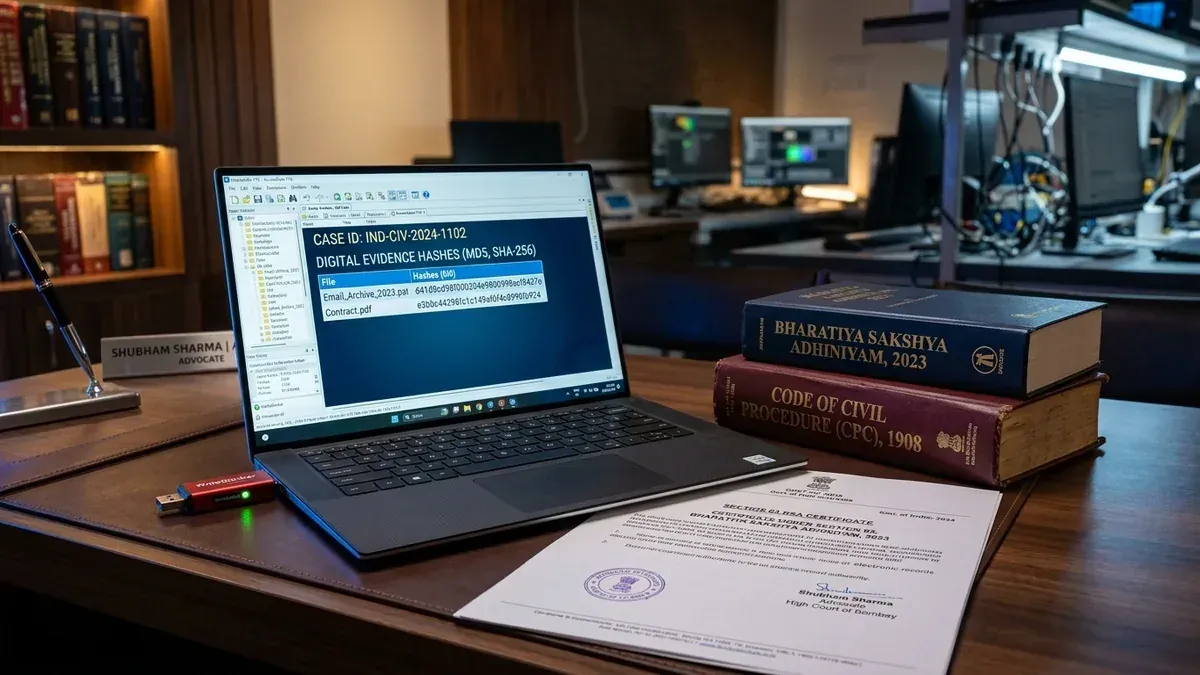
The administration of civil and criminal justice is fundamentally a quest for truth. In an adversarial system, the court relies upon the parties to place before it the primary facts and documents necessary to reach a just adjudication. However, human nature and litigation self-interest frequently conspire to subvert this goal: when a party possesses a critical ledger, a contemporaneous email thread, or an internal board resolution that fatally dismantles their own pleaded case, the overwhelming temptation is to conceal, withhold, or suppress that document from the record.
To deter litigants from playing hide-and-seek with the court, the law of evidence arms the judiciary with one of its most lethal evidentiary weapons: the Doctrine of Adverse Inference. Rooted in the ancient legal maxim omnia praesumuntur contra spoliatorem (all things are presumed against a wrongdoer or suppressor of evidence), the doctrine permits a court to presume that evidence which could have been produced, but was withheld, would have operated to the severe detriment of the withholding party.
Under the new statutory framework of the Bharatiya Sakshya Adhiniyam, 2023 (BSA), this presumption is codified in Section 119, Illustration (g) (formerly Section 114, Illustration (g) of the Indian Evidence Act, 1872). Intersecting directly with the Best Evidence Rule in Section 56 BSA and the discovery machinery of Order XI of the CPC, adverse inference shatters tactical evasion. In its immortal precedent in Gopal Krishnaji Ketkar v. Mohamed Haji Latif (1968), the Supreme Court laid down that a party possessing best evidence cannot hide behind the abstract rules of burden of proof. This comprehensive treatise explores the statutory foundation of Section 119 BSA, details the four mandatory preconditions for drawing an adverse inference, unpacks the Gopal Krishnaji Ketkar doctrine, and equips trial advocates with actionable strategies to weaponize withheld records.
Under Section 119 Illustration (g) of the Bharatiya Sakshya Adhiniyam, 2023, courts may presume withheld evidence is unfavourable to the withholding party. In Gopal Krishnaji Ketkar, the Supreme Court held that a party in possession of best evidence must produce it, irrespective of abstract burden of proof, or face adverse inference.
1. The Statutory Doctrine of Adverse Inference under Section 119 Illustration (g) BSA
The statutory foundation of adverse inference in India is codified in Section 119 of the Bharatiya Sakshya Adhiniyam, 2023 (corresponding to Section 114 of the repealed 1872 Act):
Section 119 of the BSA (Court May Presume Existence of Certain Facts):
The Court may presume the existence of any fact which it thinks likely to have happened, regard being had to the common course of natural events, human conduct, and public and private business, in their relation to the facts of the particular case.
Illustration (g): That evidence which could be and is not produced would, if produced, be unfavourable to the person who withholds it.
Several critical characteristics govern this statutory presumption:
- Discretionary Presumption of Fact ("May Presume"): Under Section 2(1)(e) of the BSA, whenever it is provided that the court "may presume" a fact, it may either regard such fact as proved, unless and until it is disproved, or may call for proof of it. An adverse inference is not an automatic, mandatory compulsion of law; it is a discretionary inference of fact drawn by the trial judge based on overall human conduct and surrounding circumstances.
- The Concept of Spoliation: The doctrine punishes spoliation—the intentional destruction, concealment, or unexplained withholding of relevant evidence. When a litigant selectively produces favorable extracts while suppressing the underlying primary records, the court is legally justified in presuming that the full truth would destroy their case.
2. The Best Evidence Rule and Litigant's Duty: The Gopal Krishnaji Ketkar Precedent
the foundational tenet of Indian jurisprudence on adverse inference is the historic judgment of the Supreme Court in Gopal Krishnaji Ketkar v. Mohamed Haji Latif (1968) 3 SCR 862, delivered by Justice V. Ramaswami.
The Supreme Court reaffirmed the three mandatory golden tests for grant of interlocutory injunctions under Order XXXIX Rules 1 and 2 of the Code of Civil Procedure: (i) strong prima facie case, (ii) balance of convenience tilted in applicant's favor, and (iii) imminent threat of irreparable injury not compensable in monetary damages. The Court held that temporary relief cannot be granted mechanically without judicial application of mind.
2.1 The Landmark Ruling
In Gopal Krishnaji Ketkar, the appellant claimed that certain land was his private property and not a public Dargah trust. The appellant admitted in cross-examination that he maintained regular account books of the Dargah's income and expenses, but refused to produce them in court, arguing that the burden of proving that the property was a public trust lay upon the plaintiff-respondent.
The Supreme Court categorically shattered this defense, enunciating one of the most celebrated passages in Indian evidence law:
"Even if the burden of proof does not lie on a party the Court may draw an adverse inference if he withholds important documents in his possession which can throw light on the facts at issue. It is not, in our opinion, a sound practice for those desiring to rely upon a certain state of facts to withhold from the Court the best evidence which is in their possession which could throw light upon the issues in controversy and to rely upon the abstract doctrine of onus of proof."
— Supreme Court in Gopal Krishnaji Ketkar (1968)
2.2 The Best Evidence Rule (Section 56 BSA)
The Gopal Krishnaji Ketkar doctrine is the direct enforcement arm of the Best Evidence Rule codified in Section 56 of the BSA. The law requires that the best available evidence—whether an original title deed, an audited account ledger, or a contemporaneous minutes book—must be brought before the court. A litigant who deliberately withholds the best evidence in their possession cannot seek shelter behind abstract legal theories of burden of proof under Section 104 or 105 BSA.
3. The Four Mandatory Preconditions for Drawing Adverse Inference
Because an adverse inference can decisively tilt a civil decree or criminal verdict, the Supreme Court in Union of India v. Mahadhyaksha Mahila Mandal, Punit Rai v. Dinesh Chaudhary (2003) 8 SCC 204, and Tomaso Bruno v. State of U.P. (2015) 7 SCC 178 laid down four cumulative conditions that must be established before the court will draw the presumption:
The Four Cumulative Tests for Section 119 Illustration (g):
1. The evidence must be conclusively proven to exist and be in the custody or control of the party.
2. The withheld evidence must be relevant and material to a core issue in controversy.
3. The party must have been given a clear opportunity or formal notice to produce it.
4. The failure to produce must be without any plausible, credible, or justifiable explanation.
- Conclusive Proof of Existence and Custody: The court cannot draw an adverse inference based on mere speculation that a document might exist. The applicant must prove through admissions in pleadings, discovery interrogatories, or witness depositions that the specific records actually exist and are within the physical custody, power, or possession of the withholding party.
- Materiality and Relevancy: The withheld document must not be merely collateral, peripheral, or cumulative. It must be evidence capable of directly resolving or illuminating a contentious issue in the suit.
- Formal Opportunity or Notice to Produce: The party must have been formally called upon to produce the evidence, or the litigation context must have created an inescapable obligation to present it. Serving a formal Notice to Produce under Order XII Rule 8 CPC is the most effective method to fulfill this requirement.
- Unexplained or Mala Fide Non-Production: If the party provides a genuine, plausible explanation—such as loss due to fire, destruction pursuant to a routine corporate document retention policy prior to suit, or legitimate legal privilege under Section 132 BSA—no adverse inference can be drawn.
4. Procedural Catalysts: Discovery under Order XI and Notice to Produce under Order XII Rule 8 CPC
An advocate cannot simply show up at the stage of final arguments and ask the court to draw an adverse inference out of thin air. The procedural foundation must be laid with precision during the pre-trial stages of the suit:
4.1 The Pre-Trial Discovery Arsenal under Order XI CPC
The Code of Civil Procedure provides an elaborate statutory mechanism to extract documents from an unwilling adversary:
- Interrogatories (Order XI Rules 1 & 2 CPC): Deliver interrogatories requiring the adversary to state on oath whether specific documents, email archives, or register books exist and in whose custody they currently reside.
- Discovery of Documents on Oath (Order XI Rule 12 CPC): Apply to the court for an order directing the opposing party to make discovery on oath of all documents relating to any matter in question in the suit.
- Production of Documents (Order XI Rule 14 CPC): Move the court to order the production upon oath of documents in the adversary's possession.
- Striking Out Defense (Order XI Rule 21 CPC): The ultimate procedural penalty. If a defendant fails to comply with an order for discovery or production, the court can strike out their defense entirely and proceed as if the defendant had not defended the suit.
4.2 Serving a Notice to Produce under Order XII Rule 8 CPC
Under Order XII Rule 8 CPC, an advocate should serve a formal Notice to Produce Documents upon the adverse party's counsel before trial begins. This serves two devastating legal functions:
- It satisfies the third mandatory precondition of adverse inference by proving that the party was officially called upon to produce the records.
- Under Section 89 of the BSA (former Section 89 IEA), if the party fails to produce the document after receiving notice, the applicant is entitled to lead secondary evidence of its contents. Once the applicant proves the copy, Section 89 establishes that the party who refused to produce cannot later introduce the original document to contradict the secondary evidence without special permission of the court.
5. Strategic Trial Warfare: Cross-Examination Traps and Rebuttal Tactics
Trapping an opposing party into an adverse inference requires surgical cross-examination of their witness.
5.1 The Four-Step Courtroom Trap
When cross-examining the opposing party's authorized representative, managing director, or accountant:
- Step 1 (Establish Standard Business Practice): "Does your company maintain audited daily attendance logs and biometric entry registers?" Witness: "Yes, we are required by labor laws to maintain them."
- Step 2 (Establish Existence for the Material Period): "Were these registers maintained for the disputed month of October 2024?" Witness: "Yes, they were duly maintained."
- Step 3 (Establish Custody): "Are these registers currently in the custody of your HR department at head office?" Witness: "Yes."
- Step 4 (Nail the Non-Production): "Have you produced these October 2024 registers in this court?" Witness: "No, we have not filed them."
With that four-question sequence, the trap is sprung. You have conclusively proved existence, materiality, and possession, setting the stage for an inescapable adverse inference under Section 119 Illustration (g) BSA during final arguments.
5.2 How to Defend Against an Adverse Inference Application
If your client is accused of withholding evidence, the defending advocate must deploy the following counter-strategies:
- Prove Non-Existence or Destruction in Ordinary Course: Place before the court official document retention policies showing that emails or CCTV recordings are automatically overwritten after 30 or 90 days.
- Show Cumulative Nature: Demonstrate that the withheld documents were merely cumulative or repetitive of primary evidence already placed on record.
- Invoke Professional or State Privilege: If documents involve legal advice, invoke attorney-client privilege under Section 132 of the BSA.
In conclusion, the doctrine of adverse inference under Section 119 Illustration (g) of the BSA ensures that civil justice is not held hostage to selective memory or calculated document suppression. Litigators who deploy Order XI discovery tools, serve timely Notices to Produce under Order XII Rule 8, and harness the unassailable authority of Gopal Krishnaji Ketkar will dismantle dishonest litigation and secure conclusive victories.