
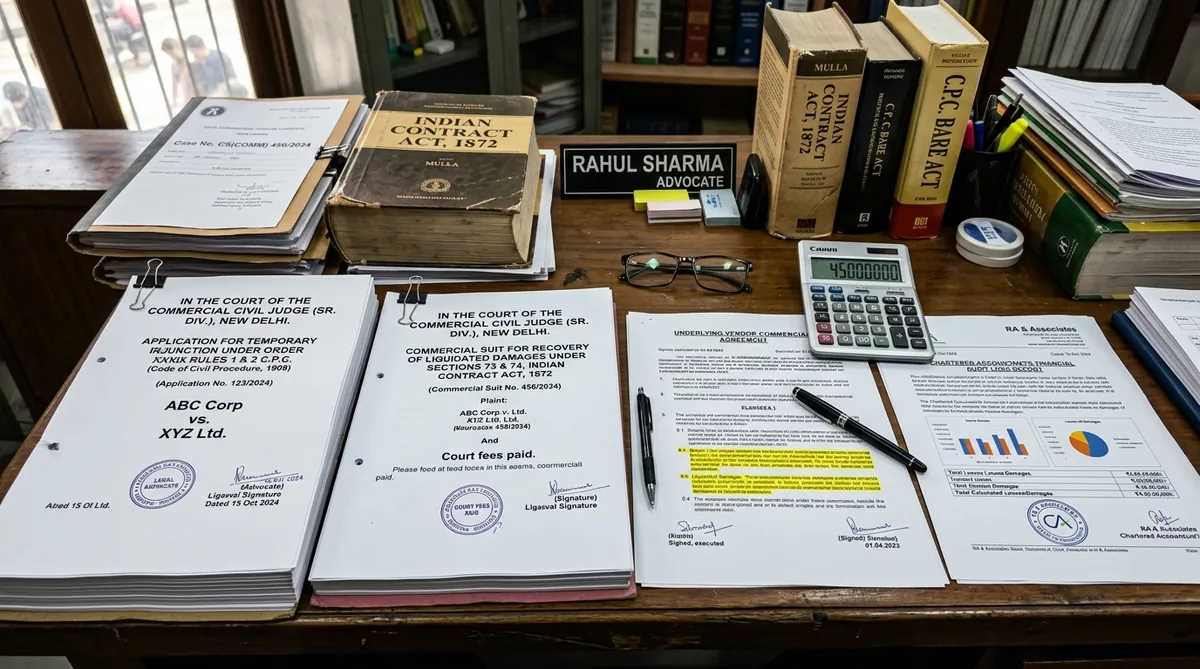
Among equitable civil remedies, the law of injunctions stands as the foremost shield protecting substantive legal rights from imminent or ongoing violation. Governed primarily by the Specific Relief Act, 1963 (SRA) and the procedural machinery of Order XXXIX of the Code of Civil Procedure, 1908 (CPC), civil courts possess wide discretionary authority to grant preventive or restorative relief. However, an immense jurisprudential gulf separates a standard prohibitory injunction from an interlocutory mandatory injunction.
While a prohibitory injunction acts passively to preserve the current status quo by restraining a party from doing a wrongful act, a mandatory injunction commands positive action—ordering the defendant to dismantle a structure, restore physical possession, or reverse a state of affairs that has already taken place. Granting a mandatory injunction at an interlocutory stage, before the full trial of the action, is an extraordinary measure that carries the perilous risk of deciding the entire suit without hearing complete evidence.
To control this judicial power, the Supreme Court of India in its immortal decision in Dorab Cawasji Warden v. Coomi Sorab Warden (1990) formulated a rigorous tripartite test. Unless a plaintiff demonstrates a case of a far higher standard than a typical prima facie claim, an interim mandatory injunction will be firmly denied. This comprehensive guide examines the conceptual differences between mandatory and prohibitory injunctions, dissects the statutory foundation under Sections 38 and 39 of the Specific Relief Act, unpacks the Dorab Cawasji Warden doctrine, and provides trial advocates with the evidentiary strategies needed to secure or defeat mandatory interlocutory relief.
Under the landmark Supreme Court ruling in Dorab Cawasji Warden v. Coomi Sorab Warden, interim mandatory injunctions under Order 39 CPC are granted only in exceptional cases. The plaintiff must establish a strong prima facie case of a higher degree than prohibitory injunctions, clear balance of convenience, and irreparable injury.
1. Conceptual Jurisprudence: Negative Restraint vs Positive Compulsion
The distinction between prohibitory and mandatory injunctions is rooted in the equitable history of the Court of Chancery and is formally codified in Part III of the Specific Relief Act, 1963.
"A prohibitory injunction restrains the commission or continuance of a wrongful act, preserving the existing state of things. A mandatory injunction compels the undoing of a wrongful act, compelling positive performance to restore an earlier lawful condition."
The statutory foundation comprises two core provisions:
- Section 38 of the Specific Relief Act, 1963 (Perpetual Injunction): A perpetual prohibitory injunction may be granted to prevent the breach of an obligation existing in favor of the applicant, whether express or implied. Where the obligation arises from contract, the court applies the rules of specific performance under Chapter II. Where the defendant invades or threatens to invade the plaintiff's right to property, an injunction is granted if the defendant is trustee of the property, where there exists no standard for ascertaining actual damage, where pecuniary compensation would not afford adequate relief, or where the injunction is necessary to prevent a multiplicity of judicial proceedings.
- Section 39 of the Specific Relief Act, 1963 (Mandatory Injunctions): When, to prevent the breach of an obligation, it is necessary to compel the performance of certain acts which the court is capable of enforcing, the court may in its discretion grant an injunction to prevent the breach complained of, and also to compel performance of the requisite acts.
- Interlocutory Interplay under Order XXXIX Rules 1 & 2 CPC: While the Specific Relief Act governs perpetual (final) injunctions decreed after trial, interlocutory (temporary) injunctions pending suit are governed by Order XXXIX of the CPC. Although Order XXXIX Rules 1 and 2 primarily speak of restraining acts of damage, alienation, or breach, the Supreme Court has conclusively established that the court possesses inherent jurisdiction under Section 151 CPC, read with Order XXXIX, to issue interim mandatory injunctions in exceptional cases.
2. The Landmark Dorab Cawasji Warden (1990) Tripartite Test
The definitive authority on interlocutory mandatory injunctions in India is the judgment of the Supreme Court in Dorab Cawasji Warden v. Coomi Sorab Warden (1990) 2 SCC 440, authored by Justice K.N. Saikia.
The Supreme Court reaffirmed the three mandatory golden tests for grant of interlocutory injunctions under Order XXXIX Rules 1 and 2 of the Code of Civil Procedure: (i) strong prima facie case, (ii) balance of convenience tilted in applicant's favor, and (iii) imminent threat of irreparable injury not compensable in monetary damages. The Court held that temporary relief cannot be granted mechanically without judicial application of mind.
2.1 The Factual Matrix
The dispute in Dorab Cawasji Warden involved an undivided family dwelling house belonging to Parsi co-owners. One co-owner, without partition, executed a transfer of his undivided share in favor of strangers (a husband and wife) and inducted them into physical possession. The appellant filed a suit under Section 44 of the Transfer of Property Act, 1882, seeking a declaration and an interim mandatory injunction directing the stranger-purchasers to vacate the premises.
The trial court granted the interim mandatory injunction, ordering the strangers to quit possession. The High Court reversed the order, holding that interim mandatory injunctions cannot be granted to dispossess a party who had already entered into physical occupation. The Supreme Court reversed the High Court and restored the trial court's mandatory injunction, laying down the universal guidelines governing this exceptional remedy.
2.2 The Three Mandatory Prerequisites
The Supreme Court established that because an interim mandatory injunction is an extraordinary and drastic relief, it can only be granted when the plaintiff satisfies three stringent, cumulative conditions:
The Tripartite Test of Dorab Cawasji Warden (1990):
1. A strong prima facie case of a higher degree than that required for a prohibitory injunction.
2. Overwhelming balance of convenience, where withholding relief will result in serious, irreversible hardship.
3. Rare and exceptional circumstances, primarily to restore the status quo ante that existed immediately before the wrongful act.
- Strong Prima Facie Case of a Higher Standard: In a regular prohibitory injunction application, a plaintiff only needs to establish a "triable issue" or a bona fide contention. For an interim mandatory injunction, however, the plaintiff must demonstrate a case of a much higher standard. The court must possess a high degree of assurance that at the final trial, the plaintiff will inevitably succeed.
- Overwhelming Balance of Convenience & Grave Irreparable Injury: The plaintiff must show that refusing the injunction will cause extreme, irreversible injury that cannot be compensated in money. The injury must be far greater than the inconvenience suffered by the defendant if the injunction is granted.
- Restoration of Status Quo Ante in Exceptional Cases: The relief is fundamentally designed to preserve or restore the status quo ante—the lawful state of things that existed immediately prior to the defendant's wrongful, high-handed, or clandestine act. It prevents a wrongdoer from taking the law into their own hands, altering physical facts during a court vacation, and then claiming protection behind the shield of a "completed act."
3. Judicial Evolution: From Metro Marins to Samir Bhojwani
Subsequent Supreme Court benches have rigorously enforced the high threshold established in Dorab Cawasji Warden, checking attempts by litigants to misuse interlocutory applications to bypass regular trials.
3.1 Metro Marins v. Bonus Watch Co. (P) Ltd. (2004) 7 SCC 478
In Metro Marins, the landlord filed a suit for eviction and arrears of rent against a tenant and applied for an interim mandatory injunction directing the tenant to hand over vacant possession during the pendency of the suit. The High Court granted the mandatory injunction. Setting aside the High Court's order, the Supreme Court held that interim mandatory injunctions directing delivery of possession are wholly impermissible in standard contractual or tenancy disputes. An interim order cannot be used as a shortcut to decree an eviction suit before recording evidence.
3.2 Purshottam Vishandas Raheja v. Shrichand Vishandas Raheja (2011) 6 SCC 73
In Purshottam Raheja, the Supreme Court reiterated that an interim mandatory injunction can be granted to protect the subject matter of the suit and prevent a fait accompli. Where a defendant rushes construction in open defiance of a pending litigation or fraudulently alters the entrance or utility lines of a shared property, the court will not hesitate to order immediate demolition or restoration of access.
3.3 Samir Bhojwani v. Aurora Properties and Investments (2020) 2 SCC 555
In Samir Bhojwani, a two-judge bench of the Supreme Court addressed whether a developer could be directed via an interim mandatory injunction to hand over completed apartments in a multi-party development dispute. The court firmly ruled:
"Interim mandatory injunction is not a remedy that can be granted on a mere asking. It cannot be granted to grant final relief at an interlocutory stage unless the case is crystal clear and falls squarely within the exceptional parameters of Dorab Cawasji Warden."
4. Strategic Trial Protocols: Evidentiary Proof and Pleadings Blueprint
Because trial judges are inherently cautious about issuing positive mandatory commands before trial, an advocate drafting an application for an interim mandatory injunction must construct an airtight evidentiary record.
4.1 Proving the Exact Date and Nature of Status Quo Ante
the foundational tenet of any mandatory injunction petition is establishing what the physical reality was immediately prior to the disputed interference:
- Contemporaneous Photographic & Videographic Proof: Produce time-stamped, geotagged photographs or satellite imagery (e.g., Google Earth historical archives) showing the presence of an access road, unbroken wall, or existing utility connections prior to demolition.
- Immediate Local Commissioner Application under Order XXVI Rule 9 CPC: On the very day the suit is filed, move an ex parte application for the appointment of a Local Commissioner to inspect the site, prepare an inventory, and record the exact physical state of construction or obstruction before the defendant can tamper with the evidence.
- Police Complaints & Statutory Notices: Produce copies of police DD entries, 112 calls, or written complaints lodged immediately when the defendant began their unauthorized positive act, demonstrating that the plaintiff acted with extreme promptitude and never acquiesced.
4.2 Drafting the High Degree of Assurance
The application must not rely on ambiguous factual disputes. The petitioner must plead unimpeachable title or easement rights backed by registered title deeds, sanctioned municipal building plans, or admitted contractual covenants:
- Plead High-Handedness or Stealth: Expressly plead that the defendant acted surreptitiously—such as constructing a wall overnight, demolishing a staircase during weekend court holidays, or forcibly breaking locks while the plaintiff was hospitalized or out of town.
- Allege Incurable Disruption of Life or Livelihood: Demonstrate that withholding mandatory relief will cause catastrophic hardship—such as cutting off drinking water, blocking the sole ingress and egress to a residence, or causing structural instability to an adjoining building.
- Tender an Unconditional Cross-Undertaking in Damages: Formally incorporate a paragraph in the application and affidavit stating that if the suit is ultimately dismissed, the plaintiff undertakes to compensate the defendant for the cost of restoration or damages caused by the interim order.
5. Appellate Challenges and Enforcement Mechanisms
Securing or defeating an interim injunction order triggers immediate appellate scrutiny and enforcement procedures under the CPC.
5.1 Miscellaneous Appeal under Order XLIII Rule 1(r) CPC
An order granting or refusing an injunction under Order XXXIX Rules 1 or 2 CPC is appealable as an appeal from order under Order XLIII Rule 1(r) CPC (commonly termed a First Appeal from Order or FAO).
However, the scope of appellate interference is tightly circumscribed by the Supreme Court's ruling in Wander Ltd. v. Antox India P. Ltd. (1990) Supp SCC 727:
"The appellate court will not interfere with the exercise of discretion of the court of first instance and substitute its own discretion except where the discretion has been shown to have been exercised arbitrarily, or capriciously or perversely or where the court had ignored the settled principles of law regulating grant or refusal of interlocutory injunctions."
5.2 Enforcement of Injunctions: Order XXXIX Rule 2A and Order XXI Rule 32 CPC
If a defendant willfully disobeys an interim mandatory or prohibitory injunction, the plaintiff can invoke two potent statutory enforcement mechanisms:
- Contempt of Injunction under Order XXXIX Rule 2A CPC: The court that granted the injunction may order the property of the guilty person to be attached, and may also order such person to be detained in civil prison for a term not exceeding three months. Attachment of property remains in force for up to one year, after which the property may be sold to compensate the injured party.
- Execution of Injunction Decrees under Order XXI Rule 32 CPC: At the final stage, an injunction decree is enforced by attachment of the judgment-debtor's property, detention in civil prison, or by the court appointing an officer or commissioner to execute the positive act at the judgment-debtor's expense under Rule 32(5).
In conclusion, while prohibitory injunctions remain the daily currency of civil trial courts, interim mandatory injunctions represent the high-caliber artillery of equity. Litigators who master the rigorous three-part test of Dorab Cawasji Warden, anchor their pleadings in solid documentary proof of the status quo ante, and respect the strict limits of appellate review will wield this remedy with surgical effectiveness.