
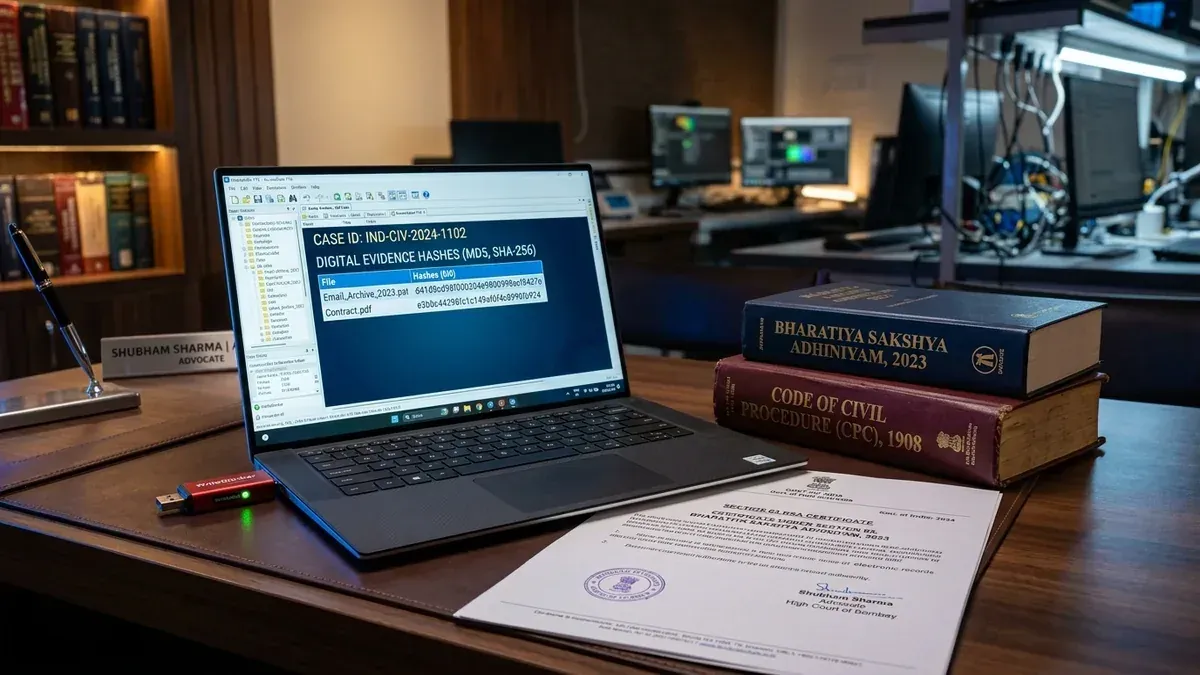
We live in an era where human interactions, commercial transactions, matrimonial disputes, and criminal conspiracies leave behind an indelible digital trail. WhatsApp conversations, email exchanges, CCTV footage, mobile Call Detail Records (CDRs), cloud server logs, and GPS tracking coordinates have largely replaced traditional paper documentation in Indian courtrooms. Yet, the electronic medium is notoriously ephemeral: digital data can be effortlessly deleted, edited, spliced, spoofed, or fabricated without leaving visible physical scars.
To protect the judicial process from digital manipulation, Indian evidence law has historically maintained a strict gatekeeping mechanism. With the repeal of the Indian Evidence Act, 1872 and the enactment of the Bharatiya Sakshya Adhiniyam, 2023 (BSA), the statutory rules governing electronic evidence underwent a major structural overhaul. The former, much-litigated Section 65B has been re-enacted and modernized under Section 63 of the BSA, complemented by a statutory Schedule prescribing standardized certificate formats.
However, the most daunting practical dilemma confronting trial litigators occurs when secondary digital copies must be proved, but the party does not own the original server, the mobile phone was destroyed, or the device is locked in the exclusive possession of an uncooperative adversary or third-party corporation. Anchored in the landmark three-judge bench ruling of the Supreme Court in Arjun Panditrao Khotkar v. Kailash Kushanrao Gorantyal (2020), this comprehensive guide examines the Section 63 BSA architecture, explains the distinction between primary and secondary digital records, deconstructs the two-part statutory certificate, and outlines the precise procedural roadmap to admit electronic evidence when the physical device is unavailable.
Under Section 63 of the Bharatiya Sakshya Adhiniyam, 2023, electronic evidence requires a mandatory statutory certificate for admissibility as secondary evidence. Following the Arjun Panditrao Khotkar doctrine, if the physical device is unavailable or held by an adverse party, the litigant must apply to court to compel production under procedural summons powers.
1. The Modern Digital Evidence Regime: Section 63 BSA vs Former Section 65B IEA
The Bharatiya Sakshya Adhiniyam, 2023 establishes an expansive, technologically updated framework for digital and electronic records under Sections 61, 62, and 63.
"Under Section 61 of the BSA, nothing in the Adhiniyam shall apply to deny the admissibility of an electronic or digital record in evidence on the sole ground that it is an electronic or digital record. Such records possess the same legal effect, validity, and enforceability as paper documents."
To appreciate the role of Section 63, one must first master the statutory division between primary and secondary electronic evidence:
- Section 62 of the BSA (Primary Electronic Evidence): Primary evidence means the original document or electronic record itself produced for the inspection of the court. Under Explanation 4 to Section 62, where an electronic record is produced from proper custody, each electronic file stored in a computer, smartphone, or server is primary evidence. Crucially, if the original physical device—such as the actual mobile phone containing WhatsApp chats, the original hard drive, or the memory card of a digital camera—is produced directly in court, it constitutes primary evidence under Section 62 and does not require any certificate under Section 63.
- Section 63 of the BSA (Secondary Electronic Evidence): Where the electronic record is not the original device, but a computer printout, optical disc (CD/DVD), USB flash drive, or cloud export containing copies of information stored in an original system, it is deemed to be secondary evidence. Section 63(1) mandates that such computer output shall be admissible in any proceeding without further proof of the original, provided the statutory conditions under Section 63(2) and the certificate requirement under Section 63(4) are strictly satisfied.
- The Four Baseline Technical Conditions of Section 63(2):
- The computer output was produced during the period over which the computer was used regularly to store or process information.
- During that period, information of the kind contained in the electronic record was regularly fed into the computer in the ordinary course of activities.
- Throughout the material part of that period, the computer was operating properly (or if not, the outage did not affect the accuracy of the electronic record).
- The information contained in the record reproduces or is derived from such information fed into the computer in the ordinary course.
2. The Mandatory Certificate under Section 63(4) and the BSA Schedule
The core gatekeeping mechanism of Section 63 is encapsulated in Sub-section (4). Under Section 63(4) BSA, whenever secondary electronic evidence is sought to be tendered in court, it must be accompanied by a formal statutory certificate.
A revolutionary departure in the BSA from the former Section 65B of the 1872 Act is the introduction of a formal, standardized Schedule appended to the statute, dividing the certification process into two distinct parts:
The Two-Tier Certificate Format under the BSA Schedule:
• Part A (User / Custodian Certificate): To be filled and signed by the person who produced or relied upon the electronic record, stating personal identification, source details, device ownership, and the purpose of production.
• Part B (Technical / Forensic Expert Certificate): To be filled and signed by an authorized technical officer, system administrator, or cyber forensic examiner certifying device integrity, hash values, software operating status, and absence of tampering.
Under Section 63(4), the certificate must:
- Identify the electronic record containing the statement and describe the manner in which it was produced.
- Give such particulars of any device involved in the production of that record as may be appropriate for showing that the computer was operating properly.
- Be signed by a person occupying an official position in relation to the operation of the relevant device or the management of the relevant activities (or an authorized forensic expert).
Without this statutory certificate, secondary electronic evidence is wholly inadmissible. The court has no discretion to waive the certificate, mark the document as an exhibit, or consider its contents.
3. The Landmark Arjun Panditrao Khotkar (2020) Doctrine
To understand the legal interpretation of Section 63 BSA, one must analyze the historic three-judge bench decision of the Supreme Court in Arjun Panditrao Khotkar v. Kailash Kushanrao Gorantyal (2020) 7 SCC 1.
The Supreme Court reaffirmed the three mandatory golden tests for grant of interlocutory injunctions under Order XXXIX Rules 1 and 2 of the Code of Civil Procedure: (i) strong prima facie case, (ii) balance of convenience tilted in applicant's favor, and (iii) imminent threat of irreparable injury not compensable in monetary damages. The Court held that temporary relief cannot be granted mechanically without judicial application of mind.
3.1 Resolving the Decadal Judicial Conflict
For nearly two decades, Indian courts were plagued by conflicting interpretations:
- In State (NCT of Delhi) v. Navjot Sandhu (2005) (the Parliament Attack Case), the Supreme Court held that secondary evidence of electronic records could be proved through oral testimony under Sections 63 and 65 of the Evidence Act without a certificate.
- In Anvar P.V. v. P.K. Basheer (2014) 10 SCC 473, a three-judge bench overruled Navjot Sandhu, holding that Section 65B is a complete code and that an electronic certificate is an mandatory condition precedent for admissibility.
- In Shafhi Mohammad v. State of H.P. (2018), a two-judge bench diluted Anvar P.V., holding that a certificate could be dispensed with if the party was not in possession of the electronic device.
3.2 The Final Ratio of the Three-Judge Bench
In Arjun Panditrao Khotkar, the Supreme Court definitively settled the controversy:
"The certificate required under Section 65B(4) is an absolute condition precedent to the admissibility of evidence by way of electronic record... Shafhi Mohammad does not lay down the correct law and is overruled. The law laid down in Anvar P.V. is affirmed."
— Supreme Court in Arjun Panditrao Khotkar (2020)
However, the Supreme Court recognized the acute hardship faced by litigants who seek to rely on electronic evidence that is not within their physical control. The court established that a party cannot be asked to perform the impossible (*lex non cogit ad impossibilia*).
5. Forensic Verification, Hash Values, and Tactical Trial Objections
Admitting electronic evidence is not merely a paperwork formality; it requires technical integrity.
5.1 Hash Value Verification and Forensic Chain of Custody
Under Part B of the BSA Schedule, technical certification requires specifying the cryptographic hash value of the electronic file. A cryptographic hash (such as SHA-256 or MD5) is a unique digital fingerprint:
- If even a single byte, comma, or timestamp in a digital file is altered, the resulting hash value changes completely.
- Cyber forensic experts must certify that the hash value of the secondary copy tendered in court matches the exact hash value extracted from the original storage device at the time of cloning.
- The forensic examiner must document the chain of custody—verifying that write-blockers were utilized to prevent any modification to the source media during extraction.
5.2 The Golden Rule of Courtroom Objections
Trial advocates must remember the fundamental rule regarding the timing of evidentiary objections established in R.V.E. Venkatachala Gounder v. Arulmigu Viswesaraswami (2003) 8 SCC 752 and applied to electronic records in Sonu v. State of Haryana (2017) 8 SCC 570:
"An objection that an electronic record is not accompanied by a statutory certificate is an objection relating to the mode of proof, not inherent inadmissibility. Such an objection must be raised at the exact time the document is tendered in evidence and marked as an exhibit. If not raised then, it cannot be permitted to be raised for the first time in appeal."
If the defending advocate remains silent when an uncertified printout is marked as an exhibit during the witness's examination-in-chief, the party is deemed to have waived the procedural objection regarding mode of proof. Conversely, if prompt objection is raised, the court is legally bound to reject the document unless the proponent immediately cures the defect by producing a valid Section 63 BSA certificate.
In conclusion, Section 63 of the Bharatiya Sakshya Adhiniyam, 2023 modernizes India's electronic evidence regime while preserving vital safeguards against digital forgery. By mastering the two-part Schedule certificate, deploying summons powers under Section 94 BNSS and Order XVI CPC when devices are unavailable, and raising instantaneous objections to uncertified records, trial litigators can effectively protect their cases in an increasingly digital courtroom.