
Civil litigation is built on the foundational bedrock of adversarial fairness: no person shall be condemned unheard (audi alteram partem), and every party is entitled to advance notice of claims brought against them. Yet, in high-stakes intellectual property theft, corporate espionage, industrial software piracy, and sophisticated commercial fraud, advance notice is often the very catalyst that destroys justice. Give a dishonest defendant forty-eight hours' advance notice of a court hearing, and server logs will be wiped, hard drives shredded, counterfeit inventory trucked away to unknown warehouses, and accounting books incinerated.
To resolve this existential procedural paradox, equity created the Anton Piller Order—the civil justice system's equivalent of a pre-dawn tactical search. Originating in the English Court of Appeal in 1976, an Anton Piller order is an extraordinary, ex parte mandatory order directing the defendant to permit the plaintiff's legal representatives, accompanied by an independent court-appointed Local Commissioner, to enter their premises to inspect, photograph, copy, and seize incriminating evidence.
In India, while the Code of Civil Procedure, 1908 does not use the Latin or English nomenclature of "Anton Piller," Indian civil courts and High Courts routinely issue these orders pursuant to Order XXXIX Rule 7 (detention, preservation, or inspection of subject-matter), Order XXVI Rule 9 (commissions for local investigation), and Section 151 CPC (inherent powers), alongside specialized provisions of the Copyright Act, 1957 and Trade Marks Act, 1999. However, because entering private business premises without prior notice touches upon constitutional liberties under Article 21, courts subject Anton Piller applications to the most rigorous judicial scrutiny. This treatise examines the three-fold legal test, analyzes landmark precedents from Bucyrus to Autodesk, details the execution protocol for Local Commissioners, and provides an authoritative defense guide against procedural overreach.
An Anton Piller order in Indian civil procedure is an ex parte search, inspection, and seizure order issued under Order 39 Rule 7 and Section 151 CPC. Executed by a court-appointed Local Commissioner, it preserves vital proprietary records, counterfeit goods, and infringing materials before dishonest defendants can destroy, hide, or alter them.
1. Nature, Genesis, and Scope of Anton Piller Orders
The Anton Piller order owes its name and legal formulation to the historic judgment of the English Court of Appeal in Anton Piller KG v. Manufacturing Processes Ltd [1976] Ch 55, delivered by Lord Denning MR and Ormrod LJ.
"It seems to me that such an order can only be justified where there is an overwhelming case for saying that there is a grave danger that documents will be destroyed or will disappear... We do not grant this order lightly. It is an extreme remedy, but the courts must be prepared to use it when the justice of the case requires."
— Lord Denning MR in Anton Piller KG (1976)
An Anton Piller order is characterized by several unique legal attributes that separate it from all other interlocutory injunctions:
- Ex Parte Nature: The application is heard and decided in absolute secrecy, without issuing notice or serving copies of the plaint or application upon the defendant prior to the arrival of the court commissioner at the defendant's doorstep.
- Order in Personam (Not a Criminal Search Warrant): An Anton Piller order is not a search warrant issued under Section 96 of the Bharatiya Nagarik Suraksha Sanhita, 2023 (formerly Section 93 CrPC). It does not authorize the police or bailiffs to break down doors or employ physical violence. Rather, it operates in personam by commanding the defendant personally to permit entry and inspection. If the defendant refuses, they cannot be forcibly assaulted, but their refusal constitutes immediate criminal contempt of court and triggers an inescapable adverse inference.
- Preservation, Not Execution: The sole purpose of the order is evidence preservation. It does not decide liability, nor does it deliver permanent possession of seized goods to the plaintiff; seized items remain under the custody of the court or on superdari pending trial.
2. The Three-Fold Legal Test for Granting Ex Parte Civil Search Orders
In Anton Piller KG, Ormrod LJ laid down three essential, cumulative preconditions that must be established before a court will entertain an ex parte search application:
The Tripartite Test of Ormrod LJ:
1. An extremely strong prima facie case on the merits of the substantive claim.
2. Serious actual or potential damage, financial or reputational, to the plaintiff.
3. Clear, compelling evidence that the defendant possesses incriminating materials and there is a real, imminent danger of destruction if notice is issued.
- An Extremely Strong Prima Facie Case: The standard of proof is noticeably higher than that for a routine prohibitory injunction. The plaintiff must place before the court unimpeachable documentary proof of their proprietary rights, registered trademarks, patents, or copyright, along with concrete evidence of the defendant's unlawful infringing activity.
- Serious Actual or Potential Damage: The plaintiff must demonstrate that the defendant's ongoing pirated trade or trade secret misappropriation threatens catastrophic commercial disruption, irreparable brand dilution, or crippling financial loss.
- Grave Danger of Evidence Destruction: This is the soul of the Anton Piller jurisdiction. The applicant must show that the defendant is dishonest, operates clandestine channels, maintains duplicate ledgers, or deals in easily erasable digital files. If the defendant is an established, reputable public corporation with permanent audited records, an Anton Piller order will be denied because the risk of evidence destruction is negligible.
Crucially, the applicant is bound by the doctrine of uberrima fides (utmost good faith). When applying ex parte, the plaintiff's counsel owes an absolute professional duty of candor to disclose all material facts to the judge, including any defenses or past correspondence that might undermine the plaintiff's case. Any concealment or misleading statement is fatal and will result in the immediate revocation of the order with punitive costs.
3. Statutory Architecture under the CPC and Intellectual Property Statutes
In the Indian legal landscape, civil search and seizure orders are powered by a composite statutory framework:
- Order XXXIX Rule 7 CPC (Preservation and Inspection of Property): The court may, on the application of any party to a suit, make an order for the detention, preservation, or inspection of any property which is the subject-matter of such suit, or as to which any question may arise therein; and for all or any of the purposes aforesaid authorize any person to enter upon or into any land or building in the possession of any other party to such suit, and authorize samples to be taken or observations to be made or experiments to be tried.
- Order XXVI Rule 9 CPC (Commissions for Local Investigations): In any suit in which the court deems a local investigation to be requisite or proper for the purpose of elucidating any matter in dispute, the court may issue a commission to such person as it thinks fit directing him to make such investigation and to report thereon to the court.
- Section 151 CPC (Inherent Powers): Where statutory rules require supplementary procedural directions—such as granting police assistance, authorizing forensic imaging of hard drives, or permitting entry outside standard court hours—the court invokes Section 151 CPC ex debito justitiae.
- Section 135 of the Trade Marks Act, 1999 & Section 64 of the Copyright Act, 1957: Expressly empower courts to issue ex parte orders for the discovery of documents, preserving infringing goods, and seizing labels, packaging, and manufacturing machinery.
4. Appointment and Execution Protocols of Court-Appointed Local Commissioners
An Anton Piller order in India is executed through the office of a Local Commissioner (LC)—typically an independent, practicing advocate appointed by the court. The Commissioner acts as an extended arm and impartial officer of the court, not as an agent or employee of the plaintiff.
4.1 The Execution Protocol
To ensure procedural integrity and prevent allegations of harassment or extortion, the Delhi High Court and Supreme Court in landmark cases such as Autodesk Inc. v. Gopal M. Maheshwari and Microsoft Corporation v. D.A. Computer have standardized the execution protocol:
- Surprise Element & Service of Order: The Local Commissioner, accompanied by the plaintiff's advocate and technical experts (if software or digital piracy is involved), arrives at the target premises unannounced. Upon arrival, the Commissioner must immediately identify themselves, present their official identity card, and serve a certified copy of the court order, the plaint, and applications upon the proprietor or person-in-charge.
- Right to Legal Counsel: The defendant must be informed of their right to telephone their legal counsel. While the commission cannot be stalled for hours under the pretext of waiting for an advocate, the Commissioner must allow a reasonable window (typically 30 to 45 minutes) for the defendant's lawyer to arrive or advise their client over the telephone.
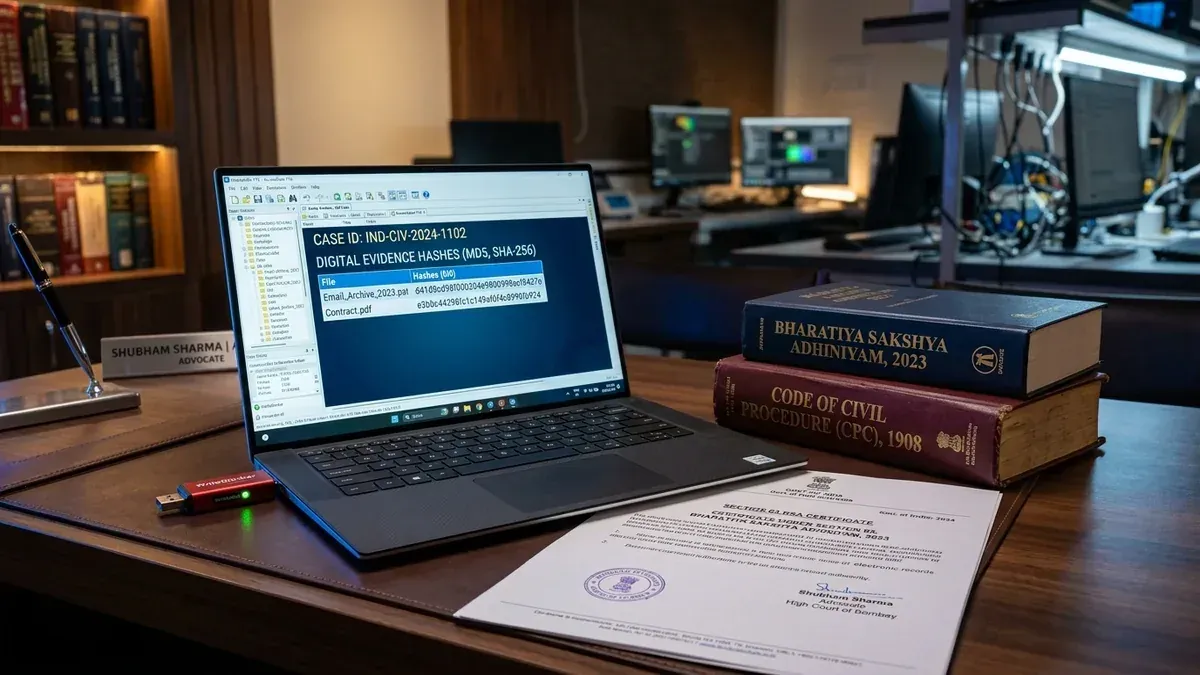
- Inspection and Forensic Imaging: Under the supervision of the Commissioner, technical experts inspect computer servers, desktop terminals, and storage media. Hard drives containing pirated software, confidential designs, or trade secrets are forensically imaged using certified write-blockers (generating SHA-256 hash values) to preserve digital chain of custody without altering original metadata.
- Physical Seizure and Superdari: Counterfeit goods, packaging materials, dies, and fake labels are inventoried in detail. Instead of physically carting away truckloads of goods to court vaults, the Commissioner typically places the seized inventory in the defendant's premises inside sealed bags or rooms, entrusting them to the defendant on superdari with an explicit written undertaking not to sell, move, or tamper with the seals.
- Police Assistance under Court Order: If the court order explicitly authorizes police assistance, the Local Commissioner can request the local Station House Officer (SHO) to deploy police personnel (including female officers if residential premises or female staff are present) to maintain law and order and prevent violent obstruction.
5. Constitutional Safeguards Against Abuse and Strategic Defense Playbook
Because an ex parte search intrudes upon commercial privacy and dignity protected under Article 21 of the Constitution of India, the Supreme Court in Bucyrus Europe Ltd. v. Vulcan Industries and Chappell v. United Kingdom emphasized that strict safeguards must govern Anton Piller orders.
5.1 The Local Commissioner's Impartial Report
Under Order XXVI Rule 10(2) CPC, the report of the Local Commissioner and the evidence taken by them form part of the record of the suit and constitute substantive evidence. The Commissioner must file their comprehensive report within 48 to 72 hours of execution, accompanied by:
- A detailed, itemized inventory signed by the Commissioner, the plaintiff's representative, and the defendant or their manager.
- Time-stamped, unedited photographs and complete video recordings documenting the entire commission from entry to departure.
- The original superdari undertaking and custody receipts.
5.2 Strategic Defense Blueprint: How to Vacate an Anton Piller Order
An advocate representing a defendant subjected to a civil search must act with urgency to mitigate damage:
- Cooperate on Site, Protest on Paper: Never assault or physically bar the Local Commissioner, as doing so leads to immediate police detention and contempt of court. Instead, cooperate politely, ensure your advocate is present, insist that every seized item is accurately described in the inventory, and record any procedural violations or uncivil behavior directly on the Commissioner's spot-proceedings sheet.
- File an Immediate Application under Order XXXIX Rule 4 CPC: Within hours of the search, move an urgent application under Order XXXIX Rule 4 CPC to discharge, vary, or vacate the ex parte order on grounds of material suppression, misrepresentation, or absence of clean hands.
- Expose Concealment of Prior Business Relations: If the plaintiff suppressed past trade negotiations, authorized dealership licenses, or earlier correspondence, present these documents to the court. Courts will instantly recall an Anton Piller order if the applicant failed in their duty of utmost good faith (uberrima fides).
- Enforce the Cross-Undertaking in Damages: If the search revealed no counterfeit goods or if the order was obtained maliciously to access proprietary customer lists, move the court to enforce the plaintiff's undertaking in damages and claim exemplary restitution for reputational harm.
In conclusion, Anton Piller orders represent one of the most potent weapons in Indian civil litigation. When deployed with utmost good faith and executed with meticulous procedural safeguards, they ensure that the shield of judicial process is not shattered by the sword of evidence destruction.
Landmark Judicial Precedents & Statutory Authorities
Courts and appellate tribunals across Delhi NCR (Faridabad, Saket, Tis Hazari, Gurugram, High Courts) strictly apply these authoritative Supreme Court benchmarks:
The Supreme Court reaffirmed the three mandatory golden tests for grant of interlocutory injunctions under Order XXXIX Rules 1 and 2 of the Code of Civil Procedure: (i) strong prima facie case, (ii) balance of convenience tilted in applicant's favor, and (iii) imminent threat of irreparable injury not compensable in monetary damages. The Court held that temporary relief cannot be granted mechanically without judicial application of mind.