
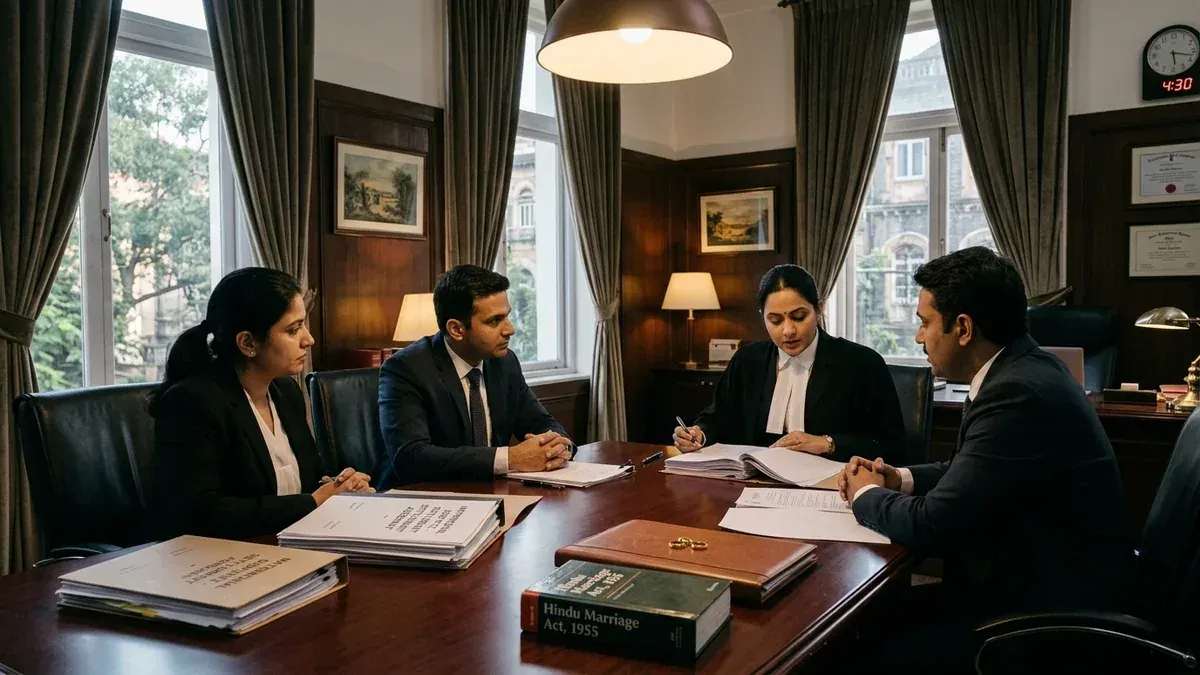
When the historic Five-Judge Constitution Bench of the Supreme Court of India delivered its unanimous verdict in Joseph Shine v. Union of India (2018) 2 SCC 189, striking down Section 497 of the Indian Penal Code, 1860 (IPC) as unconstitutional, widespread confusion erupted across the Indian legal and social landscape. Many citizens, and even some novice practitioners, erroneously assumed that the decriminalization of adultery meant that extramarital sexual relationships had received complete judicial endorsement, extinguishing all legal consequences.
This assumption is fundamentally flawed. In Joseph Shine, Chief Justice Dipak Misra and Justice D.Y. Chandrachud unequivocally clarified that while the coercive arm of the criminal state has no business policing the private bedrooms of consenting adults, adultery remains an egregious marital wrong. Adultery retains its full, devastating force as a premier civil ground for divorce under Section 13(1)(i) of the Hindu Marriage Act, 1955 (HMA) and Section 27(1)(a) of the Special Marriage Act, 1954. Furthermore, living in adultery operates as an absolute statutory bar against claiming maintenance under Section 144(4) of the Bharatiya Nagarik Suraksha Sanhita, 2023 (BNSS) (old Section 125(4) CrPC).
However, litigating adultery in modern Family Courts presents formidable evidentiary challenges. Because acts of infidelity are conducted in private secrecy, direct eye-witness testimony is virtually impossible to obtain. Litigants must rely heavily on circumstantial evidence, private detective reports, hotel room guest registers, Call Detail Records (CDRs), cell tower triangulations, GPS location tracking, and covert digital audio-video recordings.
This introduces a fierce constitutional tension between the petitioner's statutory right to prove marital wrongdoing and the respondent spouse's fundamental right to privacy affirmed in K.S. Puttaswamy v. Union of India (2017) 10 SCC 1. Does covert spousal surveillance violate privacy? Can Family Courts admit illegally obtained electronic recordings under Section 14 of the Family Courts Act, 1984? How does the Bharatiya Sakshya Adhiniyam, 2023 (BSA) regulate digital evidence? This treatise provides an exhaustive guide to proving and defending adultery in post-497 Family Court trials.
While the Supreme Court's Joseph Shine judgment decriminalized adultery under Section 497 IPC, adultery remains a valid statutory ground for divorce under Section 13(1)(i) HMA and maintenance forfeiture under Section 144(4) BNSS. Courts decide adultery on the preponderance of probabilities through circumstantial evidence, hotel bills, and certified electronic records.
1. The Legal Landscape Post-*Joseph Shine*: Decriminalization vs Civil Fault
The historic judgment in Joseph Shine v. Union of India (2018) 2 SCC 189 dismantled a 158-year-old Victorian-era penal statute that treated married women as the personal chattel or property of their husbands. In striking down Section 497 IPC and Section 198(2) CrPC, the Constitution Bench established a clean demarcation between the criminal sphere and the civil matrimonial sphere:
Justice D.Y. Chandrachud in Joseph Shine v. Union of India:
"The decriminalization of adultery does not mean that it is legally countenanced. Adultery continues to be a civil wrong and a valid ground for the dissolution of marriage. While the criminal law cannot step in to punish adultery with imprisonment, the civil law provides remedies in the form of divorce and denial of maintenance."
Under personal law statutes, adultery remains an active, premier fault-based ground for marital dissolution:
Section 13(1)(i), Hindu Marriage Act, 1955 (Amended by Act 68 of 1976):
"Any marriage solemnized, whether before or after the commencement of this Act, may, on a petition presented by either the husband or the wife, be dissolved by a decree of divorce on the ground that the other party has, after the solemnization of the marriage, had voluntary sexual intercourse with any person other than his or her spouse."
Prior to the 1976 Marriage Laws Amendment, Hindu law required proof that the respondent was "living in adultery" (a continuous course of adulterous conduct). By substituting that phrase with "had voluntary sexual intercourse with any person other than his or her spouse," Parliament established that even a single, isolated act of consensual extramarital sexual intercourse is sufficient to decree a divorce under Section 13(1)(i) HMA.
2. The Civil Burden of Proof: Preponderance of Probabilities vs Beyond Reasonable Doubt
In earlier twentieth-century decisions influenced by English matrimonial law, Indian courts occasionally observed that an allegation of adultery is quasi-criminal in nature, requiring proof beyond reasonable doubt. However, modern jurisprudence has firmly discarded that hyper-technical standard:
- Preponderance of Probabilities Governs: In Sachindranath Chatterjee v. Nilima Chatterjee (AIR 1970 Cal 38) and reaffirmed by the Supreme Court in Dastane v. Dastane (1975) 2 SCC 326, courts held that matrimonial causes are civil proceedings. The standard of proof is the preponderance of probabilities, not the criminal threshold of beyond reasonable doubt.
- The Impossibility of Direct Evidence: In Sanjeev Kumar v. State of Haryana (P&H HC 2023), the High Court observed that adultery is, by its very nature, committed under the cover of secrecy and darkness. Expecting ocular testimony or eyewitnesses to the physical act of penetration is absurd. Courts must draw legitimate judicial inferences from surrounding circumstantial evidence.
- The Classical Two-Fold Test (Association and Opportunity): To prove adultery through circumstantial evidence, the petitioner must establish two concurrent elements:
- Guilty Inclination / Passion: Affectionate correspondence, explicit digital chats, romantic photographs, or mutual public displays of intimacy demonstrating romantic passion between the respondent and the co-respondent.
- Opportunity for Cohabitation: Demonstrating that the parties spent hours alone behind locked doors in hotel rooms, private apartments, or secluded guest houses under circumstances where sexual intercourse would naturally be presumed by any reasonable person.
3. Electronic Evidence, Private Detectives, and the Privacy Conflict
In contemporary matrimonial litigation, electronic communications and mobile device forensics form the core evidentiary battleground. Petitioners routinely engage private investigation agencies (PIs) and deploy hidden surveillance cameras, GPS trackers, voice-activated audio recorders, and spyware to capture evidence of infidelity.
This introduces an acute clash between the right to privacy under Article 21 and the statutory admissibility of evidence under Section 14 of the Family Courts Act, 1984:
Section 14, Family Courts Act, 1984:
"A Family Court may receive as evidence any report, statement, document, information or matter that may, in its opinion, assist it to deal effectually with a dispute, whether or not the same would be otherwise relevant or admissible under the Indian Evidence Act, 1872."
Family Courts possess expansive discretionary powers under Section 14 to receive evidence that might otherwise be technically inadmissible under general evidence law. However, High Courts have taken contrasting approaches regarding secretly recorded spousal communications:
| Category of Evidence | Evidentiary Weight & Admissibility Rules | Leading Judicial Precedent |
|---|---|---|
| 1. Hotel Records & CCTV Footage | Highest probative value. Family Courts have full power to summon hotel guest registers, check-in IDs, and CCTV logs under Order 16 CPC. | Preeti Gupta v. State (Delhi HC): Subpoenaing hotel records does not violate privacy where adultery is pleaded with specific dates. |
| 2. Call Detail Records (CDRs) | Admissible via court subpoena to telecom operators. Shows frequent, unusual late-night calls and tower co-location. | Sanjeev Kumar v. State (P&H HC 2023): Summoning CDRs permissible upon prima facie showing to facilitate matrimonial adjudication. |
| 3. Secret Spousal Audio Recordings | Divided jurisprudence. Admissible under Section 14 Family Courts Act, but subject to intense scrutiny regarding privacy and tampering. | Deepti Kapur v. Ranit Ray (Delhi HC 2020): Admissible in Family Court despite privacy breach, but weight is evaluated at trial. |
| 4. Private Detective Reports | Inadmissible as standalone proof unless the private detective steps into the witness box for cross-examination. | Uncorroborated investigator reports are treated as self-serving hearsay without sworn deposition. |
Under the Bharatiya Sakshya Adhiniyam, 2023 (BSA), any digital evidence—including WhatsApp chats, photographic prints, audio clips, and email trails—must be accompanied by a mandatory certificate under Section 63 BSA (Old Section 65B IEA) signed by the person in lawful management of the recording device.
4. Adultery as an Absolute Bar to Maintenance under Section 144(4) BNSS
Beyond divorce, the proof of adultery produces severe financial consequences under maintenance statutes. Under Section 144(4) of the Bharatiya Nagarik Suraksha Sanhita, 2023 (BNSS) (old Section 125(4) CrPC):
Section 144(4), Bharatiya Nagarik Suraksha Sanhita, 2023:
"No wife shall be entitled to receive an allowance for the maintenance or interim maintenance and expenses of proceeding from her husband under this section if she is living in adultery, or if, without any sufficient reason, she refuses to live with her husband, or if they are living separately by mutual consent."
Furthermore, Section 144(5) BNSS empowers the Magistrate to cancel an existing maintenance order if it is proved that the wife is living in adultery. However, there is a profound statutory distinction between Section 13(1)(i) HMA (divorce) and Section 144(4) BNSS (maintenance forfeiture):
- Divorce Requires an Isolated Act: Under Section 13(1)(i) HMA, proof of a single, isolated act of voluntary extramarital intercourse is sufficient to decree a divorce.
- Maintenance Forfeiture Requires "Living in Adultery": Section 144(4) BNSS uses the deliberate continuous phrase "living in adultery". In Ashok v. Anusuyabai and Pandurang Baburao Dabhade v. Baburao Dabhade (Bombay HC), courts held that "living in adultery" denotes a continuous, habitual course of adulterous conduct or ongoing cohabitation with a paramour. A single lapse of virtue or isolated indiscretion does NOT disqualify a wife from receiving maintenance under Section 144 BNSS.
- Impact on Child Maintenance: Adultery by the mother never disqualifies dependent children from receiving full maintenance and educational expenses from the father under Section 144 BNSS.
5. Trial Strategy: Impleading the Co-Respondent and Rebuttal Techniques
Litigating an adultery trial requires meticulous compliance with state-specific High Court Family Court Rules:
Operational Checklist: Adultery Trial Practice
- Mandatory Impleadment of the Co-Respondent (Paramour): Under the Hindu Marriage Rules framed by most High Courts (e.g., Delhi, Punjab & Haryana, Bombay), the alleged adulterer/paramour MUST be impleaded as a necessary co-respondent by name in the divorce petition. Failure to implead the co-respondent or seek express court exemption under Rule 10/11 renders the petition defective and liable to rejection.
- Plead Specific Dates, Times, and Locations: Avoid vague, sweeping allegations. The petition must specify exact hotel dates, travel flight numbers, apartment locations, and timelines to establish credible opportunity.
- File Interlocutory Applications for Court Subpoenas under Order XVI CPC: Do NOT attempt to bribe hotel staff or illegally hack telecom servers. File formal applications before the Family Judge under Order XVI Rules 1 and 6 CPC, requesting the court to issue witness summons to:
- The General Manager of the hotel to produce guest registration cards, bills, and CCTV recordings.
- The Nodal Officers of telecom service providers to produce certified CDRs and tower locations under Section 63 BSA.
- Defending False Adultery Allegations: If you are falsely accused of adultery:
- File an application to strike out scandalous pleadings under Order VI Rule 16 CPC if the allegations are unparticularized slurs.
- Cross-examine the petitioner on the chain of custody of any digital recordings to expose doctoring, AI deepfakes, or missing Section 63 BSA certificates.
- Subpoena third-party business witnesses to prove that meetings were bona fide corporate conferences or innocent professional interactions.
- Counter-sue for mental cruelty under Section 13(1)(ia) HMA: Levelling reckless, unsubstantiated allegations of unchastity against a spouse constitutes the highest degree of mental cruelty under the Supreme Court's Vijaykumar Ramchandra Bhate precedent.
By combining rigorous evidentiary documentation with constitutional privacy protections, family law practitioners can successfully navigate the delicate trial complexities of adultery litigation in post-497 Family Courts.
Landmark Judicial Precedents & Statutory Authorities
Courts and appellate tribunals across Delhi NCR (Faridabad, Saket, Tis Hazari, Gurugram, High Courts) strictly apply these authoritative Supreme Court benchmarks:
The Supreme Court formulated authoritative parameters governing mental cruelty under Section 13(1)(ia) of the Hindu Marriage Act, holding that sustained reprehensible conduct, prolonged separation, baseless character assassination, and total destruction of the matrimonial bond constitute actionable cruelty. The Bench held that where a marriage is irretrievably broken down, forcing estranged spouses to remain legally bound constitutes protracted mental cruelty.