
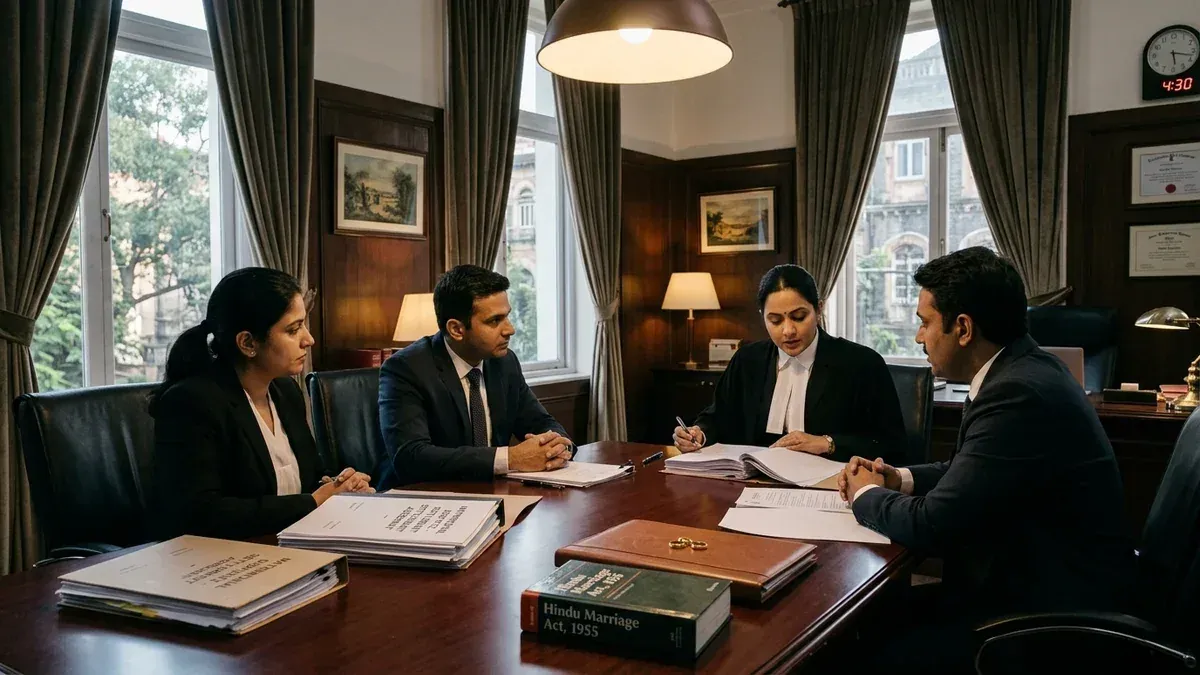
In an era of globalized corporate employment, international migration, and inter-city mobility, marital breakdown among Non-Resident Indians (NRIs) and relocated professionals inevitably triggers complex child custody battles. When one parent returns to India with minor children while the other remains employed in the United States, United Kingdom, Canada, Australia, or the Gulf, or when parents relocate to different Indian metropolitan hubs post-separation, traditional physical visitation schedules (such as weekend visits at court mediation centers) become physically and financially impossible.
In these cross-border and cross-country disputes, the non-custodial parent faces an acute, heartbreaking crisis: the complete severing of emotional bonding with their child. Custodial parents frequently exploit geographical distance to weaponize Parental Alienation Syndrome (PAS)—deliberately poisoning the child's mind, intercepting letters, blocking phone numbers, and denying all access until the child forgets the non-custodial parent or begins viewing them as a stranger.
To combat this tragic dynamic, the Supreme Court of India fundamentally modernized custody jurisprudence by formulating the doctrine of Virtual Visitation Rights. In landmark pronouncements led by Yashita Sahu v. State of Rajasthan (2020) 3 SCC 738 and Ritika Sharan v. Sujoy Ghosh (2020) SCC OnLine SC 878, the Apex Court ruled that every child possesses an inalienable right to receive the love, affection, and guidance of both parents. Where geographical separation or NRI employment precludes frequent physical contact, Family Courts are legally obligated to structure robust, enforceable virtual contact schedules via high-definition video conferencing (WhatsApp, Zoom, FaceTime, Google Meet).
This comprehensive legal treatise explores the jurisprudential foundations of virtual visitation under the Guardians and Wards Act, 1890 (GWA), the technical and procedural mechanics of court-enforced video call schedules across international time zones, the legal safeguards against custodial coaching and surveillance, and the coercive remedies available—including contempt of court and modification of physical custody—when virtual visitation orders are wilfully obstructed.
Under the Supreme Court's ruling in Yashita Sahu v. State of Rajasthan, a child is entitled to the affection of both parents. Where distance or NRI status precludes physical custody, Family Courts must order regular virtual visitation via video calls. Custodial obstruction constitutes civil contempt and grounds for custody modification.
1. The Jurisprudential Imperative: The *Yashita Sahu* Doctrine
The definitive milestone in Indian child access jurisprudence is the landmark verdict of the Supreme Court in Yashita Sahu v. State of Rajasthan (2020) 3 SCC 738. Authored by Justice Deepak Gupta, the Supreme Court established that a child of separated parents must not suffer the loss of either parent's companionship:
The Supreme Court's Foundational Principles in Yashita Sahu:
"1. Welfare of the Child is Paramount: In custody disputes, the primary consideration is not the statutory rights of the warring parents, but the best interests and welfare of the child under Section 13 of the Hindu Minority and Guardianship Act, 1956 and Section 7 of the Guardians and Wards Act, 1890.
2. Right to Love and Affection of Both Parents: A child has an organic right to the love, affection, care, and guidance of both parents. Even if the parents are estranged, the child cannot be deprived of one parent.
3. Mandatory Virtual Contact: Where one parent is living abroad or in a distant city, and physical visitation is infrequent, the court must grant contact through electronic media—including video calling, Skype, FaceTime, WhatsApp video, or other digital platforms. Virtual visitation must be granted as a matter of rule, not exception."
This mandate was powerfully reinforced by the Supreme Court in Ritika Sharan v. Sujoy Ghosh (2020 SCC OnLine SC 878), where the court held: "Technology enables courts to bridge geographical distances. In custody matters involving parents residing in different countries, virtual visitation through video calls must be structured so that the child maintains continuous, weekly, uninterrupted interaction with the non-custodial parent."
Furthermore, in Perry Kansagra v. Smriti Madan Kansagra (2020) 11 SCC 338 and Prateek Gupta v. Shilpi Gupta (2018) 2 SCC 309, the Supreme Court addressed cross-border parental abductions and relocation conflicts. The court ruled that where a parent relocates a child across international boundaries or state borders, Indian courts exercising parens patriae jurisdiction under Section 7 and Section 12 of the Guardians and Wards Act, 1890 must prioritize the psychological continuity of the child's bond with the left-behind parent above all jurisdictional rivalries. Technology serves as an indispensable constitutional tool to prevent the emotional erasure of a loving parent.
Under international conventions to which India is a signatory, including Articles 9 and 10 of the United Nations Convention on the Rights of the Child (UNCRC), state parties are obligated to respect the right of a child who is separated from one or both parents to maintain personal relations and direct contact with both parents on a regular basis.
2. Technical Architecture: Structuring Enforceable Virtual Schedules
A common pitfall in Family Court litigation is obtaining vague, unworkable orders that merely state: "The father shall be permitted to video call the child at convenient times." Such orders are doomed to failure, inviting immediate conflict over what constitutes "convenient."
To ensure seamless execution, especially when coordinating across multiple international time zones (e.g., IST and US Eastern/Pacific Time or UK GMT), family law practitioners must draft comprehensive, minute-by-minute Virtual Visitation Protocols for incorporation into the court order:
| Operational Component | Standard Court-Enforced Specification | Purpose & Compliance Safeguard |
|---|---|---|
| 1. Fixed Days & Timings | Specified days (e.g., every Tuesday, Thursday, and Saturday) at exact local Indian Standard Time (e.g., 7:30 PM to 8:30 PM IST). | Prevents disputes over child's school, homework, meal, or sleep schedules. |
| 2. Minimum Duration | Typically 30 to 60 minutes per session, scaled appropriately to the child's age and attention span. | Prevents token 2-minute calls disconnected under pretext of child distraction. |
| 3. Designated Digital Platform | WhatsApp Video, Zoom, Google Meet, or Apple FaceTime on a dedicated tablet or laptop screen. | Provides stable, high-definition audio-visual fidelity and screen-sharing for joint reading. |
| 4. Make-Up Call Rule | If a call is missed due to illness, school exams, or connectivity failure, a mandatory compensatory call within 24 hours. | Eliminates manufactured technical excuses and preserves continuity of bonding. |
| 5. Special Occasion Access | Unrestricted 45-minute video call on child's birthday, parent's birthday, Diwali, Christmas, and New Year. | Celebrates key developmental milestones and nurtures cultural connection. |
3. Combating Parental Alienation and In-Call Coaching
The most insidious threat to successful virtual visitation is custodial sabotage. Custodial parents frequently sit directly behind the camera screen, glaring at the child, signaling answers, making disparaging facial expressions, or whispering coaching cues. In extreme cases, custodial parents deliberately keep background televisions blaring, abruptly disconnect the WiFi router, or repeatedly tell the child: "Tell your father you don't want to talk to him."
In Vivek Singh v. Romani Singh (2017) 3 SCC 231, the Supreme Court took formal judicial notice of Parental Alienation Syndrome (PAS), observing that alienating a child from the other parent is a grave form of psychological abuse that inflicts permanent trauma on the child's development.
To combat custodial sabotage, High Courts uniformly incorporate Strict Privacy and Non-Interference Directives into virtual access orders:
- The Unmonitored Privacy Rule: The child must be placed in a quiet, well-lit private room (such as a study or bedroom). The custodial parent, grandparents, and third parties are strictly prohibited from remaining in the room or being within earshot during the video call.
- Prohibition on Coaching and Prompting: The custodial parent is expressly enjoined from coaching, instructing, or influencing the child regarding what to say or how to respond to the non-custodial parent.
- Direct Hardware Delivery: In cases involving high conflict, courts permit the NRI parent to purchase and courier a dedicated iPad, tablet, or smartphone directly for the child's exclusive personal use, with the custodial parent held personally responsible for keeping the device charged and connected to high-speed internet.
- Appointment of a Local Commissioner or Child Counselor: Where obstruction is persistent, the Family Court can appoint an independent advocate or professional child psychologist as a Court Commissioner under Section 12 of the Family Courts Act, 1984 to oversee video calling sessions remotely, facilitate initial conversational icebreakers, and submit confidential compliance reports directly to the judge.
Where early virtual sessions are fraught with emotional coldness or severe hesitation caused by prolonged parental alienation, courts frequently order supervised virtual sessions. Under this mechanism, the Family Court directs a trained child psychologist from the court's mediation center to join the video call for the first 10 minutes to ease psychological anxiety and reassure the child, ensuring that the natural parent-child connection is revived in a supportive, trauma-free environment.
4. The Hybrid Model: Combining Virtual Calls with Physical Vacation Custody
While virtual visitation is an indispensable bridge across geographical distances, the Supreme Court has repeatedly affirmed that video calling cannot completely replace physical tactile contact. In Gaurav Nagpal v. Sumedha Nagpal (2009) 1 SCC 42 and Vikram Vir Vohra v. Shalini Bhalla (2010) 4 SCC 409, the court formulated the Hybrid Custody and Visitation Model:
- Daily/Weekly Digital Tether: Regular virtual visitation maintains continuous day-to-day emotional intimacy, enabling the parent to assist with homework, discuss school friendships, read bedtime stories, and share daily triumphs.
- Physical Vacation Custody: When the NRI parent travels to India during annual leave, the court awards substantial physical overnight custody (ranging from one to four weeks) during summer, winter, or Puja vacations, permitting the child to stay with the parent in their ancestral home or family resort.
- Overseas Travel Permission: Where the non-custodial parent has established reliable compliance and posted adequate financial security, courts increasingly permit the child to travel abroad to the parent's country of residence during school vacations, ensuring exposure to international environments.
The hybrid model also encompasses institutional academic and healthcare participation. In modern custody practice, Family Courts regularly direct school principals and educational institutions to create dual parent login credentials on school management ERP portals, enabling the overseas parent to track daily attendance, examination grades, teacher feedback, and extracurricular activities. In addition, courts mandate that the non-custodial parent be provided video conferencing links to participate in official Parent-Teacher Meetings (PTMs) and medical specialist consultations, guaranteeing active co-parenting regardless of physical distance.
5. Enforcement Protocol: Contempt of Court and Custody Transfer for Obstruction
When a custodial parent deliberately frustrates or disobeys a court-ordered virtual visitation schedule, the aggrieved parent must deploy an aggressive, systematic legal enforcement protocol:
Operational Checklist: Enforcing Virtual Visitation Orders
- Maintain an Unassailable Digital Call Log: Maintain a meticulously organized call log sheet. For every scheduled session, document the exact call placement time, call duration, screenshots of unanswered outgoing video calls, WhatsApp rejection messages, and telecom network confirmation.
- Preserve Screen Recordings of Disrupted Sessions: With court permission, screen-record video sessions where the custodial parent intrudes, coaches the child, or uses abusive language. Secure a Section 63 BSA certificate to establish the unimpeachable authenticity of the electronic video files.
- File a Contempt Application under Section 10/12 Contempt of Courts Act: If the custodial parent wilfully misses multiple consecutive sessions without medical emergency proof, immediately move the High Court for Civil Contempt under Section 12 of the Contempt of Courts Act, 1971 read with Article 215 of the Constitution. Courts take a stern view of parents who weaponize children to defy judicial decrees.
- Apply for Stoppage of Maintenance for Wilful Obstruction: In appropriate cases, file an application before the Family Court seeking suspension or stoppage of the spouse's personal maintenance allowance (while continuing child support) until the contemnor parent resumes full compliance with visitation directives.
- Petition for Modification of Custody under Section 25 GWA: Under settled Supreme Court jurisprudence in Ruchi Majoo v. Sanjeev Majoo (2011) 6 SCC 779, a custodial parent who persistently alienates a child from the other parent demonstrates their unfitness to retain custody. The non-custodial parent can petition for complete transfer of physical custody on the ground that the child's welfare is compromised by the alienating parent.
By combining disciplined technological logging with aggressive contempt enforcement, relocated and NRI parents can protect their sacred parental bond and secure their child's holistic emotional upbringing.
Landmark Judicial Precedents & Statutory Authorities
Courts and appellate tribunals across Delhi NCR (Faridabad, Saket, Tis Hazari, Gurugram, High Courts) strictly apply these authoritative Supreme Court benchmarks:
The Supreme Court reaffirmed the three mandatory golden tests for grant of interlocutory injunctions under Order XXXIX Rules 1 and 2 of the Code of Civil Procedure: (i) strong prima facie case, (ii) balance of convenience tilted in applicant's favor, and (iii) imminent threat of irreparable injury not compensable in monetary damages. The Court held that temporary relief cannot be granted mechanically without judicial application of mind.