
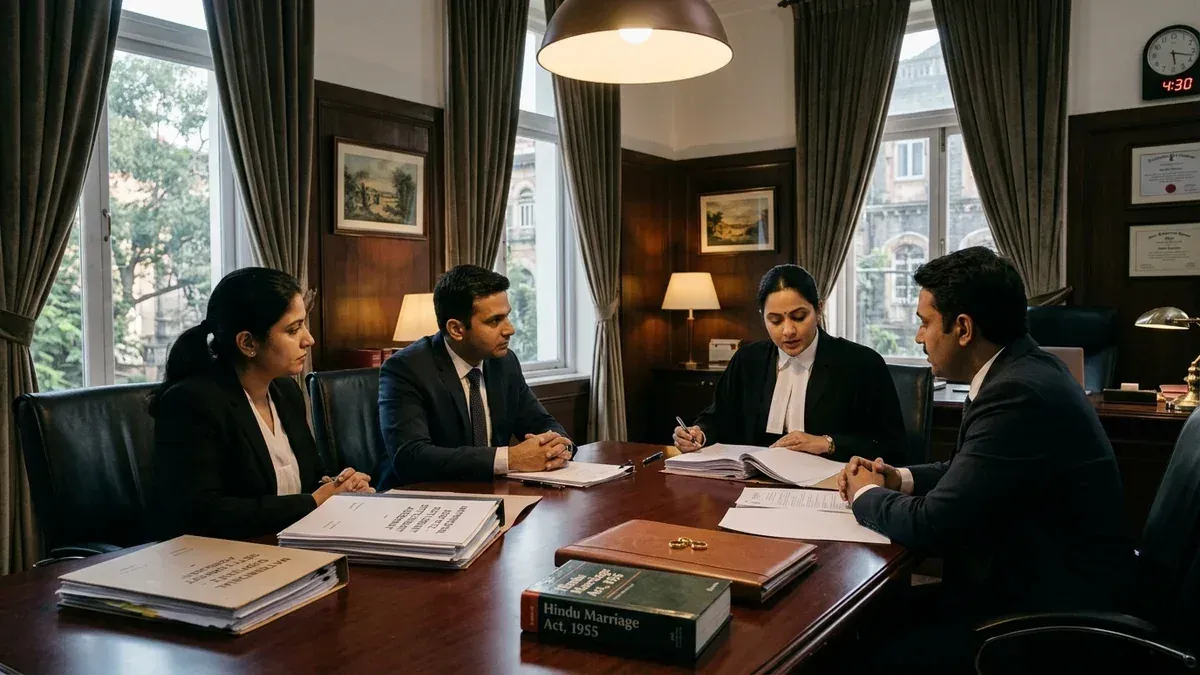
In high-conflict matrimonial litigation, one of the most agonizing, high-stakes forensic maneuvers is an application filed by a husband demanding a Child DNA Paternity Test. In divorce petitions alleging adultery under Section 13(1)(i) HMA or in response to maintenance applications filed on behalf of minor children under Section 144 BNSS (old Section 125 CrPC), husbands frequently disown paternity. To prove their spouse's infidelity and escape lifelong child support liabilities, husbands petition the Family Court to compel the mother and minor child to submit blood and buccal swab samples for forensic deoxyribonucleic acid (DNA) genetic profiling.
While modern DNA technology offers scientific certainty exceeding 99.99% in determining biological parentage, Indian law does NOT treat a child's paternity as a simple scientific inquiry. Under Indian jurisprudence, a child born during the subsistence of a valid marriage enjoys the most formidable legal shield known to law: the conclusive presumption of legitimacy, formerly codified under Section 112 of the Indian Evidence Act, 1872, now recodified as Section 114 of the Bharatiya Sakshya Adhiniyam, 2023 (BSA).
The law consciously prioritizes the innocent child's social status, emotional security, and constitutional right to privacy and human dignity over a husband's suspicious curiosity. Ordering a DNA test carries the catastrophic potential of bastardizing an innocent child, subjecting them to lifelong social stigma, emotional trauma, and dispossession of inheritance rights. Consequently, the Supreme Court of India in landmark verdicts from Goutham Kundu (1993) to the definitive ruling in Aparna Ajinkya Firodia v. Ajinkya Arun Firodia (2023) SCC OnLine SC 161 established that courts cannot order DNA paternity tests casually, mechanically, or on roving inquiries.
This comprehensive legal treatise examines the statutory operation of Section 114 BSA, the stringent threshold test of demonstrating "non-access," the tension between scientific truth and legal fiction explored in Nandlal Wasudeo Badwaik, the doctrine of the child's best interests under Aparna Firodia, and the procedural mechanics of drafting and resisting DNA test applications in Indian Family Courts.
Section 114 of Bharatiya Sakshya Adhiniyam creates a conclusive presumption of legitimacy for children born during valid marriage. Under the Supreme Court's Aparna Firodia ruling, Family Courts cannot order DNA paternity tests casually. A test is granted only upon prima facie proof of non-access, prioritizing the child's welfare over spousal disputes.
1. The Conclusive Presumption of Legitimacy under Section 114 BSA
The statutory foundation governing child legitimacy in Indian law is codified under Section 114 of the Bharatiya Sakshya Adhiniyam, 2023 (which replaced Section 112 of the Indian Evidence Act, 1872 without substantive alteration):
Section 114, Bharatiya Sakshya Adhiniyam, 2023 (Old Section 112 Indian Evidence Act):
"The fact that any person was born during the continuance of a valid marriage between his mother and any man, or within two hundred and eighty days after its dissolution, the mother remaining unmarried, shall be conclusive proof that he is the legitimate child of that man, unless it can be shown that the parties to the marriage had no access to each other at any time when he could have been begotten."
The statutory anatomy of Section 114 BSA reveals the extraordinary strength of this legal protection:
- The Meaning of 'Conclusive Proof': Under Section 2(1)(d) BSA (old Section 4 IEA), when one fact is declared to be "conclusive proof" of another, the court shall NOT allow evidence to be given for the purpose of disproving it. The law deliberately closes the evidentiary door to protect marital legitimacy.
- The Sole Statutory Exception ('Non-Access'): Parliament created only one single, narrow statutory escape hatch to displace the presumption: proof that the husband and wife had no access to each other at any time during the plausible window of conception (the 280-day biological gestation period).
- The Legal Definition of 'Non-Access': In Chilukuri Venkateswarlu v. Chilukuri Venkatanarayana (1954) SCR 424, the Supreme Court settled that "access" or "non-access" does not mean whether actual sexual intercourse took place; it means opportunity for intercourse. If the husband and wife were residing in the same house, town, or had physical opportunity to cohabit during the conception window, "access" exists as a matter of law. To prove non-access, the husband must establish complete physical impossibility—such as being stationed overseas in military service, confined in prison, or total physical geographical separation across continents during the entire conception window.
2. The *Goutham Kundu* and *Aparna Firodia* Benchmarks: Bar on Roving Inquiries
For three decades, the foundational standard governing DNA testing was the landmark decision of the Supreme Court in Goutham Kundu v. State of West Bengal (1993) 3 SCC 418, which held that courts cannot order a DNA test as a matter of course.
This doctrine was substantially expanded, modernized, and cemented by the Supreme Court of India in Aparna Ajinkya Firodia v. Ajinkya Arun Firodia (2023 SCC OnLine SC 161). Authored by Justice V. Ramasubramanian and Justice B.V. Nagarathna, the Apex Court established comprehensive national guidelines governing DNA paternity applications:
| Principle | Aparna Firodia Binding Standard | Impact on Family Court Litigation |
|---|---|---|
| 1. No Fishing / Roving Inquiries | A DNA test cannot be directed to enable a husband to fish for evidence of adultery or settle suspicions. | Husband cannot demand a DNA test unless he has already produced independent prima facie proof of non-access. |
| 2. Child's Welfare is Paramount | The innocent child's emotional security, bodily integrity, and social legitimacy override spousal disputes. | Courts must consider whether ordering a test will cause irreparable psychological damage to the child. |
| 3. Balancing Article 21 Privacy | A child possesses an autonomous fundamental right to privacy under Puttaswamy; bodily samples cannot be seized casually. | Compelling a child to provide DNA requires satisfying the strict proportionality test. |
| 4. Non-Access as Condition Precedent | Section 114 BSA presumption can only be displaced by proving non-access. DNA is not an alternative to non-access. | If access during conception is admitted or established, the court has NO jurisdiction to order a DNA test. |
The Supreme Court held: "A DNA test cannot be directed as a matter of course. It can be directed only in exceptional cases where there is strong prima facie material to doubt paternity and the husband establishes non-access. Genetic information is deeply personal, and a child should not be subjected to a paternity test merely because of marital discord between the parents."
3. Scientific Truth vs Legal Fiction: The *Nandlal Badwaik* Tension
A profound jurisprudential question arises: what happens when a scientific DNA test has already been conducted and conclusively demonstrates that the husband is NOT the biological father, yet the parties had access to each other?
This direct collision between 19th-century legal presumption and 21st-century biological reality was adjudicated in Nandlal Wasudeo Badwaik v. Lata Nandlal Badwaik (2014) 2 SCC 576:
The Supreme Court's Holding in Nandlal Wasudeo Badwaik:
"We may remember that Section 112 of the Evidence Act was enacted at a time when the modern scientific advancements and DNA tests were not even in contemplation of the Legislature. The result of a genuine DNA test is scientifically accurate. When there is a conflict between a mere legal fiction and an unshakeable scientific reality, the scientific reality must prevail over the fiction of law."
In Nandlal Badwaik, the trial court had ordered DNA tests, and Central Forensic Science Laboratory (CFSL) reports established exclusion of paternity. The Supreme Court held that the husband could not be compelled to pay maintenance for a child who was scientifically proven not to be his offspring.
However, the Supreme Court in Aparna Firodia (2023) strictly reconciled Nandlal Badwaik with Goutham Kundu:
- *Nandlal Badwaik* Applies ONLY After a Lawful Test: The ruling in Nandlal Badwaik applies to the evidentiary weight of a DNA test that has already been validly admitted onto the record. It does NOT grant a husband an unrestricted right to demand a DNA test in the first instance.
- The Gateway Barrier Remains Non-Access: At the threshold stage of deciding whether a DNA test should be ordered, the court must still apply Section 114 BSA and Aparna Firodia. If the husband fails to demonstrate non-access, the DNA test can never be ordered.
4. Refusal to Undergo DNA Testing and Adverse Inference
Can a Family Court physically force a mother or child to undergo a DNA test if they refuse to give blood or buccal swab samples?
In Sharda v. Dharmpal (2003) 4 SCC 493 and reaffirmed in Aparna Firodia, the Supreme Court established the definitive procedural law:
- No Physical Coercion: A matrimonial court cannot physically compel, handcuff, or forcibly extract biological samples from a woman or child. Physical force violates Article 21 bodily autonomy.
- The Doctrine of Adverse Inference: Under Section 119, Illustration (g) of the Bharatiya Sakshya Adhiniyam, 2023 (old Section 114, Illustration (g) IEA), if a party refuses to submit to a lawful, court-directed medical or DNA test without reasonable cause, the court may draw an adverse inference against that party.
- Limits on Adverse Inference Against Children: Crucially, in Aparna Firodia, the Supreme Court cautioned that drawing an adverse inference is discretionary. Where a mother refuses a DNA test specifically to protect her minor child from being branded illegitimate in society, the Family Court should be extraordinarily slow to draw a mechanical adverse inference, especially where the husband has failed to substantiate non-access with independent evidence.
5. Strategic Litigation Protocol: Drafting and Resisting DNA Applications
Litigants and family law counsel navigating DNA paternity applications must follow a disciplined, step-by-step litigation roadmap:
Operational Checklist: Child DNA Paternity Litigation
- For Husbands Seeking a DNA Paternity Test:
- Do NOT file a DNA test application on mere suspicion or as a routine first step.
- Build unassailable documentary evidence of non-access during the conception window: international passport exit/entry stamps showing overseas employment, prison custody certificates, hospital hospitalization records proving physical impossibility of sexual contact.
- Pleaded specific, verified adultery allegations under Section 13(1)(i) HMA with detailed dates and implead the alleged paramour as a co-respondent.
- Cite Nandlal Wasudeo Badwaik (2014) and Sharda v. Dharmpal (2003) to establish that where non-access is prima facie proved, scientific truth serves the cause of justice.
- For Wives and Guardians Resisting a DNA Test:
- Anchor your reply squarely upon the conclusive presumption of legitimacy under Section 114 BSA.
- Produce conclusive evidence of access: shared residential leases, joint utility bills, vacation photographs, flight bookings, or WhatsApp chats proving the parties cohabited or met during the gestation period.
- Quote heavily from Aparna Ajinkya Firodia v. Ajinkya Arun Firodia (2023): demonstrate that the application is a fishing inquiry designed to harass the mother and bastardize the child.
- Invoke the child's autonomous fundamental right to privacy under Article 21 and the UN Convention on the Rights of the Child, arguing that the court must protect the minor's psychological well-being.
- If the Family Court erroneously orders a DNA test without establishing non-access, immediately file a Civil Revision Petition under Article 227 of the Constitution before the High Court to stay the order.
By anchoring matrimonial advocacy upon established constitutional parameters, litigants can ensure that the solemn institution of the family and the sanctity of childhood remain insulated from frivolous forensic intrusion.
Landmark Judicial Precedents & Statutory Authorities
Courts and appellate tribunals across Delhi NCR (Faridabad, Saket, Tis Hazari, Gurugram, High Courts) strictly apply these authoritative Supreme Court benchmarks:
The Supreme Court reaffirmed the three mandatory golden tests for grant of interlocutory injunctions under Order XXXIX Rules 1 and 2 of the Code of Civil Procedure: (i) strong prima facie case, (ii) balance of convenience tilted in applicant's favor, and (iii) imminent threat of irreparable injury not compensable in monetary damages. The Court held that temporary relief cannot be granted mechanically without judicial application of mind.