
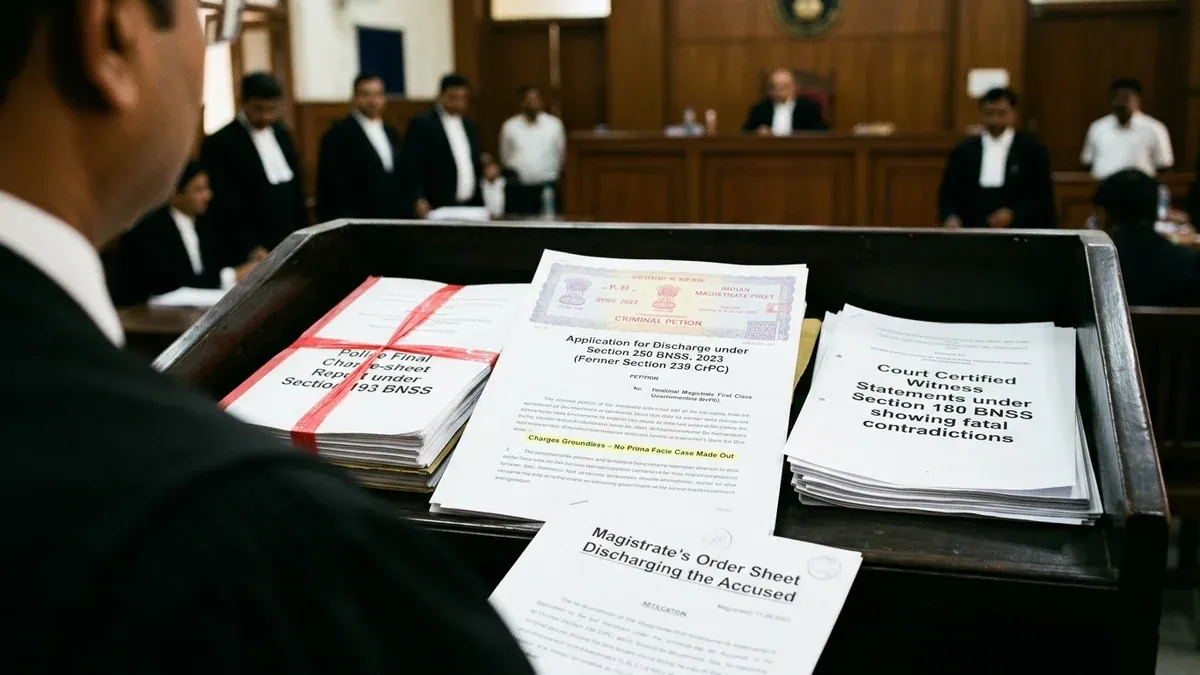
When an investigating agency files a police charge sheet under Section 193 of the Bharatiya Nagarik Suraksha Sanhita, 2023 (BNSS) / Section 173 CrPC, the accused is not automatically condemned to endure years of a grueling criminal trial. The law provides a vital pre-trial judicial filter: the Discharge Application under Section 250 BNSS (for Sessions trials) and Section 262 BNSS (for warrant cases before Magistrates).
The Supreme Court of India in Union of India v. Prafulla Kumar Samal (1979) and reaffirmed in Sanjay Kumar Rai v. State of Uttar Pradesh (2021) has held that a trial judge is not a mere post office to rubber-stamp the prosecution’s charge sheet. If the judicial conscience finds that the evidence does not disclose a "grave suspicion," the court is statutorily bound to discharge the accused immediately.
Under Section 250 BNSS, an accused can petition the Sessions Court for discharge before charges are framed. If the judge considers the allegations groundless and devoid of grave suspicion, the court must record reasons and discharge the accused, sparing them the prolonged ordeal and humiliation of a full trial.
1. Statutory Architecture of Section 250 BNSS
Section 250 BNSS provides:
"If, upon consideration of the record of the case and the documents submitted therewith, and after hearing the submissions of the accused and the prosecution in this behalf, the Judge considers that there is not sufficient ground for proceeding against the accused, he shall discharge the accused and record his reasons for so doing."
Unlike the trial stage where guilt must be proved beyond reasonable doubt, at the stage of framing of charges under Section 251 BNSS / Section 228 CrPC, the test is whether the prosecution material raises a grave suspicion against the accused.
2. Foundational Principles of Discharge: Prafulla Kumar Samal
In Union of India v. Prafulla Kumar Samal (1979 3 SCC 4), the Supreme Court laid down four cardinal rules governing discharge:
- The Judge has the undoubted power to sift and weigh the evidence for the limited purpose of finding out whether or not a prima facie case against the accused has been made out.
- Where the materials placed before the court disclose grave suspicion against the accused which has not been properly explained, the court will be fully justified in framing a charge.
- If two views are equally possible and the Judge is not satisfied that the evidence gives rise to a grave suspicion, he will be fully within his right to discharge the accused.
- The test to determine a prima facie case would naturally depend upon the facts of each case, and it is difficult to lay down a rule of universal application.
3. Tactical Strategy for Drafting a Discharge Application
To succeed in a discharge application under Section 250 BNSS, defense counsel should focus exclusively on undisputed records filed by the prosecution itself:
- Highlight Inherent Contradictions: Discrepancies between statements of eyewitnesses recorded under Section 180 BNSS (161 CrPC) and medical post-mortem or injury reports.
- Rely on Public Documents of Sterling Quality: School leaving certificates proving juvenility, passport stamps proving absence from the country (alibi), or admitted government registers.
- Establish Missing Statutory Ingredients: Demonstrating total absence of entrustment for breach of trust, or absence of deception at inception for cheating.
Landmark Judicial Precedents & Statutory Authorities
Courts and appellate tribunals across Delhi NCR (Faridabad, Saket, Tis Hazari, Gurugram, High Courts) strictly apply these authoritative Supreme Court benchmarks:
The Supreme Court laid down the classic seven illustrative categories where the High Court must exercise inherent powers under Section 482 CrPC (Section 528 BNSS) to quash FIRs and criminal proceedings to prevent abuse of judicial process. The Bench held that where the allegations in the FIR, even if taken at face value, do not disclose the commission of any cognizable offence, or where the prosecution is manifestly attended with mala fide motives, the criminal proceedings are liable to be quashed at the threshold.