
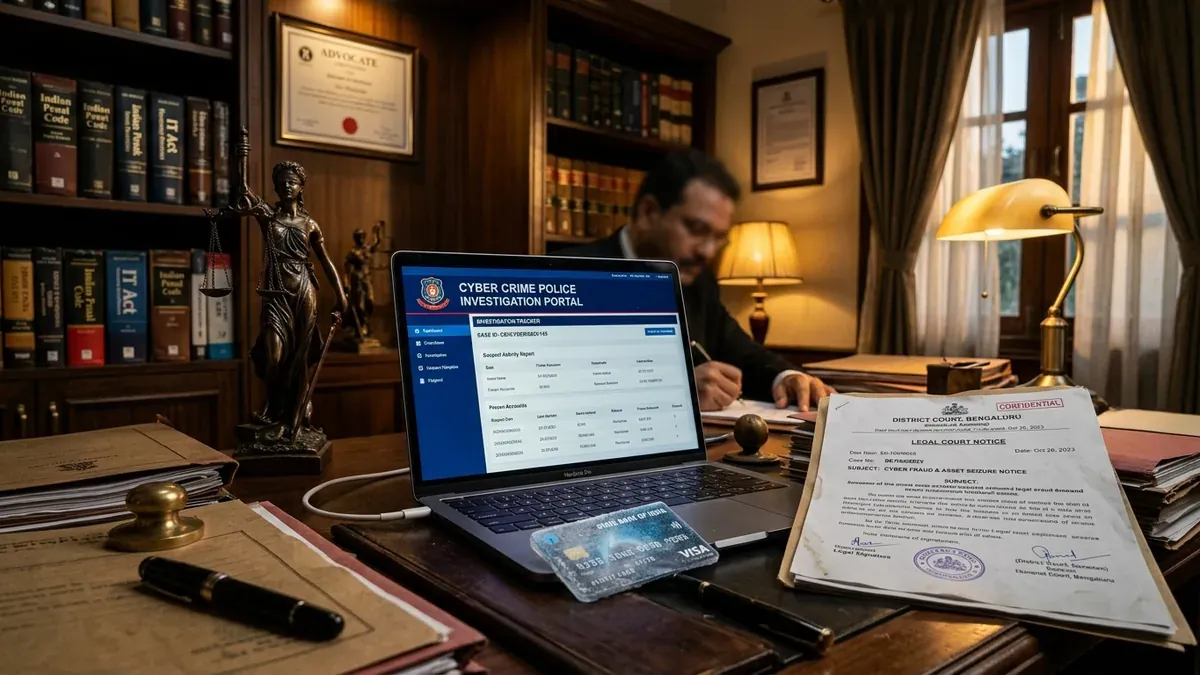
Among the most distressing challenges facing businesses and individuals today is having their bank accounts frozen by police cyber cells located in distant states—such as Telangana, Kerala, Gujarat, or Maharashtra—while the account holder resides and operates in Delhi, Haryana, or Karnataka. Distance, lack of communication from investigating officers, and threats of non-appearance make resolving out-of-state freezes practically impossible through local police visits.
Fortunately, constitutional law and High Court jurisprudence provide robust remedies. Under Article 226 of the Constitution of India and Section 528 of the Bharatiya Nagarik Suraksha Sanhita, 2023 (BNSS) / Section 482 CrPC, litigants can approach their home state High Court where the bank branch is situated, successfully compelling banks and distant cyber cells to unfreeze accounts or restrict liens to the exact disputed amounts.
When a cyber cell in another state freezes a bank account, account holders can invoke High Court writ jurisdiction under Article 226 where the bank branch is situated. High Courts routinely order accounts unfreezed or restrict the debit freeze strictly to the disputed fraudulent amount, liberating remaining legitimate balances.
1. The Multi-Layered Chain of Cyber Account Freezes
Modern cyber frauds operate through intricate multi-layer fund diversion. When an individual in Hyderabad or Kochi reports a loss of ₹10,00,000 on the National Cyber Crime Reporting Portal:
- The money moves from the victim's account to Layer 1 (fraudster's shell account).
- Layer 1 transfers funds to Layer 2 (P2P crypto merchant or digital payment gateway).
- Layer 2 pays an innocent merchant in Delhi (Layer 3 or Layer 4) for genuine retail goods, professional services, or hardware.
- Automated police scripts trace every penny downstream and trigger automated freezing notices to all recipient banks nationwide under Section 106 BNSS / 102 CrPC.
Innocent merchants who never interacted with the victim find their vital operational and payroll accounts completely locked without notice.
2. Territorial Jurisdiction: Approaching Your Home State High Court
Victims of out-of-state account freezes are not required to travel across the country to file petitions in distant state courts. Under Article 226(2) of the Constitution:
"The power conferred on a High Court may also be exercised by any High Court exercising jurisdiction in relation to the territories within which the cause of action, wholly or in part, arises for the exercise of such power, notwithstanding that the seat of such Government or authority or the residence of such person is not within those territories."
The Delhi High Court and Karnataka High Court have authoritatively held that because the petitioner's bank account was opened, maintained, and operated within their territorial jurisdiction, and the financial freeze occurred there, a substantial part of the cause of action arises within the home state.
3. Reliefs Granted by High Courts in Writ Petitions
When moving a writ petition under Article 226 or a petition under Section 528 BNSS against an out-of-state cyber cell, High Courts routinely grant the following specific reliefs:
- Restriction of Lien to Disputed Amount: Ordering the bank to place a lien strictly on the exact disputed sum (e.g. ₹40,000) and immediately unfreeze and make operable the entire remaining balance (e.g. ₹25,00,000).
- Complete Unfreezing on Indemnity: Permitting the petitioner to furnish an indemnity bond or fixed deposit receipt (FDR) equivalent to the disputed amount to unfreeze the entire account.
- Direction for Virtual Questioning: Directing out-of-state cyber cells to conduct any necessary examination through video conferencing (VC) rather than demanding physical presence across states.
Landmark Judicial Precedents & Statutory Authorities
Courts and appellate tribunals across Delhi NCR (Faridabad, Saket, Tis Hazari, Gurugram, High Courts) strictly apply these authoritative Supreme Court benchmarks:
The Supreme Court upheld the constitutional validity of the SARFAESI Act, 2002, while guaranteeing that secured borrowers possess an efficacious statutory remedy under Section 17 before the Debt Recovery Tribunal (DRT). In Satyawati Tondon, the Court held that High Courts should refrain from entertaining Article 226 writ petitions in commercial banking recovery matters when an alternate statutory remedy is available under the RDDBFI or SARFAESI Acts.