
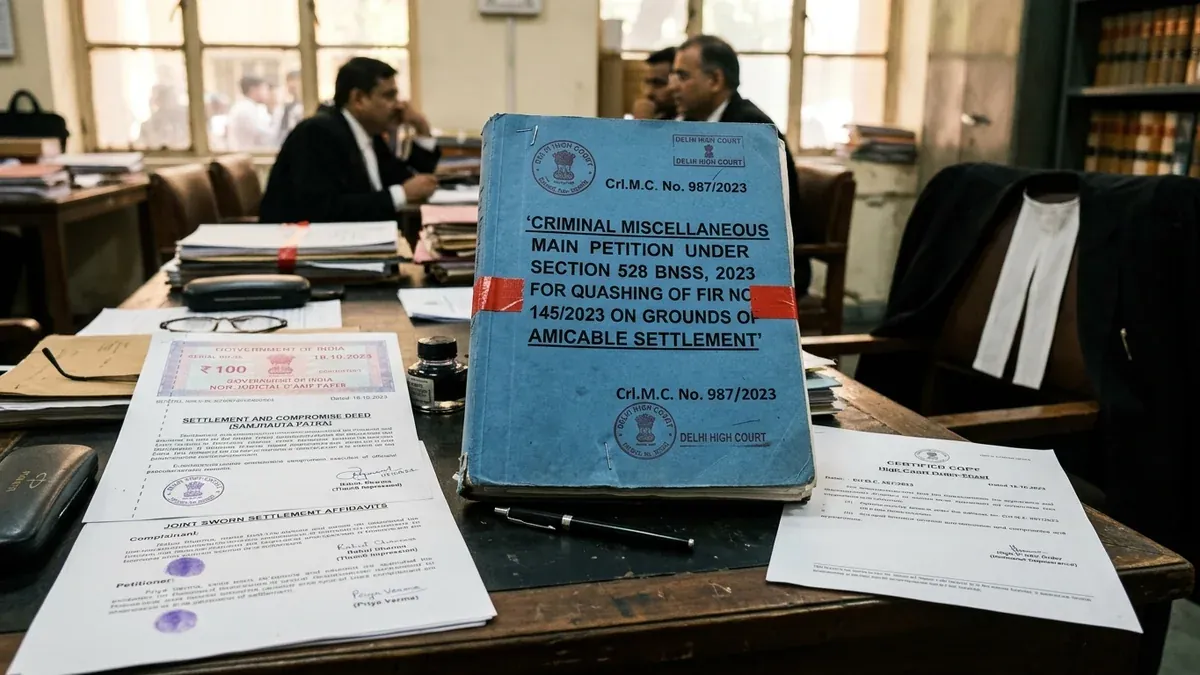
In Indian criminal practice, a substantial portion of First Information Reports (FIRs) originate from personal animosity, business friction, matrimonial discord, or family property disputes. Often, after tempers cool and cooler heads prevail, the complainant and accused reach an amicable, full-and-final settlement. However, when the offences alleged in the FIR are non-compoundable under Section 359 of the Bharatiya Nagarik Suraksha Sanhita, 2023 (BNSS) (formerly Section 320 CrPC), trial courts possess zero power to close the case.
In such scenarios, the sole legal remedy is invoking the inherent jurisdiction of the High Court under Section 528 of the BNSS (replacing Section 482 CrPC). Anchored by landmark Supreme Court judgments in B.S. Joshi (2003), Gian Singh v. State of Punjab (2012), and Narinder Singh v. State of Punjab (2014), High Courts routinely exercise this constitutional power to quash non-compoundable FIRs and terminate criminal trials.
Under Section 528 BNSS, High Courts possess inherent authority to quash criminal proceedings even for non-compoundable offences if parties have arrived at an amicable compromise. The Supreme Court in Gian Singh affirmed that where disputes are predominantly private or commercial in nature, quashing secures justice and prevents judicial abuse.
1. Compounding under Section 359 BNSS vs. Inherent Quashing under Section 528
The Indian criminal code distinguishes between statutory compounding and inherent judicial quashing:
- Statutory Compounding (Section 359 BNSS): Restricted strictly to minor, specified offences (e.g. simple hurt, defamation, trespass). The trial Magistrate can record the compromise directly.
- Inherent Quashing (Section 528 BNSS): For non-compoundable offences (such as cheating under Section 318 BNS, forgery, breach of trust, or matrimonial cruelty under Section 85 BNS), the trial court cannot compound the case. Only the High Court can quash proceedings using its inherent powers.
2. The Supreme Court Benchmarks: Gian Singh and Narinder Singh
In Gian Singh v. State of Punjab (2012 10 SCC 303), a three-judge bench of the Supreme Court held:
The Constitution Bench settled that anticipatory bail under Section 438 CrPC (Section 482 BNSS) should not routinely be limited to a fixed time frame, reaffirming that personal liberty under Article 21 cannot be curtailed on vague apprehensions. In Satender Kumar Antil, the Supreme Court mandated that investigating agencies and magistrates strictly adhere to procedural compliance under Section 41A (Section 35 BNSS), establishing that arrests must be justified by exceptional necessity rather than mechanical executive exercise.
"The power of the High Court in quashing a criminal proceeding or FIR or complaint in exercise of its inherent jurisdiction is distinct and different from the power of a criminal court for compounding the offences under Section 320 (now 359 BNSS)... In cases arising out of commercial, financial, mercantile, partnership or matrimonial disputes where the wrong is basically to the victim and the parties have resolved their entire dispute, the High Court may quash the criminal proceedings."
However, in Narinder Singh v. State of Punjab (2014 6 SCC 466), the Court established strict limitations: offences with severe societal impact—such as murder (Section 103 BNS), rape (Section 64 BNS), POCSO offences, and dacoity—cannot be quashed on compromise, because these are crimes against society as a whole.
3. High Court Procedure for Quashing on Compromise
To quash an FIR based on settlement before the High Court, the parties must follow a structured procedure:
- Execute Written Settlement Deed / MoU: Stating that all disputes are settled without coercion or duress.
- File Joint Petition under Section 528 BNSS: Enclosing the FIR, settlement deed, and affidavit of no-objection from the complainant.
- Personal Appearance & Verification: The High Court orders both parties to appear before the Registrar or Court to verify that the compromise is voluntary and genuine.