
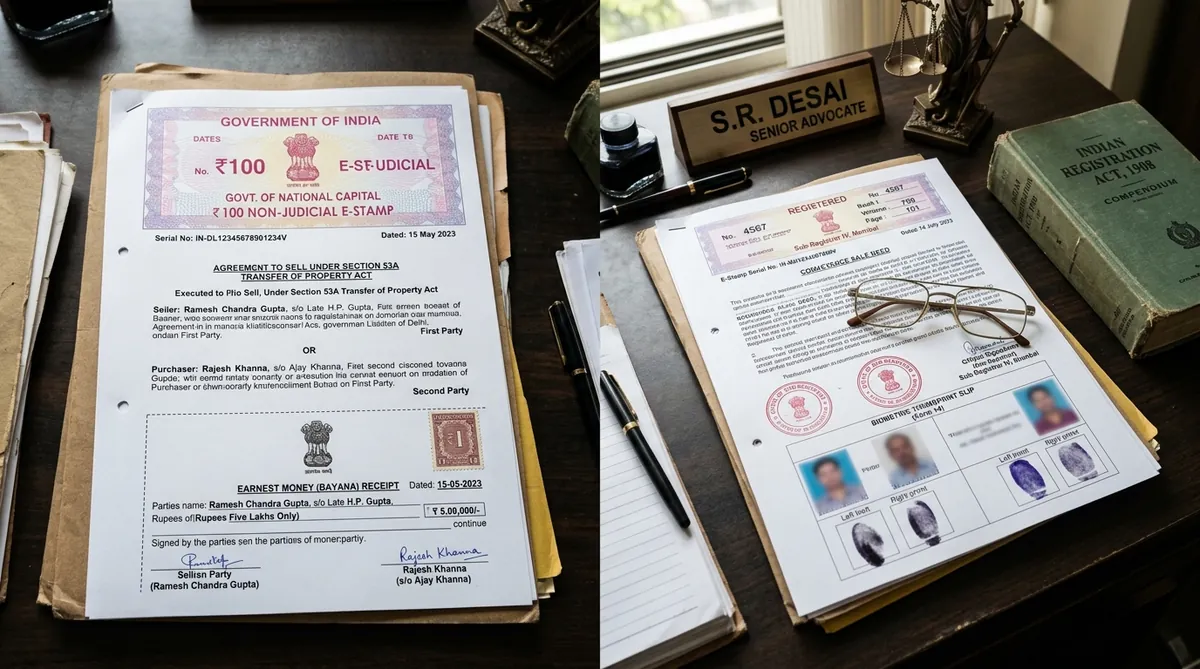
In property litigation involving suits for specific performance of agreements to sell, the fate of the entire case invariably hinges upon a single statutory battlefield: Section 16(c) of the Specific Relief Act, 1963.
Even if a buyer establishes that a valid agreement to sell was executed, substantial earnest money was paid, and the seller maliciously repudiated the transaction, the suit will be dismissed outright if the buyer fails to prove continuous "readiness and willingness" from the date of the agreement up to the date of the final decree. Understanding the sharp distinction between financial capacity and mental intent is critical to surviving rigorous cross-examination.
Under Section 16(c) of the Specific Relief Act 1963, a plaintiff seeking specific performance must plead and prove continuous readiness and willingness throughout the dispute. While readiness denotes financial capacity to pay balance sale consideration, willingness reflects mental intention to perform obligations, as reaffirmed by the Supreme Court in Mehboob-Ur-Rehman.
1. The Legal Dichotomy: 'Readiness' vs 'Willingness'
In the classic authority N.P. Thirugnanam v. Dr. R. Jagan Mohan Rao (1995) 5 SCC 115, the Supreme Court established the definitive legal distinction between the twin concepts:
- Readiness (Financial Capacity): Readiness refers to the capacity of the plaintiff to pay the balance sale consideration. It is an objective test of financial liquidity, backing, and ability to arrange funds on the agreed completion date.
- Willingness (Conduct & Intent): Willingness refers to the mental state and bona fide intention of the plaintiff to fulfill all contractual obligations. It is manifested through continuous conduct—issuing timely legal notices, procuring draft sale deeds, purchasing stamp papers, and attending the Sub-Registrar's office.
- Continuous Chain: The plaintiff must establish that readiness and willingness existed uninterruptedly at the time of the agreement, on the stipulated date of execution, during the pre-suit notice period, and throughout the trial until final judgment.
2. Proving Financial Readiness: Kamal Kumar Benchmarks
In Kamal Kumar v. Premlata Joshi (2019) 3 SCC 704 and U.N. Krishnamurthy v. A.M. Krishnamurthy (2022), the Supreme Court formulated strict documentary standards for proving readiness:
"It is not necessary for the plaintiff to carry cash or produce physical currency notes before the court. What is indispensable is that the plaintiff must prove that he had arranged the funds or had the definite financial capacity to pay the balance consideration."
— Supreme Court in Kamal Kumar v. Premlata Joshi
- Admissible Proof of Readiness: Clear bank account statements showing adequate cleared balance, term deposits (FDRs), sanctioned bank loan approval letters, or unencumbered liquid shares.
- Inadmissible Vague Assertions: Mere oral statements that friends or relatives promised to lend funds, or prospective loan applications that were never sanctioned, fail to satisfy the Section 16(c) threshold.
3. The 2018 Amendment & Mehboob-Ur-Rehman Ruling
Prior to 2018, Section 16(c) contained the phrase "who fails to aver and prove that he has performed or has always been ready and willing." This led to hyper-technical dismissals if lawyers failed to incorporate archaic boilerplate language in the plaint.
The Supreme Court laid down the golden benchmarks for proving testamentary succession under Section 68 of the Evidence Act (Section 71 BSA). The propounder must affirmatively establish the testator's sound disposing mind, valid attestation by two witnesses, and satisfactorily dispel all suspicious circumstances surrounding the execution of the Will before judicial probate or letters of administration can issue.
The 2018 Amendment Act deleted the words "aver and":
- Substantive Proof Remains Mandatory: In Mehboob-Ur-Rehman v. Ahsanul Haq (2019) 9 SCC 415, the Supreme Court clarified that the deletion of "aver and" merely removes rigid formalism from pleadings. It does not relieve the plaintiff of the fundamental substantive burden to prove readiness and willingness through cogent evidence during trial.
- Sub-Registrar Attendance Proof: Obtaining an official attendance receipt or endorsement from the Sub-Registrar on the date fixed for sale deed execution provides golden evidence establishing the buyer's physical presence and willingness.