
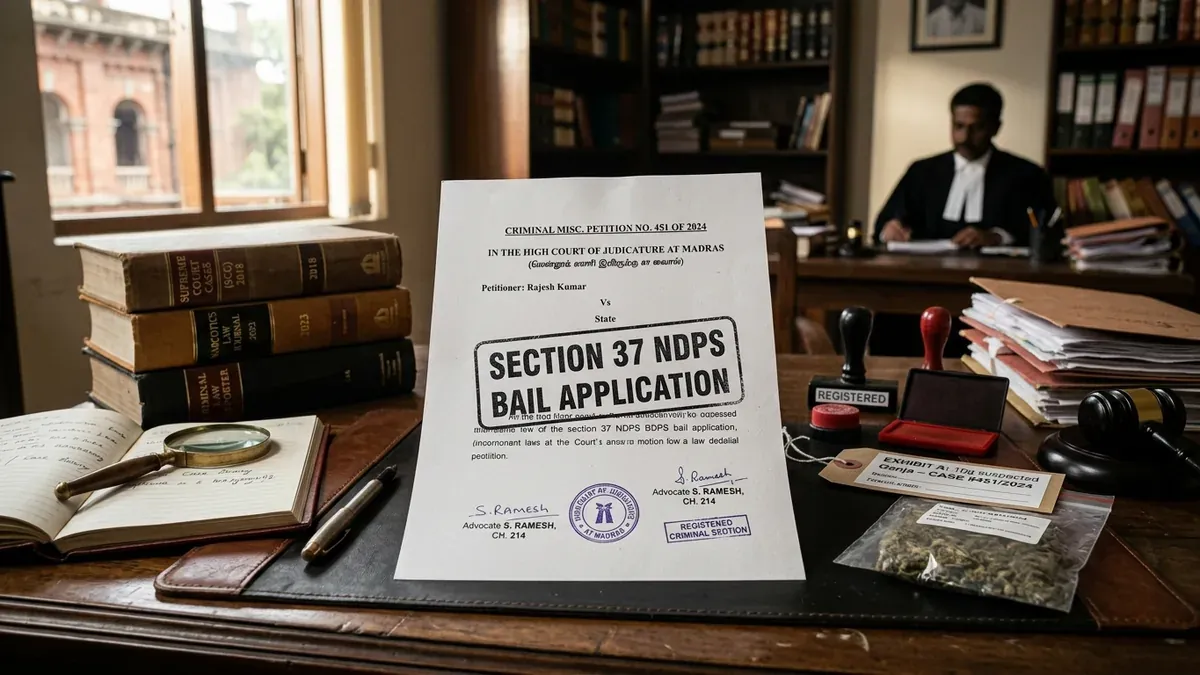
In prosecutions under the Narcotic Drugs and Psychotropic Substances Act, 1985 (NDPS Act), the Chemical Examiner's Report issued by the Forensic Science Laboratory (FSL) or Central Revenue Control Laboratory (CRCL) is the absolute evidentiary bedrock of the case. Without forensic chemical confirmation that the seized contraband is indeed a scheduled narcotic or psychotropic substance, the prosecution is fundamentally speculative.
However, chronic laboratory backlogs across India routinely cause FSL reports to be delayed by six months to several years. Investigating agencies frequently file "incomplete" charge sheets within the statutory 180-day remand period without the FSL report to thwart the accused's statutory right to default bail under Section 187 of the Bharatiya Nagarik Suraksha Sanhita, 2023 (BNSS) / Section 167(2) CrPC. This practice has led to landmark judicial interventions concerning default and interim bail.
Under the NDPS Act, filing a police report without the mandatory FSL chemical analysis report does not constitute a complete investigation in jurisdictions like Punjab and Haryana, entitling the undertrial to default bail. Other courts frequently grant interim bail when forensic chemical examination is delayed beyond statutory remand periods.
1. The Evidentiary Indispensability of the FSL Report
Unlike conventional offences where eyewitness testimony or recovery panchnamas suffice to establish an offence, an NDPS prosecution cannot establish guilt based solely on visual appearance, smell, or police field testing kits (DD kits). As held in Gaunter Edwin Kircher v. State of Goa (1993 3 SCC 145), chemical analysis is the solitary conclusive method to determine the chemical identity, percentage, and classification of suspected contraband.
2. The National Judicial Split on Default Bail Without FSL
A profound divergence of judicial opinion exists across Indian High Courts regarding whether a police report filed without an FSL report is an "incomplete" charge sheet:
The Constitution Bench settled that anticipatory bail under Section 438 CrPC (Section 482 BNSS) should not routinely be limited to a fixed time frame, reaffirming that personal liberty under Article 21 cannot be curtailed on vague apprehensions. In Satender Kumar Antil, the Supreme Court mandated that investigating agencies and magistrates strictly adhere to procedural compliance under Section 41A (Section 35 BNSS), establishing that arrests must be justified by exceptional necessity rather than mechanical executive exercise.
| High Court / Bench | Lead Precedent | Legal Position on Default Bail |
|---|---|---|
| Punjab & Haryana High Court | Ajit Singh @ Jeeta v. State of Punjab (Full Bench 2018) | Filing charge sheet without FSL report is an incomplete investigation; accused is entitled to default bail under Section 167(2) CrPC / 187 BNSS upon expiry of 180 days. |
| Delhi High Court | Kishan Lal v. State (1989) & Suleman v. State (2022) | Charge sheet without FSL is not incomplete for default bail, BUT undertrial is entitled to interim bail pending receipt of the FSL report. |
| Supreme Court Reference | Hanif Ansari v. State (SLP Crl. 2023) | Pending reference before a larger bench of the Supreme Court to resolve inter-High Court conflict. |
3. Securing Interim Bail Pending FSL Analysis
Even in jurisdictions where default bail is contested, High Courts consistently grant interim bail on humanitarian and due process grounds when the FSL report is delayed beyond reasonable limits.
In Mohd. Arbaz v. State (NCT of Delhi), the Delhi High Court established that keeping an accused incarcerated indefinitely without scientific confirmation that the seized powder is a prohibited drug violates Article 21. Courts routinely order interim release on personal bond with surety, subject to the condition that if the FSL report subsequently confirms commercial narcotic contraband, the accused must surrender immediately.