
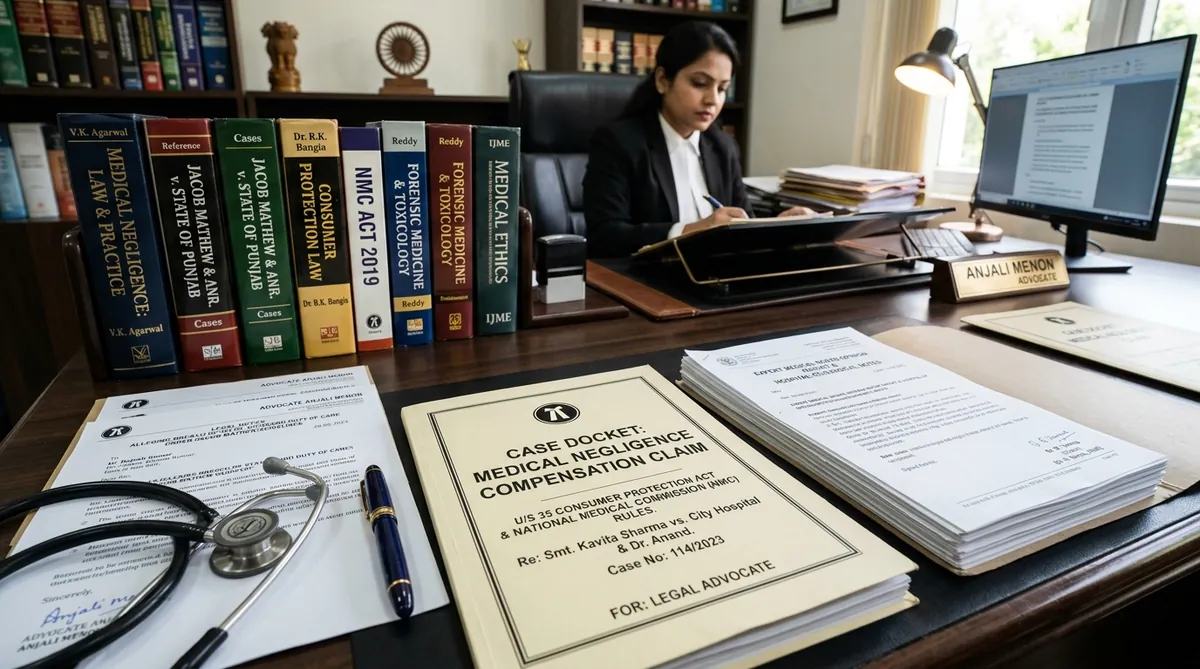
When medical treatment, surgical intervention, or pharmacological administration results in catastrophic patient injury, irreversible paralysis, or untimely death, distinguishing between an unavoidable therapeutic complication and actionable medical negligence is one of the most intellectually complex challenges in Indian law.
Indian courts do not demand that a physician guarantee a successful cure or possess extraordinary surgical skill. Grounded in the English common law doctrine of Bolam v. Friern Hospital Management Committee (1957) and endorsed by the Supreme Court of India in landmark decisions such as Jacob Mathew (2005) and Kusum Sharma (2010), liability is assessed against the standard of the ordinary, skilled medical practitioner.
In Indian medical negligence litigation, courts assess liability using the Bolam Test: a doctor is not negligent if they acted in accordance with a practice accepted as proper by a responsible body of medical professionals. The Supreme Court emphasizes that mere error of judgment or diagnostic failure does not equate to negligence.
1. The Bolam Test: Reasonable Standard of Care
The core formulation of the Bolam rule adopted by the Supreme Court states:
"A doctor is not guilty of negligence if he has acted in accordance with a practice accepted as proper by a responsible body of medical men skilled in that particular art... merely because there is a body of opinion that takes a contrary view will not make him negligent."
- No Perfection Demanded: A doctor does not commit negligence merely because a higher degree of surgical skill could have achieved a better outcome.
- Choice of Treatment: Where two recognized schools of thought exist (e.g., conservative pharmacological treatment vs. immediate surgical resection), adopting one over the other does not constitute malpractice.
2. The Bolitho Exception: Logical Basis Requirement
The English House of Lords in Bolitho v. City and Hackney Health Authority (1997), adopted by the Supreme Court in Vinitha Ashok v. Lakshmi Hospital (2001), added a crucial safeguard:
- Judicial Scrutiny of Expert Opinion: Courts are not bound to accept medical expert opinions blindly.
- Logical Defensibility: The court must be satisfied that the exponents of the medical opinion have directed their minds to comparative risks and benefits, and reached a logically defensible conclusion.
- Outdated Practices: If a body of medical opinion defends a practice that defies scientific logic or violates established clinical protocols, the court can reject the defense.
3. The Kusum Sharma Charter for Medical Defense
In Kusum Sharma v. Batra Hospital (2010) 3 SCC 480, the Supreme Court laid down 11 binding guidelines protecting medical practitioners:
- Error of Judgment: A mere error of judgment or an accident during emergency treatment is not negligence per se.
- Standard of the Day: The doctor's conduct must be judged by the state of medical knowledge at the time of the incident, not by hindsight.
- Expert Medical Evidence: In complex clinical matters, consumer forums cannot conclude negligence without examining an independent expert medical board report.
Landmark Judicial Precedents & Statutory Authorities
Courts and appellate tribunals across Delhi NCR (Faridabad, Saket, Tis Hazari, Gurugram, High Courts) strictly apply these authoritative Supreme Court benchmarks:
The Supreme Court established that statutory authorities and commercial real estate developers fall strictly within the jurisdiction of Consumer Protection Forums for deficiency of service. In Experion Developers, the Court ruled that one-sided builder-buyer agreements containing punitive forfeiture clauses constitute unfair trade practices, entitling homebuyers to full refund with commercial interest upon unreasonable possession delays.