
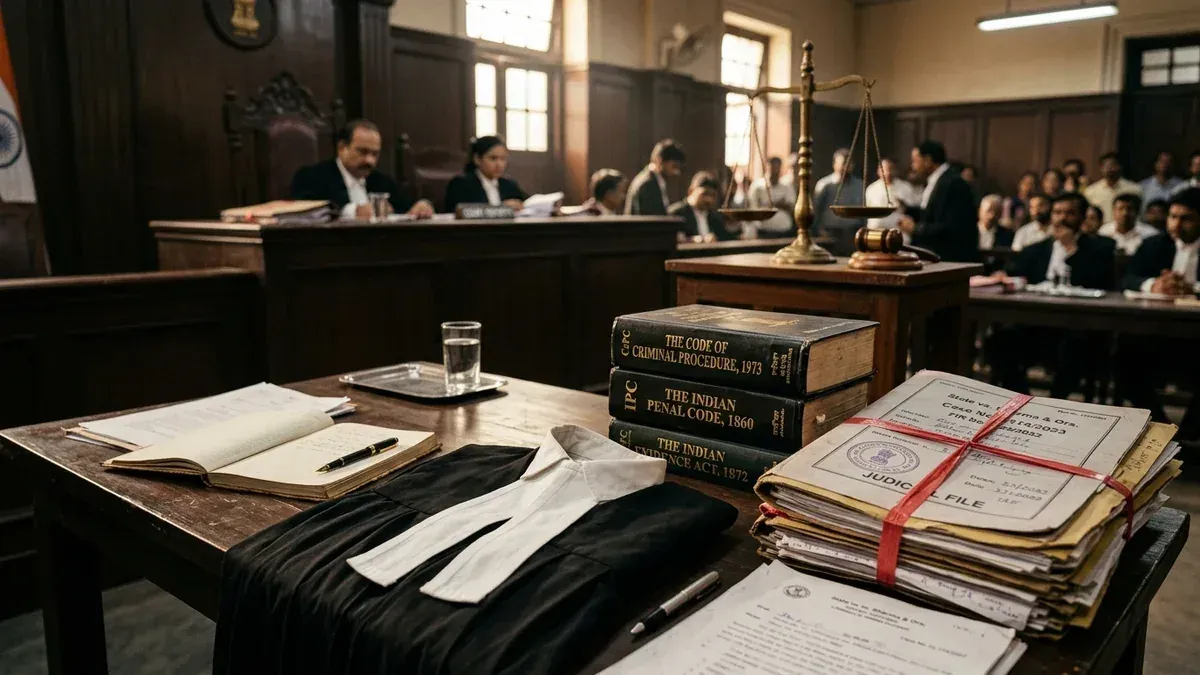
In Indian criminal procedure, the completion of a police investigation and the subsequent submission of a final report (commonly known as a charge-sheet or cancellation report) does not necessarily draw the curtain on investigative activity. In numerous trials, subsequent facts emerge, unexamined scientific evidence comes to light, key witnesses surface, or tainted investigations conducted by compromised local police officers are exposed before the court.
When faced with an inadequate, defective, or fraudulent investigation, complainants frequently petition the trial Magistrate, demanding that the earlier police report be discarded, the original investigating officer removed, and a "fresh" or "re-investigation" directed from scratch. Conversely, investigating agencies themselves often seek to revive dormant cases years after the submission of a charge-sheet by initiating fresh inquiries without judicial authorization.
This dynamic brings into sharp focus one of the most critical jurisdictional distinctions in criminal procedural law: the profound difference between "further investigation" and "re-investigation" (or de novo / fresh investigation). Under the erstwhile Code of Criminal Procedure, 1973, this power was governed by Section 173(8) CrPC, now seamlessly recodified as Section 193(9) of the Bharatiya Nagarik Suraksha Sanhita, 2023 (BNSS).
Through landmark decisions culminating in the Three-Judge Bench ruling in Vinay Tyagi v. Irshad Ali @ Deepak (2013) 5 SCC 762 and Ramachandran v. R. Udhayakumar (2008) 5 SCC 413, the Supreme Court of India established an immutable legal rule: while trial Magistrates and police agencies possess full statutory power to conduct further investigation to collect supplementary evidence, neither the police nor a Magistrate has any jurisdiction whatsoever to direct a re-investigation or fresh inquiry. That extraordinary power is reserved exclusively for Constitutional Courts (the High Courts and Supreme Court) exercising powers under Article 226 or Article 32 of the Constitution.
This treatise provides an in-depth analysis of Section 193(9) BNSS, the tri-fold classification of investigations under the Vinay Tyagi doctrine, the evidentiary status of primary and supplementary charge-sheets, and the procedural mechanics for navigating further investigation applications during criminal trials.
Under Section 193(9) BNSS (old Section 173(8) CrPC) and the Supreme Court's Vinay Tyagi judgment, investigating agencies and trial Magistrates can only conduct or order 'further investigation' to collect supplementary evidence. Neither police nor Magistrates possess jurisdiction to direct a fresh, de novo, or 're-investigation', which remains an exclusive constitutional power.
1. The Tripartite Classification of Investigations: The *Vinay Tyagi* Precedent
In criminal law, precision in terminology dictates the boundaries of judicial jurisdiction. In the seminal Three-Judge Bench decision in Vinay Tyagi v. Irshad Ali @ Deepak (2013) 5 SCC 762, the Supreme Court of India definitively categorized criminal investigations into three distinct legal concepts:
The Supreme Court laid down the classic seven illustrative categories where the High Court must exercise inherent powers under Section 482 CrPC (Section 528 BNSS) to quash FIRs and criminal proceedings to prevent abuse of judicial process. The Bench held that where the allegations in the FIR, even if taken at face value, do not disclose the commission of any cognizable offence, or where the prosecution is manifestly attended with mala fide motives, the criminal proceedings are liable to be quashed at the threshold.
| Category of Investigation | Legal Definition & Effect on Prior Record | Competent Authorizing Authority |
|---|---|---|
| 1. Further Investigation | A continuation of the earlier investigation. It builds upon the primary charge-sheet, collecting additional oral or documentary evidence without erasing or nullifying the previous investigation. | • Investigating Agency (Police / CBI / ED) • Judicial Magistrate / Trial Court (under Section 193(9) BNSS) • High Court & Supreme Court |
| 2. Re-investigation / Fresh Inquiry | Completely obliterates and wipes clean the earlier investigation. The prior charge-sheet and evidence are set aside as if they never existed, and an entirely new probe is initiated. | Exclusively Constitutional Courts (High Court under Article 226 / Section 528 BNSS, or Supreme Court under Article 32 / 142). Magistrates have ZERO power. |
| 3. De Novo Investigation | A complete investigation from the very beginning conducted by an independent agency (e.g., transferring a case from local state police to CBI or SIT) due to demonstrated institutional bias or corruption. | Exclusively Constitutional Courts in rare and exceptional circumstances to instill public confidence in the administration of justice. |
The Supreme Court held that the scheme of the criminal procedure code permits only "further investigation". The court observed: "A Magistrate has no power to direct 're-investigation' or 'fresh investigation' (de novo) in relation to the same offence. Such a power does not flow from Section 173(8) CrPC. The power to order re-investigation or fresh investigation vests exclusively in the High Court or Supreme Court, and even there, it is an extraordinary power to be exercised sparingly."
2. The Statutory Contours of Section 193(9) BNSS (Old Section 173(8) CrPC)
Section 193(9) of the Bharatiya Nagarik Suraksha Sanhita, 2023 sets out the statutory framework for further investigation and the submission of supplementary police reports:
Section 193(9), Bharatiya Nagarik Suraksha Sanhita, 2023 (Old Section 173(8) CrPC):
"Nothing in this section shall be deemed to preclude further investigation in respect of an offence after a report under sub-section (3) has been forwarded to the Magistrate and, where upon such investigation, the officer in charge of the police station obtains further evidence, oral or documentary, he shall forward to the Magistrate a further report or reports regarding such evidence in the form as the State Government may, by rules, provide; and the provisions of sub-sections (3) to (8) shall, as far as may be, apply in relation to such report or reports as they apply in relation to a report forwarded under sub-section (3)."
Several critical operational elements emerge from the statutory language of Section 193(9) BNSS:
- The Non-Obstante Proviso: The opening phrase "Nothing in this section shall be deemed to preclude..." expressly preserves the continuing statutory duty of the police to pursue fresh leads. The filing of a charge-sheet does not render the investigating officer functus officio.
- Requirement of 'Further Evidence': Further investigation cannot be conducted on a whim or to re-evaluate evidence already analyzed. The police officer must obtain "further evidence, oral or documentary"—such as the discovery of a concealed weapon, newly surfaced CCTV footage, forensic DNA reports, or the arrest of an absconding co-accused.
- Supplementary Police Report: Upon concluding the further investigation, the police do NOT withdraw or amend the original charge-sheet. They submit a supplementary police report. Both reports form part of the composite judicial record.
- Judicial Courtesy vs Legal Mandate: In Rama Chaudhary v. State of Bihar (2009) 6 SCC 346 and Sri Bhagwan Samardha Sreepada Vallabha Venkata Vishwandadha Maharaj v. State of A.P. (1999) 5 SCC 740, the Supreme Court held that while the police have statutory power to conduct further investigation, practice and judicial propriety require that the investigating officer should seek the formal leave or permission of the trial court before embarking upon further investigation after cognizance has been taken.
3. Jurisdictional Limits of Judicial Magistrates under Section 193(9) BNSS
A frequent recurring question in trial practice is: what powers does a Judicial Magistrate possess when dissatisfied with a police report? In Chandra Babu @ Moses v. State (2015) 8 SCC 774 and Minu Kumari v. State of Bihar (2006) 4 SCC 359, the Supreme Court outlined the exact options available to a Magistrate upon receiving a police report:
The Four Lawful Courses Available to a Magistrate:
1. Accept the Report: Take cognizance of the offence under Section 210 BNSS (old 190 CrPC) and issue process against the accused under Section 227 BNSS (old 204 CrPC).
2. Accept the Closure Report: If a cancellation / untraced report is filed, accept it after issuing a mandatory protest notice to the informant / victim.
3. Reject the Closure Report & Take Direct Cognizance: If the material collected in the case diary discloses an offence despite the police recommending closure, disagree with the police opinion and directly take cognizance.
4. Direct Further Investigation: If the Magistrate finds the investigation shoddy or incomplete, order the police to conduct further investigation under Section 193(9) BNSS.
However, the Magistrate's order directing further investigation is subject to strict legal boundaries:
- No Power to Order Re-investigation: If a Magistrate records: "The investigation is defective, hence I order a fresh investigation by a new officer", the order is patently illegal and liable to be quashed. In Ramachandran v. R. Udhayakumar (2008) 5 SCC 413, the Supreme Court struck down a Magistrate's order directing re-investigation, holding that a Magistrate cannot direct wiping out of the earlier investigation.
- No Power to Dictate the Outcome: The Magistrate can direct further investigation, but CANNOT direct the police to file a charge-sheet against a specific person or reach a predetermined conclusion. The police retain complete operational autonomy in forming their opinion under Section 193 BNSS.
- Stage of Trial Matters: The Magistrate can direct further investigation at any time before the trial commences, and even after charges are framed if vital new material surfaces (Vinubhai Haribhai Malaviya v. State of Gujarat (2019) 14 SCC 1). However, once the trial nears its conclusion and defense evidence is closed, courts will not permit further investigation to fill prosecution lacunae.
4. Constitutional Powers: When High Courts Order Re-investigation or Transfer to CBI
While trial Magistrates are strictly confined to further investigation, the High Courts under Article 226 and Section 528 BNSS (inherent powers) and the Supreme Court under Article 32 enjoy constitutional plenary authority. In rare and exceptional circumstances, constitutional courts can wipe out an earlier investigation and order a de novo re-investigation by an independent central agency:
- Institutional Bias and Political Interference: In State of West Bengal v. Committee for Protection of Democratic Rights (2010) 3 SCC 571, a Constitution Bench ruled that constitutional courts can transfer an investigation to the Central Bureau of Investigation (CBI) without the consent of the state government where the local police machinery is hopelessly compromised, biased, or acting under political subjugation.
- Shocking Defects and Fabrication: In Babubhai v. State of Gujarat (2010) 12 SCC 254, the Supreme Court ordered a complete de novo re-investigation where the police had deliberately concocted false FIRs and fabricated evidence to shield actual perpetrators, observing that a tainted, non-transparent investigation violates the fundamental right to a fair trial under Article 21.
- Stringent Test for Transfer: The Supreme Court in Arnab Ranjan Goswami v. Union of India (2020) 14 SCC 12 reiterated that an accused has no fundamental right to choose their investigating agency. Transfer to the CBI or ordering a fresh de novo investigation is an extraordinary remedy to be exercised with great circumspection, not upon the mere dissatisfaction of an accused with the course of investigation.
5. Litigant Action Plan: Applying for or Defending Against Further Investigation
Whether you are a victim seeking a thorough probe or an accused facing endless investigations, navigating Section 193(9) BNSS requires a disciplined litigation strategy:
Operational Checklist: Navigating Section 193(9) BNSS Applications
- For Complainants / Victims Seeking Further Investigation:
- Draft an application specifically praying for "Further Investigation under Section 193(9) BNSS"—never use the terms "re-investigation" or "fresh inquiry" before a Magistrate.
- Identify concrete, specific evidentiary gaps: unexamined material witnesses, unretrieved digital server logs, missing CDR analysis, or uncollected CCTV footage.
- Cite Vinubhai Haribhai Malaviya v. State of Gujarat (2019) 14 SCC 1 to establish that the Magistrate has expansive powers to ensure a fair and complete investigation until trial commences.
- For Accused Persons Resisting Protracted Inquiries:
- Oppose repeated further investigations designed merely to delay the trial or cure prosecution witnesses' admissions made during cross-examination.
- Demonstrate that the "new" evidence was already within the police's knowledge at the time of the initial charge-sheet and represents a mere change of opinion.
- If a Magistrate has erroneously ordered "re-investigation" or directed the police to file a charge-sheet against specific persons, immediately file a petition under Section 528 BNSS before the High Court to quash the order as exceeding statutory jurisdiction under Chandra Babu and Vinay Tyagi.
- Evidentiary Handling of Dual Reports: Ensure that your trial defense strategy accounts for both the original charge-sheet and the supplementary report. Contradictions between the primary report and supplementary report serve as potent cross-examination material to demolish prosecution credibility.
By understanding the precise statutory boundaries of Section 193(9) BNSS, litigants can effectively safeguard their right to a fair, complete, and unmanipulated criminal trial.