
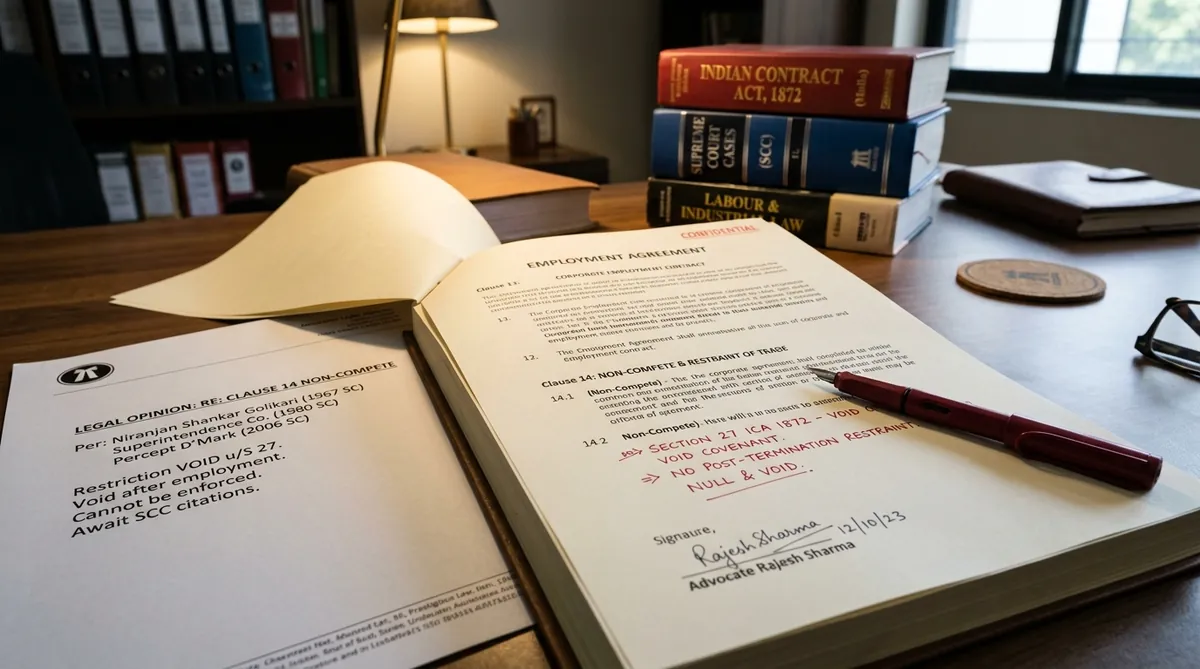
In executive employment contracts, technology offer letters, and corporate acquisitions across India, few clauses trigger as much friction, commercial apprehension, and legal posturing as the Post-Employment Non-Compete Covenant. Multinational corporations routinely transplant standard US or UK employment agreements into Indian operations, purporting to restrict departing software architects, sales directors, and C-suite executives from joining a competitor or founding a competing startup for six to twenty-four months post-resignation.
Under Indian jurisprudence, however, these sweeping restrictions collide with an insurmountable statutory fortress: Section 27 of the Indian Contract Act, 1872 (ICA). Unlike Anglo-American common law systems—which evaluate non-compete covenants under a discretionary "rule of reasonableness" based on geographical scope and duration—Indian statutory law treats post-employment non-competes as strictly void ab initio. This definitive treatise analyzes Section 27, the Supreme Court trilogy governing negative covenants, the sharp dichotomy between during-employment and post-employment restraints, and the lawful covenants employers can enforce to protect proprietary business assets.
Under Section 27 of the Indian Contract Act 1872, post-employment non-compete agreements are void ab initio as unlawful restraints of trade. Unlike English common law, Indian courts apply no reasonableness exception post-termination. However, employers can legally enforce confidentiality agreements, non-solicitation clauses for clients and employees, and proprietary trade secret protections.
1. Section 27 Indian Contract Act: The Absolute Statutory Prohibition
Section 27 of the Indian Contract Act, 1872 is unambiguous and uncompromising in its statutory command:
"Every agreement by which any one is restrained from exercising a lawful profession, trade or business of any kind, is to that extent void."
The Sole Statutory Exception: Sale of Goodwill
The statute contains only one explicit statutory exception: Exception 1 – Saving of agreement not to carry on business of which goodwill is sold. Where a business founder sells the goodwill of a company for substantial consideration, an agreement not to carry on a similar business within specified local limits may be upheld if deemed reasonable by the court.
Crucially, Parliament enacted no exception whatsoever for employment contracts. The Indian courts have repeatedly held that the legislature deliberately excluded the common law doctrine of "reasonable restraint" in employment relationships to protect the constitutional freedom of livelihood under Article 21 and Article 19(1)(g) of the Constitution.
2. The Supreme Court Trilogy: Niranjan Golikari, Krishan Murgai & Percept D'Mark
The Indian law on negative covenants is anchored in three landmark Supreme Court decisions:
The Constitution Bench established the landmark principles governing the abolition and absorption of contract labour under the Contract Labour (Regulation and Abolition) Act, 1970. The Court held that mere issuance of a notification prohibiting contract labour under Section 10 does not lead to automatic absorption; however, where the contract arrangement is found to be a sham or camouflage to deny statutory benefits, the industrial adjudicator is fully empowered to direct regular employment.
1. Niranjan Shankar Golikari v. Century Spinning & Mfg. Co. (1967) 2 SCR 378
In *Golikari*, the Supreme Court drew the foundational, indelible distinction between a negative covenant operating during the subsistence of the employment contract versus a covenant operating post-termination:
- During Subsistence of Employment: An agreement restraining an employee from serving any other employer or engaging in competing business while under active contract of service is valid and enforceable. It does not violate Section 27 because it merely harnesses the employee's full-time energies for the master's business.
- Post-Termination: A restriction that purports to bind the employee after the employment relationship has terminated by resignation, expiration, or dismissal is void ab initio under Section 27.
2. Superintendence Company of India v. Krishan Murgai (1981) 2 SCC 246
In *Krishan Murgai*, a three-judge bench of the Supreme Court examined whether a post-service restriction of two years within Delhi was enforceable if reasonable. Justice V.D. Tulzapurkar held:
"Under Section 27 of the Contract Act, a restriction is either valid or void; there is no intermediate stage of 'reasonableness'. The English common law doctrine that restraints of trade are valid if reasonable has no application in India where the statute declares all agreements in restraint of trade void to that extent."
3. Percept D'Mark (India) Pvt. Ltd. v. Zaheer Khan (2006) 4 SCC 227
In *Percept D'Mark*, the Supreme Court reaffirmed that Section 27 applies universally, declaring that any post-contractual covenant restricting freedom of trade—even a "Right of First Refusal" clause that restricted cricketer Zaheer Khan from engaging other marketing agents—is completely void and unenforceable.
3. Lawful Protective Covenants: What Employers Can Enforce
While a blanket ban on working for a competitor is legally void, Indian courts recognize that employers possess legitimate proprietary interests that can be lawfully protected through carefully tailored covenants:
1. Protection of Confidential Information and Trade Secrets
An employee's obligation to maintain strict confidentiality regarding proprietary source code, algorithms, customer databases, unreleased product designs, and financial models does not expire upon termination. Courts readily grant permanent injunctions restraining ex-employees from disclosing or exploiting trade secrets under the Specific Relief Act, 1963 and equitable principles of breach of confidence (John Richard Brady v. Chemical Process Equipments P. Ltd.).
2. Non-Solicitation of Clients and Customers
Indian High Courts (notably Delhi and Bombay) draw a vital distinction between competing in the open market and directly poaching the former employer's clients using proprietary customer lists. A covenant restraining an ex-employee from actively soliciting clients with whom they had direct commercial dealings during the final 12 months of employment is generally considered valid and actionable in tortious damages.
3. Non-Solicitation of Employees (Anti-Poaching)
Agreements restraining former executives from inducing, raiding, or poaching former colleagues to join a rival venture are enforceable, provided they do not bar employees from voluntarily applying to open public job postings.
4. The Springboard Doctrine in Indian Employment Injunctions
When an employee resigns and instantly utilizes the ex-employer's confidential research to launch a competing enterprise, Indian courts invoke the equitable "Springboard Doctrine":
Originally formulated in English equity (Terrapin Ltd. v. Builders' Supply Co.) and adopted by Indian High Courts (such as Delhi High Court in Inx Media Pvt. Ltd. v. Bharat Kumar), the doctrine holds that a departing employee cannot use confidential information obtained during employment as a "springboard" to gain an unfair head-start over competitors. Even where Section 27 bars an injunction against competing generally, the court will issue an injunction restraining the ex-employee from launching the specific product or utilizing the specific stolen architecture for a period equivalent to the time it would have taken to develop it independently.
5. Strategic Drafting Guidelines for Corporate Counsel
To protect corporate intellectual property while ensuring contracts withstand Section 27 judicial scrutiny, legal teams must follow these drafting principles:
- Eliminate Blanket Non-Competes: Discard broad post-employment non-compete clauses that declare the employee cannot join any competitor in India for two years. Such clauses are legally dead on arrival and undermine the credibility of the entire agreement before a judge.
- Fortify Confidentiality Definitions: Precisely define what constitutes "Confidential Information", distinguishing general industry skills, knowledge, and experience (which belong to the employee) from specific proprietary trade secrets (which belong to the company).
- Structure Paid Garden Leave: If an executive must be kept out of the market, extend the active contractual notice period and utilize a fully compensated garden leave mechanism during active employment.
- Robust Severability Clauses: Include an airtight severability provision ensuring that if any restrictive covenant is found invalid under Section 27, the remaining confidentiality, IP assignment, and non-solicitation covenants remain fully operative.