
When the Sexual Harassment of Women at Workplace (Prevention, Prohibition and Redressal) Act, 2013 (POSH Act) was promulgated, many corporate entities treated it as an administrative HR formality. Over a decade later, regulatory scrutiny, aggressive High Court judicial interventions, and environmental, social, and governance (ESG) disclosure mandates have transformed POSH compliance into a critical corporate governance imperative.
Under Section 26 of the POSH Act, the legislature embedded formidable punitive consequences for non-compliant enterprises. Far beyond initial monetary fines of Rs. 50,000, repeat non-compliance exposes companies to statutory cancellation, withdrawal, or non-renewal of their core business licenses, operating permits, and municipal registrations. Following the Supreme Court's historic directives in Aureliano Fernandes v. State of Goa (2023), corporate boards, executive directors, and compliance officers face severe reputational and legal risks for failing to institute robust POSH safeguards. This treatise examines the statutory penalty architecture, municipal license revocation risks, and affirmative employer duties under Indian workplace law.
Section 26 of the POSH Act 2013 penalizes employers failing to constitute an Internal Committee, non-compliance with statutory inquiry recommendations, or failure to file mandatory annual reports with fines up to fifty thousand rupees. Repeat convictions incur doubled financial penalties, alongside potential cancellation, withdrawal, or non-renewal of business licenses and operational registrations.
1. The Statutory Penalty Architecture: Section 26 Deconstructed
Section 26 of the POSH Act operates as the primary penal enforcement mechanism against delinquent employers. It establishes a graduated penalty scale depending on the gravity and recurrence of the default:
First-Time Conviction: Monetary Penalties (Section 26(1))
An employer who fails to:
- Constitute an Internal Committee (IC) under Section 4(1);
- Take action on the recommendations of the Internal Committee under Section 13(3) and Section 14;
- File the mandatory Annual Report before the District Officer under Section 21 and Section 22; or
- Contravenes or attempts to contravene or abets the contravention of other provisions of the Act or rules;
shall be punishable with a fine which may extend to fifty thousand rupees (Rs. 50,000).
Subsequent Conviction: The "Corporate Death Penalty" (Section 26(2))
Where an employer, having been convicted of an offense punishable under Section 26(1), subsequently commits and is convicted of the same offense, the statutory consequences escalate dramatically:
"Under Section 26(2), the employer faces: (i) twice the penalty imposed on a first conviction; and (ii) cancellation of his licence or withdrawal, or non-renewal, or approval, or cancellation of the registration, as the case may be, by the government or local authority required for carrying on his business or profession."
This provision is colloquially referred to in corporate litigation as the statutory "corporate guillotine." A technology services firm, manufacturing plant, or hospitality chain could see its Shops and Establishments registration, factory license, municipal trade license, or GST operating certificate revoked by local authorities upon a repeat POSH conviction.
2. Affirmative Statutory Duties of Employers under Section 19
Compliance with the POSH Act is not passive. Section 19 places mandatory, affirmative legal duties on every employer:
- Safe Working Environment: Provide a safe working environment at the workplace which shall include safety from the persons coming into contact at the workplace.
- Display of Penal Consequences: Prominently display at any conspicuous place in the workplace the penal consequences of sexual harassments and the order constituting the Internal Committee.
- Mandatory Sensitization Workshops: Organize regular workshops and awareness programmes at regular intervals for sensitizing employees with the provisions of the Act and orientation programmes for members of the Internal Committee.
- Inquiry Facilities & Attendance: Provide necessary facilities to the Internal Committee for dealing with the complaint and conducting an inquiry, and assist in securing the attendance of respondent and witnesses.
- Facilitating Police Complaints: Provide assistance to the woman if she chooses to file a complaint in relation to the offense under the Indian Penal Code (or Bharatiya Nyaya Sanhita, 2023) or any other law.
- Treating Harassment as Misconduct: Cause to initiate action, under the service rules or standing orders, against the perpetrator, or if the perpetrator is not an employee, at the workplace where the incident took place.
3. Annual Reporting Scrutiny: Section 21 & Section 22 Filings
A frequent point of corporate default is failure to comply with statutory reporting mandates:
1. Report to District Officer (Section 21)
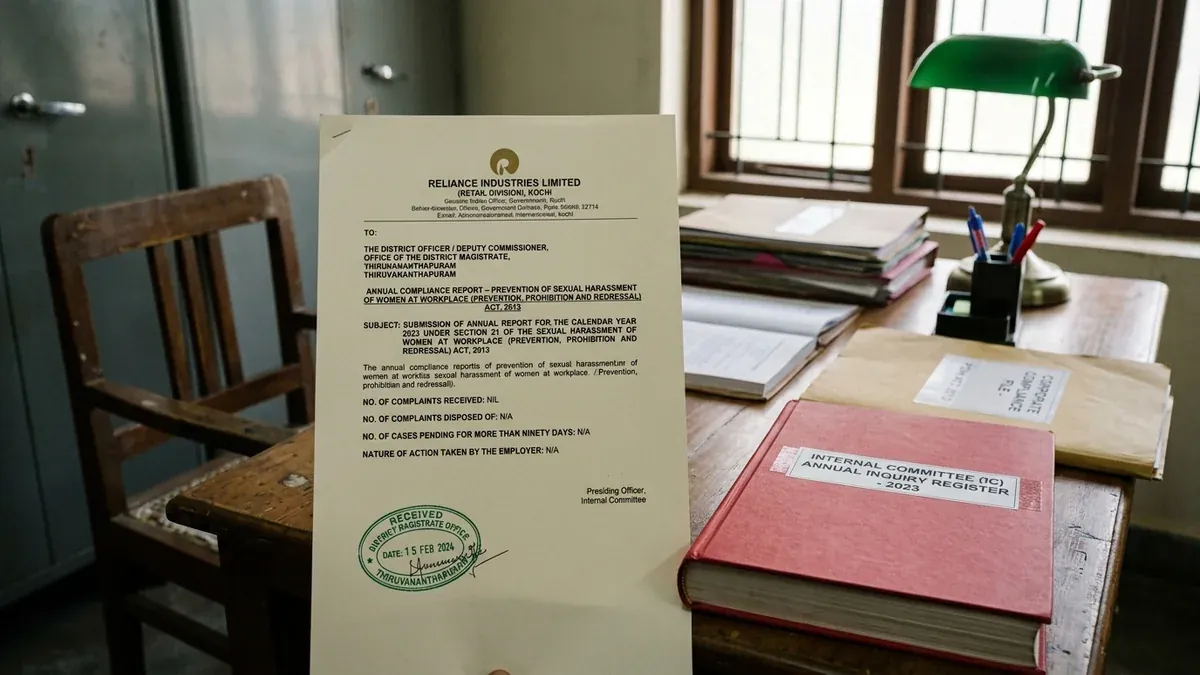
The Internal Committee must prepare in each calendar year an Annual Report and submit the same to the employer and the designated District Officer (often the District Magistrate or Collector). The report must contain:
- Number of sexual harassment complaints received during the year;
- Number of complaints disposed of during the year;
- Number of cases pending for more than ninety days;
- Number of workshops or awareness programmes carried out; and
- Nature of action taken by the employer under IC recommendations.
2. Board's Report Disclosure under Companies Act, 2013 (Section 22)
Under Section 22 of the POSH Act read with the Companies (Accounts) Rules, 2014 (Rule 8(5)(x)), every company—public or private—must include a formal statement in its Directors' Annual Report confirming that the company has complied with provisions relating to the constitution of an Internal Committee under the POSH Act, stating the number of cases filed and resolved. Misstatements or omissions in the Board's Report attract severe personal fines on Directors under Section 134(8) of the Companies Act, 2013.
4. The Supreme Court's Aureliano Fernandes Directives: Judicial Crackdown
In Aureliano Fernandes v. State of Goa (2023) SCC OnLine SC 621, the Supreme Court expressed profound alarm over the pervasive lack of functional Internal Committees across both public and private sectors:
The Constitution Bench established the landmark principles governing the abolition and absorption of contract labour under the Contract Labour (Regulation and Abolition) Act, 1970. The Court held that mere issuance of a notification prohibiting contract labour under Section 10 does not lead to automatic absorption; however, where the contract arrangement is found to be a sham or camouflage to deny statutory benefits, the industrial adjudicator is fully empowered to direct regular employment.
"The Supreme Court declared: 'However salutary this enactment may be, it will remain a dead letter if those who are tasked with its implementation fail to measure up to their responsibilities... An inquiry conducted in violation of natural justice or by an improperly constituted committee is an exercise in futility that inflicts double victimization.'"
The Apex Court directed all High Courts, statutory regulatory bodies, corporate registrars, and government departments to carry out time-bound audits to ensure every establishment has a fully operational, properly constituted IC with contact details displayed publicly on its official website.
5. Master Corporate POSH Compliance Audit Checklist
To ensure absolute immunity from Section 26 penalties and business license forfeiture, corporate counsel must implement the following compliance audit:
POSH Audit & Governance Matrix
| Statutory Requirement | Statutory Section | Action Required by Employer |
|---|---|---|
| Internal Committee Constitution | Section 4(1) & (2) | Constitute IC at every branch/office employing 10+ workers; ensure Presiding Officer is senior female employee; verify independent external member. |
| Workplace Notice Displays | Section 19(b) | Display penal consequences, IC member names, and emergency contact emails conspicuously at all physical offices and intranet portals. |
| Employee Sensitization | Section 19(c) | Conduct mandatory annual training workshops for all permanent, contract, and remote staff; maintain attendance logs for audit. |
| District Officer Annual Filing | Section 21 | Submit annual statistical report before January 31 of each calendar year to the local District Collector / Women & Child Welfare Officer. |
| Board's Report Disclosure | Section 22 read with Section 134 Companies Act | Incorporate certified POSH statistics and compliance certification in the Directors' Report annexed to annual financial statements. |