
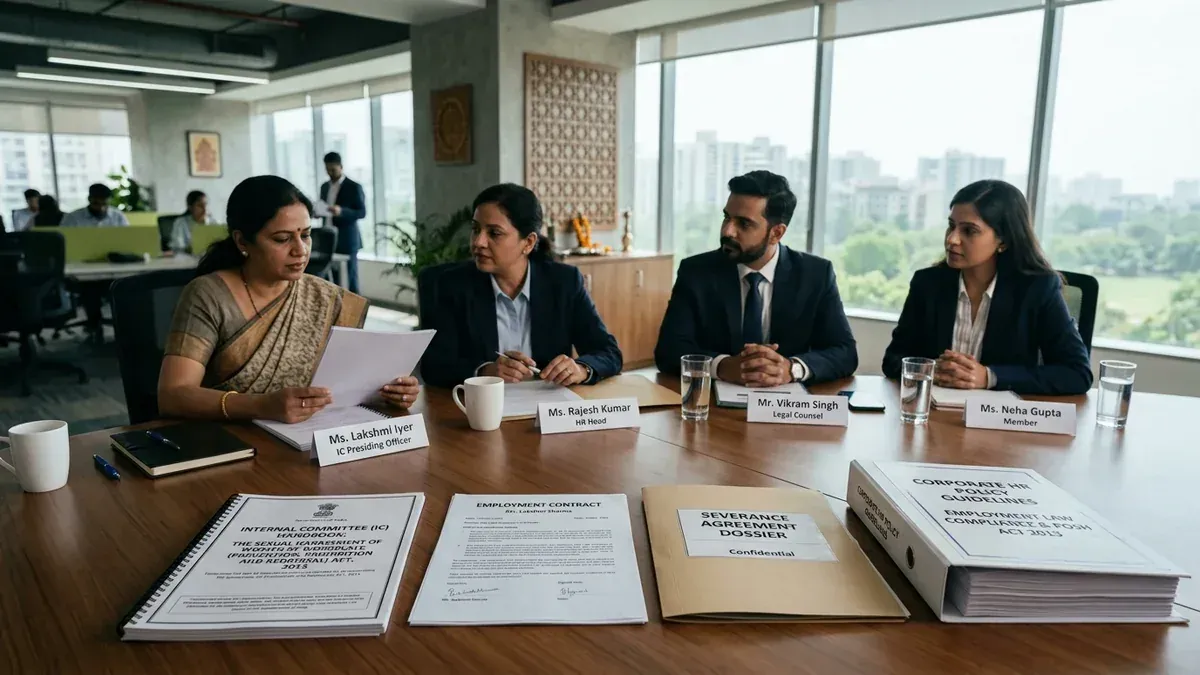
When an employer in India decides to dismiss, discharge, or demote an employee on allegations of serious misconduct—such as insubordination, theft, habitual absence, sabotage, or financial fraud—the managerial decision cannot be executed arbitrarily. To withstand judicial challenge, the disciplinary action must be preceded by a legally flawless Domestic Enquiry conducted in strict conformity with certified standing orders and the principles of natural justice.
However, corporate domestic inquiries are frequently plagued by institutional flaws: biased enquiry officers acting as management agents, vague charge-sheets, refusal to permit defense witnesses, and denial of inquiry reports. When a dismissed workman challenges their termination, the dispute lands before the Labour Court or Industrial Tribunal.
Under Section 11A of the Industrial Disputes Act, 1947, the Labour Court is not a mere rubber-stamp of managerial discretion. It exercises expansive appellate powers to reappraise the entire evidentiary record, declare domestic inquiries defective, and set aside shockingly disproportionate penalties. This comprehensive treatise analyzes the procedural stages of a domestic inquiry, the constitutional mandate of ECIL v. B. Karunakar, and the scope of Labour Court scrutiny under Section 11A.
Domestic disciplinary enquiries must strictly follow principles of natural justice: precise charge-sheets, unbiased enquiry officers, witness cross-examination, and reasoned enquiry reports. Under Section 11A of the Industrial Disputes Act, Labour Courts possess broad supervisory jurisdiction to re-evaluate evidence, set aside defective domestic enquiries, and substitute disproportionate employer termination penalties.
1. Essential Procedural Stages of a Lawful Domestic Enquiry
A valid domestic inquiry must proceed through a structured sequence of procedural stages, each designed to ensure fairness and transparency:
Stage 1: Preliminary Fact-Finding Investigation
Before formal charges are framed, the employer conducts an internal fact-finding inquiry to verify whether prima facie evidence of misconduct exists.
Stage 2: The Charge-Sheet (Notice of Allegations)
The foundation of the entire disciplinary proceeding is the Charge-Sheet. Under established labour jurisprudence (Surath Chandra Chakrabarty v. State of West Bengal), a charge-sheet must:
- Be precise, specific, and unambiguous, detailing exact dates, times, places, and specific acts of misconduct under certified standing orders;
- Vague allegations (e.g., "you are habitually negligent") without specific instances violate natural justice;
- Provide a reasonable time (typically 7 to 14 days) for the employee to submit a written explanation.
Stage 3: Appointment of an Independent Enquiry Officer
If the employee denies the charges or their explanation is found unsatisfactory, management appoints an Enquiry Officer (EO). The EO must be an impartial person who has no personal interest in the dispute, is not a witness, and is not subordinate to the complainant officer (State of Uttar Pradesh v. Mohammad Nooh).
Stage 4: The Oral Enquiry and Cross-Examination
During the oral hearings, management must first lead its evidence through witnesses and documents. The delinquent employee possesses an inviolable right to:
- Inspect all documents relied upon by management;
- Cross-examine management witnesses;
- Examine defense witnesses and tender exculpatory evidence;
- Be assisted by a co-worker or union representative as permitted by standing orders.
2. The Karunakar Doctrine: Mandatory Duty to Furnish Enquiry Report
One of the most consequential procedural safeguards in Indian disciplinary jurisprudence was established by the Constitution Bench of the Supreme Court in Managing Director, ECIL, Hyderabad v. B. Karunakar (1993) 4 SCC 727:
The Supreme Court ruled that when the Enquiry Officer is not the disciplinary authority, the delinquent employee has a constitutional right under natural justice to receive a copy of the Enquiry Officer's findings and report before the disciplinary authority takes a final decision on penalty:
"The Constitution Bench held: 'The right to receive the Enquiry Officer's report is an essential part of reasonable opportunity... The employee is entitled to represent to the disciplinary authority why the findings of the Enquiry Officer should not be accepted and why the proposed penalty should not be imposed.' Failure to furnish the report vitiates the dismissal order if prejudice is demonstrated."
3. Labour Court Scrutiny Under Section 11A IDA: The Firestone Tyre Precedent
Prior to 1971, Labour Courts could only interfere with management disciplinary action where there was victimization, unfair labour practice, or basic violation of natural justice.
The Constitution Bench established the landmark principles governing the abolition and absorption of contract labour under the Contract Labour (Regulation and Abolition) Act, 1970. The Court held that mere issuance of a notification prohibiting contract labour under Section 10 does not lead to automatic absorption; however, where the contract arrangement is found to be a sham or camouflage to deny statutory benefits, the industrial adjudicator is fully empowered to direct regular employment.
By introducing Section 11A of the Industrial Disputes Act, 1947, Parliament conferred appellate powers on Labour Courts and Industrial Tribunals:
"Under Section 11A, the Labour Court is satisfied that the order of discharge or dismissal was not justified, it may, by its award, set aside the order of discharge or dismissal and direct reinstatement of the workman on such terms and conditions, if any, as it thinks fit, or give such other relief to the workman including the award of any lesser punishment in lieu of discharge or dismissal."
The Firestone Tyre Doctrine (1973)
In Workmen of M/s Firestone Tyre and Rubber Co. of India v. Management (1973) 1 SCC 813, the Supreme Court laid down the definitive two-stage procedure for Section 11A scrutiny:
- Stage 1 (Fairness of the Domestic Enquiry): The Labour Court first tries the preliminary issue of whether the domestic enquiry was conducted fairly and in accordance with natural justice.
- Stage 2 (Employer's Right to Lead Fresh Evidence): If the Labour Court finds the domestic enquiry defective or vitiated by bias, the employer is entitled to lead fresh evidence before the Labour Court to prove misconduct on merits, provided the employer made a specific prayer in its written statement at the earliest opportunity.
- Interference with Punishment: Even if misconduct is proved, the court has the statutory power under Section 11A to substitute the punishment if dismissal is shockingly disproportionate to the gravity of the charge.
4. Evidentiary Standards in Workplace Enquiries: The Rattan Singh Rule
A domestic disciplinary inquiry is not a criminal trial. In State of Haryana v. Rattan Singh (1977) 2 SCC 491, Justice V.R. Krishna Iyer established the standard of proof in domestic enquiries:
- Preponderance of Probabilities Governs: Strict rules of the Indian Evidence Act, 1872 (and now Bharatiya Sakshya Adhiniyam, 2023) do not apply to domestic tribunals. Misconduct does not need to be proved beyond reasonable doubt; it is evaluated on a preponderance of probabilities.
- Hearsay Evidence Permissible with Safeguards: Hearsay evidence can be considered in domestic proceedings provided it has reasonable nexus and probative value, but a finding cannot rest entirely on uncorroborated, anonymous gossip.
- Sufficiency of Evidence Bar: High Courts and Labour Courts will not re-weigh evidence like an ordinary appellate court if there is some legal evidence on record supporting the finding. However, a finding with zero evidence is perverse and must be quashed.
5. Master Checklist for Conducting a Watertight Domestic Enquiry
To ensure disciplinary proceedings survive scrutiny before Labour Courts and High Courts, HR and legal teams must execute this compliance protocol:
Domestic Enquiry Procedural Integrity Protocol
| Phase | Key Action Required | Common Judicial Pitfall |
|---|---|---|
| 1. Charge-Sheet | Draft specific charges with dates, times, standing order clauses, and list of witnesses. | Using vague, sweeping language without disclosing underlying evidence. |
| 2. Enquiry Officer | Appoint an independent advocate or retired judicial officer with zero bias. | Appointing an in-house manager who reports directly to the complainant executive. |
| 3. Proceedings Record | Record daily hearing sheets verbatim; obtain signatures of delinquent worker on all sheets. | Failing to provide hearing transcripts to the worker or refusing defense witnesses. |
| 4. Report & Show Cause | Serve Enquiry Report along with a second show-cause notice proposing punishment. | Issuing dismissal letter directly without sharing the Enquiry Officer's report (*Karunakar* breach). |