
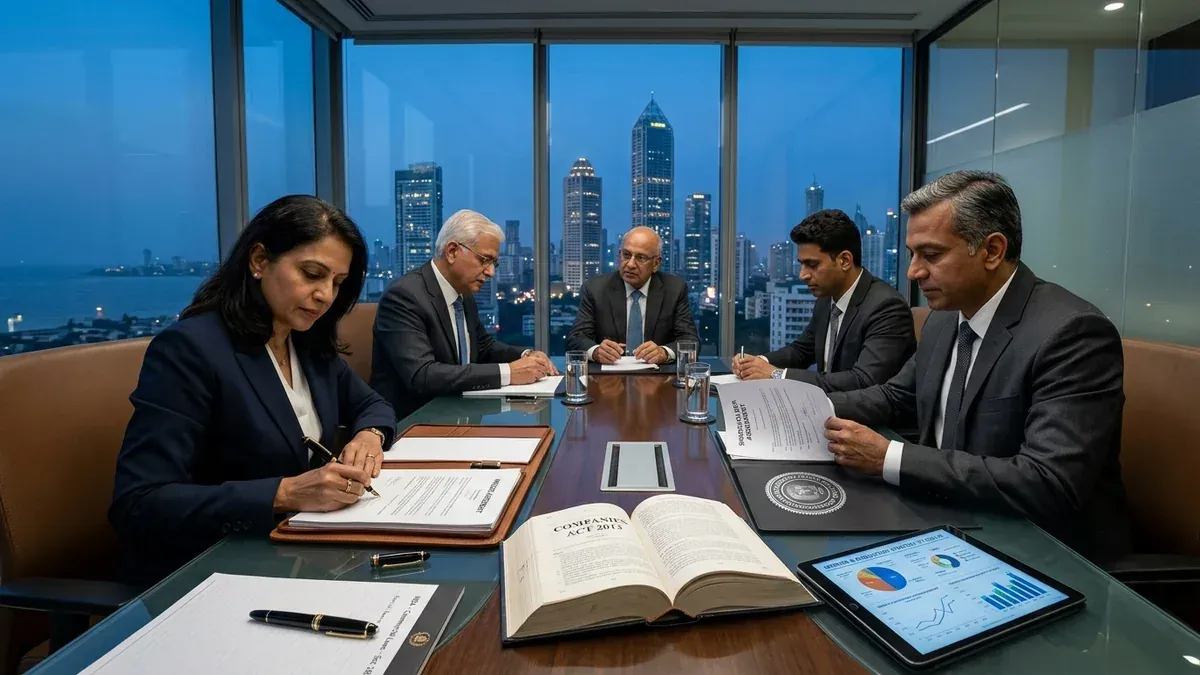
In 2017, the Ministry of Corporate Affairs (MCA) launched an unprecedented enforcement blitz against suspected "shell companies" across India, striking off hundreds of thousands of dormant entities and simultaneously publishing blacklists of disqualified directors under Section 164(2) of the Companies Act, 2013. In tandem, the MCA automatically deactivated the Director Identification Numbers (DIN) of over four lakh individuals on the MCA21 portal. This mass administrative disqualification sent shockwaves through the corporate landscape, as active, compliant operating companies found their boards paralyzed because sitting directors were disqualified overnight due to defaults in unrelated, dormant entities.
The statutory interplay between Section 164(2) (disqualification of directors) and Section 167(1)(a) (vacation of office of director) created an acute constitutional and corporate crisis. Directors were not only barred from re-appointment in the defaulting company for five years, but the MCA interpreted the law to mean that they immediately vacated office across all other fully functional, solvent companies in which they served.
Over the past several years, landmark constitutional challenges before the High Courts of Delhi, Bombay, Gujarat, Madras, and Karnataka have reshaped director disqualification jurisprudence. The courts held that the MCA's automatic deactivation of DINs was ultra vires the Companies Act and in gross violation of natural justice. Today, directors caught in the web of Section 164(2) have precise legal pathways under Article 226 writ jurisdiction and statutory compounding to reactivate their DINs and restore their corporate standing.
Under Section 164(2) of the Companies Act 2013, directors face five-year disqualification if their company defaults on financial statements or annual returns for three consecutive years. Disqualification triggers vacation under Section 167(1). Affected directors can seek DIN reactivation and relief through High Court writ petitions under Article 226.
1. Grounds for Disqualification under Section 164: Personal Defaults vs. Corporate Defaults
Section 164 of the Companies Act, 2013 categorizes director disqualifications into two fundamentally distinct classes: individual disqualifications under subsection (1) and corporate-default disqualifications under subsection (2).
Personal Disqualifications: Section 164(1)
Under Section 164(1), an individual is disqualified from being appointed as a director of any company if:
- Unsound Mind: He is of unsound mind and stands so declared by a competent court;
- Insolvency: He is an undischarged insolvent or has applied to be adjudicated as an insolvent and his application is pending;
- Moral Turpitude / Conviction: He has been convicted by a court of any offense, whether involving moral turpitude or otherwise, and sentenced in respect thereof to imprisonment for not less than six months (with disqualification lasting five years from sentence expiry; or permanently if sentenced to seven years or more);
- Disqualification by Court/Tribunal: An order disqualifying him for appointment as a director has been passed by a court or Tribunal and is in force;
- Unpaid Calls on Shares: He has not paid any calls in respect of any shares of the company held by him for six months from the last date fixed for payment;
- Related Party Conviction: He has been convicted of the offense dealing with related party transactions under Section 188 at any time during the preceding five years; or
- No DIN: He has not been allotted a Director Identification Number under Section 154.
Corporate Defaults: The Lethal Section 164(2) Mechanism
Section 164(2) operates not on personal misconduct, but on the company's collective failure. No person who is or has been a director of a company which:
- Default in Annual Filings: Has not filed financial statements or annual returns for any continuous period of three financial years; or
- Default in Repayment: Has failed to repay the deposits accepted by it or pay interest thereon or to redeem any debentures on the due date or pay dividend declared and such failure continues for one year or more;
shall be eligible to be re-appointed as a director of that company or appointed in other companies for a period of five years from the date on which the company fails to do so.
The Six-Month Safe Harbor for New Directors: Proviso to Section 164(2)
To prevent incoming directors, turnaround professionals, and white-knight investors from being instantly penalized upon assuming directorship in a distressed or non-compliant company, Parliament introduced a crucial protective proviso:
"Provided that where a person is appointed as a director of a company which is in default of clause (a) or clause (b), he shall not incur the disqualification for a period of six months from the date of his appointment."
This statutory safe harbor grants incoming directors an essential six-month grace period to conduct forensic reviews, prepare audited accounts, rectify filing lapses, and restore regulatory compliance without incurring personal disqualification.
Protection of Independent and Non-Executive Directors under Section 149(12)
Independent directors and non-executive directors (NEDs) frequently face unjust disqualification when a company defaults on annual returns. Under Section 149(12) of the Act, an independent director and a non-executive director not being a promoter or key managerial personnel shall be held liable only in respect of such acts of omission or commission by a company which had occurred with his knowledge, attributable through board processes, and with his consent or connivance or where he had not acted diligently.
High Courts across India have repeatedly affirmed that an independent director who resigned prior to the default, or who demonstrated proactive dissent recorded in board minutes, cannot be lumped into administrative disqualification blacklists.
2. The Interplay Between Section 164(2) and Section 167(1)(a): The Contagion Effect
The most contentious legal battleground arose from the automatic trigger under Section 167(1)(a), which dictates:
"The office of a director shall become vacant in case he incurs any of the disqualifications specified in Section 164."
The MCA interpreted this to mean that the moment a director incurred disqualification under Section 164(2) due to default in Company A (e.g., an inactive subsidiary), the director automatically and immediately vacated their directorship in Company B, Company C, and all other compliant operating entities.
The 2018 Statutory Proviso to Section 167(1)(a)
Recognizing that this interpretation was penalizing completely innocent, compliant operating companies and paralyzing business governance, Parliament amended Section 167(1)(a) via the Companies (Amendment) Act, 2017 (effective May 7, 2018), inserting a crucial proviso:
- Vacation Limited to Other Companies: The proviso clarifies that where a director incurs disqualification under Section 164(2), the office of the director shall become vacant in all the companies, other than the company which is in default.
- Legislative Intent: This ensures that the defaulting company does not become entirely boardless, allowing the directors to cure the default in that company, while preventing the contagion from permanently infecting unrelated active boards without due process.
3. The Illegality of DIN Deactivation: Why the MCA's Mass Actions Were Struck Down
When the MCA published the disqualification lists, it unilaterally modified the status of the directors' DINs on the MCA21 portal to "Deactivated due to Section 164(2)".
This administrative move had devastating collateral consequences. Once a DIN is deactivated:
- The director cannot affix their Digital Signature Certificate (DSC) on any MCA statutory forms.
- Even active, profit-making companies where the individual was a director could not file their annual balance sheets, tax audits, or statutory returns because the portal rejected documents signed by a deactivated DIN.
- The company itself was then pushed into statutory default, creating a vicious cycle of cascading corporate disqualifications.
The Companies (Appointment and Qualification of Directors) Rules, 2014
In high-stakes writ petitions, counsel challenged this deactivation by analyzing Rule 11 of the Companies (Appointment and Qualification of Directors) Rules, 2014. Rule 11 explicitly enumerates the exhaustive grounds on which the Central Government or Regional Director may cancel or deactivate a DIN:
- The DIN is found to be duplicated;
- The DIN was obtained by wrongful manner or fraudulent means;
- Death of the individual;
- The individual has been declared as a person of unsound mind by a competent court;
- The individual has been adjudicated an insolvent; or
- On an application made by the individual.
Noticeably absent from Rule 11 is any ground authorizing the deactivation of a DIN on account of disqualification under Section 164(2). The High Courts held that directorship is a personal status governed by DIN, whereas disqualification under Section 164(2) merely limits eligibility to act as a director in specific companies. Deactivating the DIN stripped the person of their fundamental corporate identity without statutory authority.
4. Authoritative Judicial Decisions: Mukut Pathak, Meethelaveetil, and Bhagavan Das
A series of landmark High Court rulings established binding principles protecting directors from retrospective and arbitrary disqualification:
The Supreme Court upheld the constitutional validity of the Insolvency and Bankruptcy Code, 2016, establishing that the paramount objective of the Code is corporate resolution and maximization of asset value rather than debt recovery. The Court underscored that the commercial wisdom of the Committee of Creditors (CoC) is non-justiciable and entitled to primacy in resolution plan approvals.
1. Mukut Pathak v. Union of India (Delhi High Court, 2019)
In this monumental judgment delivered by Justice Sanjeev Sachdeva, the Delhi High Court ruled on hundreds of consolidated writ petitions:
- No Retrospective Application: Section 164(2) of the Companies Act, 2013 came into force on April 1, 2014. Financial years prior to 2014-15 could not be factored in to compute the three-year continuous default. The default could only be reckoned starting from FY 2014-15, meaning no disqualification could legally occur before November 1, 2017.
- DIN Deactivation is Quashed: The High Court declared the deactivation of DINs for Section 164(2) defaults as completely ultra vires the Act and Rules, issuing a writ of mandamus directing the MCA to reactivate all such DINs forthwith.
- Natural Justice Violation: Disqualifying directors without issuing prior show-cause notices or affording an opportunity of being heard violated Article 14 of the Constitution.
2. Meethelaveetil Kaitheri Muralidharan v. Union of India (Madras High Court, 2020)
The Madras High Court concurred entirely with the Delhi High Court, holding that the publication of disqualification lists without prior notice was fatal to the administrative action. The court directed the immediate restoration of DINs and permitted directors to file statutory returns for active companies.
3. Bhagavan Das Dhananjaya Das v. Union of India (Karnataka High Court)
The Karnataka High Court reiterated that the power to deactivate a DIN cannot be exercised as an automatic penal consequence of Section 164(2). The DIN is a permanent identification number assigned to an individual, akin to a PAN, and must remain active to allow compliance filings.
5. Step-by-Step Legal Roadmap to Reactivate Deactivated DIN
For directors currently disqualified on the MCA portal, the following legal strategies represent the established mechanisms for securing DIN reactivation and corporate rehabilitation:
| Pathway | Forum / Authority | Legal Basis | Expected Outcome & Timeline |
|---|---|---|---|
| Writ Petition (Article 226) | High Court having territorial jurisdiction | Violation of Art. 14/19(1)(g); Rule 11 ultra vires; Mukut Pathak & Muralidharan precedents. | Interim stay on disqualification within 1-2 weeks; mandatory directions to MCA to reactivate DIN. |
| Company Restoration (Sec 252) | National Company Law Tribunal (NCLT) | Appeal against ROC strike-off of defaulting company under Section 248. | Once company is restored and pending returns filed, grounds for Section 164(2) default cease. |
| Expiry of 5-Year Disqualification | Registrar of Companies / Regional Director | Statutory lapse of the 5-year disqualification period under Section 164(2). | Filing Form DIR-10 with RD/ROC seeking automatic status update on MCA21 portal. |
| Amnesty Schemes (e.g., CFSS / Condonation) | MCA Schemes (When active) | Companies Fresh Start Scheme or Special Condonation windows. | Immunity from prosecution and filing overdue returns with regular nominal fees. |
Filing Form DIR-10 for Removal of Disqualification
Where the statutory five-year disqualification period has naturally elapsed, the disqualification does not always lift automatically on the MCA portal due to technical architecture limitations. The director must submit an application in Form DIR-10 (Application for removal of disqualification of directors) to the concerned Registrar of Companies, accompanied by proof that five years have elapsed since the default occurred and that no other disqualifications under Section 164(1) exist.
6. The 2019/2020 Reforms: In-House Adjudication (Section 454) vs. Compounding (Section 441)
A transformative legislative shift occurred via the Companies (Amendment) Acts of 2019 and 2020, which re-categorized dozens of minor, technical, and procedural defaults from the criminal justice system into an administrative civil penalty framework under Section 454 (Adjudication of Penalties).
Understanding the dividing line between Section 454 and Section 441 is critical for corporate litigators:
- In-House Adjudication Mechanism (IAM) under Section 454: Defaults punishable by penalties (e.g., delayed filing of financial statements under Section 137, failure to file annual returns under Section 92, non-filing of Form INC-22A) are adjudicated directly by the Registrar of Companies acting as the Adjudicating Officer. No compounding application lies for these sections because they do not carry criminal fines. The ROC directly imposes monetary penalties, subject to appeal before the Regional Director under Section 454(5).
- Compounding under Section 441: Compounding applies exclusively to provisions where the legislature has retained criminal fines or imprisonment in the alternative, adjudicated before the Special Court. Examples include Section 185 (Loans to Directors), Section 188 (Related Party Transactions), and Section 128 (Failure to maintain books of account). Here, Section 441 remains the indispensable settlement mechanism to avert criminal trials.
Compounding of Cross-Border Corporate Non-Compliance: FEMA 1999 vs. Companies Act
Multinational corporations and foreign-funded Indian entities often commit dual defaults involving both the Companies Act and foreign exchange regulations. Where foreign direct investment (FDI), downstream investments, or external commercial borrowings (ECB) are involved, delays in reporting share allotments not only violate Section 42/62 of the Companies Act but also attract contraventions under the Foreign Exchange Management Act, 1999 (FEMA).
Corporate legal teams must coordinate parallel compounding strategies: filing Form GNL-1 before the RD/NCLT under Section 441 for company law omissions, while simultaneously submitting a compounding application before the Reserve Bank of India (RBI) under the Foreign Exchange (Compounding Proceedings) Rules, 2000. Resolving one forum without addressing the other leaves directors exposed to regulatory enforcement from the Directorate of Enforcement (ED).