
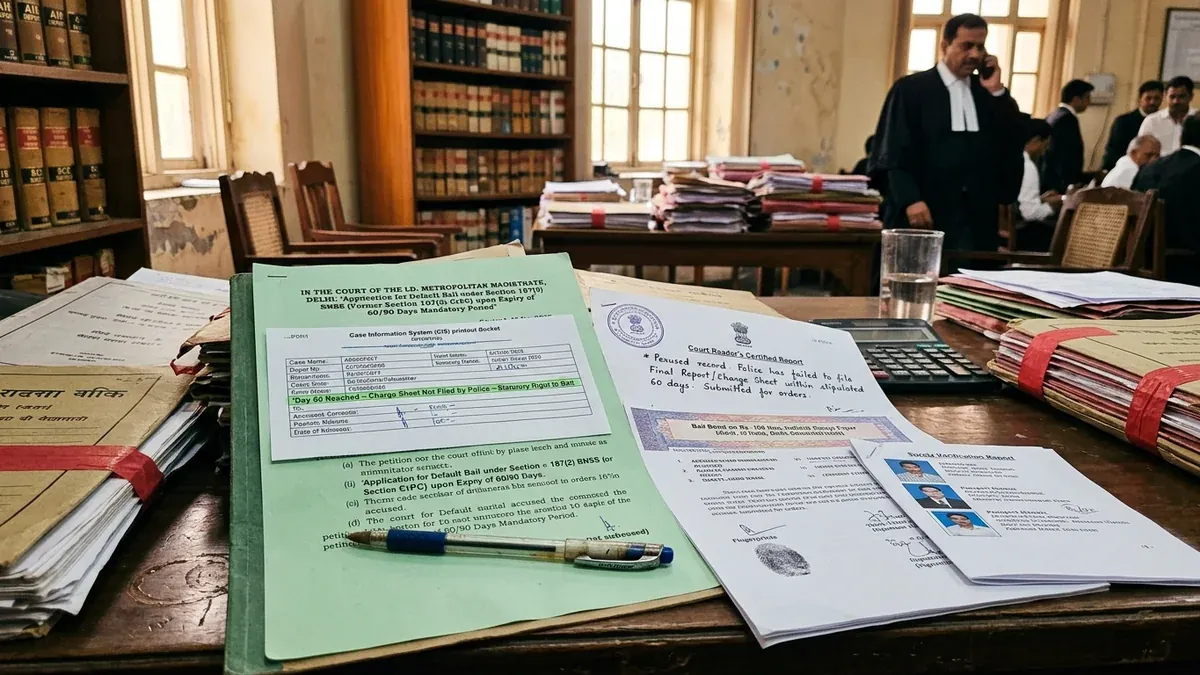
Default bail—also termed statutory bail or compulsory bail—is one of the most inviolable constitutional safeguards in Indian criminal justice. Governed by Section 187 of the Bharatiya Nagarik Suraksha Sanhita, 2023 (BNSS) (formerly Section 167(2) of the Code of Criminal Procedure, 1973), default bail serves as a statutory check against indolent, sluggish, or malicious police investigations, guaranteeing that an accused person cannot be detained indefinitely during pre-charge sheet remand.
The Supreme Court of India in landmark decisions including Uday Mohanlal Acharya (2001), Bikramjit Singh v. State of Punjab (2020), and M. Ravindran v. Intelligence Officer, DRI (2021) has held that default bail is an intrinsic facet of the fundamental right to personal liberty under Article 21 of the Constitution. Once the statutory time window expires, the right to bail becomes absolute and indefeasible.
Under Section 187 BNSS, an accused gains an indefeasible fundamental right to default bail if police fail to file a complete charge sheet within 60 or 90 days. The Supreme Court in Bikramjit Singh affirmed that default bail is part of Article 21 and cannot be defeated by belated police filings.
1. Statutory Timelines: The 60-Day and 90-Day Mandate
Under Section 187(4) and (5) BNSS, the maximum duration for which a Magistrate can authorize the detention of an undertrial prisoner during investigation is strictly defined:
| Statutory Period | Applicable Offences | Legal Effect of Non-Filing |
|---|---|---|
| 90 Days | Offences punishable with death, imprisonment for life, or imprisonment for not less than 10 years. | Accused must be released on bail on Day 91 if ready and willing to furnish bail bonds. |
| 60 Days | All other offences punishable with imprisonment up to 10 years (e.g. cheating, theft, forgery). | Accused must be released on bail on Day 61 upon filing an application and readiness to furnish surety. |
2. The Indefeasible Right: Availing Bail Before Charge Sheet Filing
The core operational principle established in Bikramjit Singh and M. Ravindran is the doctrine of the "Indefeasible Right":
"The moment the 60 or 90 days elapse without a police report being filed, the right to default bail accrues to the accused. If the accused files an application availing this right, no subsequent filing of a charge sheet later that day or while the bail plea is pending can defeat or extinguish that accrued right."
Courts cannot adjourn default bail applications to give police additional time to scramble and submit a charge sheet. Once the application is submitted, the court must promptly verify only two facts: (1) whether the statutory period has expired, and (2) whether a complete charge sheet was filed prior to the application.
3. The Trap of "Incomplete" or "Preliminary" Charge Sheets
Investigating agencies frequently attempt to defeat default bail by filing hastily cobbled, "piecemeal" or "incomplete" charge sheets without forensic reports, sanction orders, or crucial documentary annexures.
In Ritu Chhabaria v. Union of India (2023 SCC OnLine SC 502), the Supreme Court ruled that filing an incomplete investigation report solely to thwart default bail violates fundamental rights. The investigation must be substantially complete against the accused before police custody can transition into regular trial custody.
Landmark Judicial Precedents & Statutory Authorities
Courts and appellate tribunals across Delhi NCR (Faridabad, Saket, Tis Hazari, Gurugram, High Courts) strictly apply these authoritative Supreme Court benchmarks:
The Constitution Bench settled that anticipatory bail under Section 438 CrPC (Section 482 BNSS) should not routinely be limited to a fixed time frame, reaffirming that personal liberty under Article 21 cannot be curtailed on vague apprehensions. In Satender Kumar Antil, the Supreme Court mandated that investigating agencies and magistrates strictly adhere to procedural compliance under Section 41A (Section 35 BNSS), establishing that arrests must be justified by exceptional necessity rather than mechanical executive exercise.