
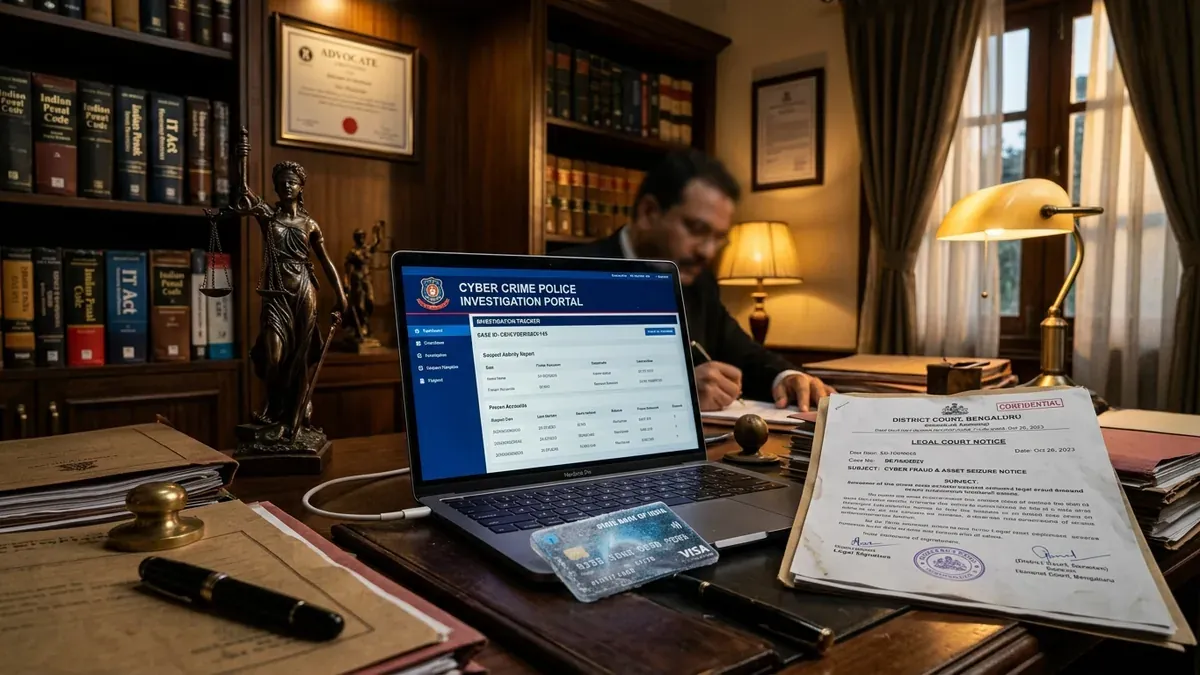
With the exponential rise in cyber crime complaints filed on the National Cyber Crime Reporting Portal (NCRP / 1930 Helpline), thousands of legitimate business owners, digital merchants, crypto traders, and professionals suddenly wake up to find their corporate and savings bank accounts frozen. Police cyber cells across India routinely issue sweeping notices to banks under Section 106 of the Bharatiya Nagarik Suraksha Sanhita, 2023 (BNSS) / Section 102 of the Code of Criminal Procedure, 1973 (CrPC).
While law enforcement requires swift powers to track defrauded funds, indiscriminate debit freezes placed on total account balances paralyse legitimate business operations. Understanding the statutory boundaries of Section 106 BNSS, mandatory judicial oversight, and the procedural blueprint for de-freezing accounts before the jurisdictional Magistrate is essential for immediate commercial relief.
Under Section 106 BNSS, police can seize or freeze bank accounts suspected of being connected to criminal offences. However, officers must report the freeze immediately to the jurisdictional Magistrate. Account holders can petition the Magistrate for account de-freezing by demonstrating legitimate business origin and executing an indemnity bond.
1. Statutory Scope of Bank Account Freezing under Section 106 BNSS
Section 106 BNSS empowers police officers to seize property suspected to be stolen or connected to an offence:
"Any police officer may seize any property which may be alleged or suspected to have been stolen, or which may be found under circumstances which create suspicion of the commission of any offence... Every police officer acting under sub-section (1) shall forthwith report the seizure to the Magistrate having jurisdiction."
The Supreme Court in State of Maharashtra v. Tapas D. Neogy (1999 7 SCC 685) confirmed that bank accounts constitute "property" capable of seizure under Section 102 CrPC / Section 106 BNSS. However, the statute explicitly commands that any such freeze must be forthwith reported to the jurisdictional Magistrate.
2. Mandatory Judicial Safeguards & Common Police Violations
Police cyber cells frequently violate statutory mandates when freezing accounts:
The Supreme Court upheld the constitutional validity of the SARFAESI Act, 2002, while guaranteeing that secured borrowers possess an efficacious statutory remedy under Section 17 before the Debt Recovery Tribunal (DRT). In Satyawati Tondon, the Court held that High Courts should refrain from entertaining Article 226 writ petitions in commercial banking recovery matters when an alternate statutory remedy is available under the RDDBFI or SARFAESI Acts.
- Failure to Report to Magistrate: In over 80% of cyber freezes, police email banks instructing them to freeze accounts but fail to inform the Magistrate. High Courts have repeatedly ruled that failure to report forthwith renders the freeze illegal (Teesta Atul Setalvad v. State of Gujarat).
- Total Freeze Instead of Disputed Amount: Freezing an account containing ₹50,00,000 over a disputed transaction of ₹25,000 is disproportionate and violates the doctrine of proportionality under Article 19(1)(g) and Article 21.
- Freezing Layer 3 and Layer 4 Innocent Accounts: Freezing accounts of merchants who sold goods in good faith to a buyer who unknowingly received tainted funds.
3. Procedure for De-Freezing Before the Jurisdictional Magistrate
An aggrieved account holder should immediately file an application under Section 503 BNSS (Section 451/457 CrPC) before the Magistrate having territorial jurisdiction over the police station that ordered the freeze:
| Step | Legal Action | Key Documents Required |
|---|---|---|
| 1. Bank Notice Scrutiny | Obtain freeze requisition copy from bank manager | Notice containing FIR/NCR number, investigating officer name, and cyber cell police station details. |
| 2. Section 503 BNSS Application | File petition before jurisdictional Magistrate | Petition detailing bona fide commercial transaction, invoices, GST returns, and audited bank ledger. |
| 3. Furnishing Indemnity Bond | Execute bond for disputed transaction amount | Undertaking to produce funds if court orders confiscation upon conclusion of trial. |