
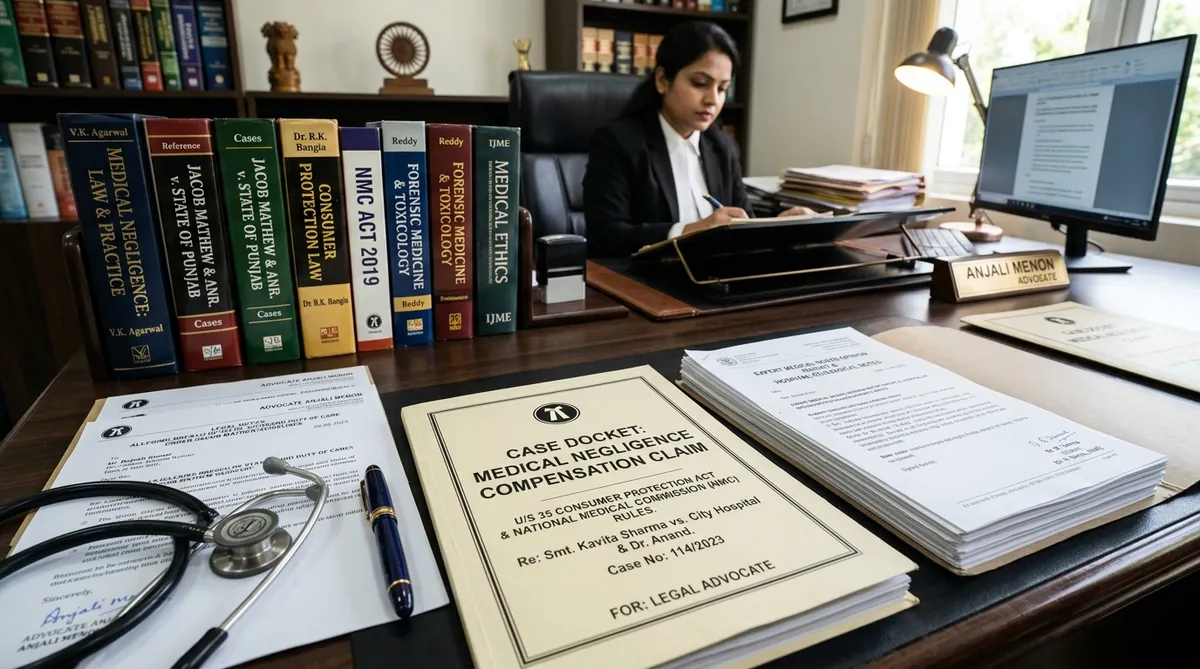
When a patient dies in a hospital intensive care unit or post-operative recovery ward, grieving families frequently experience profound outrage. In many instances, local police stations are pressured by mobs or relatives to register immediate criminal FIRs against treating doctors and surgeons under penal homicide provisions (formerly Section 304A IPC, now Section 106 of the Bharatiya Nyaya Sanhita, 2023).
Recognizing that the constant specter of criminal arrest forces doctors into "defensive medicine"—refusing to treat critically ill patients or perform high-risk emergency surgeries—the Supreme Court of India in the monumental 3-Judge Bench ruling Jacob Mathew v. State of Punjab (2005) 6 SCC 1 laid down mandatory procedural safeguards.
In Jacob Mathew v. State of Punjab, the Supreme Court established strict protections shielding medical professionals from frivolous criminal prosecution. To sustain an FIR under Section 106 BNS (304A IPC), the negligence must be gross, reckless, or flagrant, supported by an independent expert government medical opinion prior to arrest.
1. Conceptual Divide: Simple Negligence vs. Gross Negligence
The core jurisprudence of Jacob Mathew hinges on the qualitative gulf between civil malpractice and criminal liability:
- Civil Negligence: In tort law and consumer forums, liability is founded on failure to exercise ordinary reasonable care, assessed on the balance of probabilities, resulting in monetary compensation.
- Criminal Negligence (Section 106 BNS / 304A IPC): Demands a far higher degree of culpability—gross negligence, utter recklessness, or reckless disregard for human life. The prosecution must prove guilt beyond all reasonable doubt.
- Lord Atkin's Formula: The negligence must show such disregard for the life and safety of others as to amount to a crime against the State and conduct deserving punishment.
2. Mandatory Pre-FIR Police Protocols
To prevent harassment and extortion of healthcare professionals, the Supreme Court enacted inviolable directives for police:
"A private complaint against a doctor shall not be entertained by a court unless the complainant produces prima facie medical evidence from another competent doctor. Investigating officers cannot register an FIR or arrest a doctor unless an independent medical opinion from a government medical board confirms gross negligence."
- No Routine Arrest: A doctor cannot be arrested mechanically merely because an allegation of death by negligence is made.
- Medical Board Referral: The IO must refer case sheets to an impartial board of qualified doctors in the relevant medical specialty.
- Anticipatory Bail: Unless necessary for custodial interrogation, doctors are entitled to anticipatory bail as a matter of judicial policy.
3. The Statutory Exception in BNS 2023
Parliament gave statutory recognition to medical protections in the Bharatiya Nyaya Sanhita, 2023:
- Section 106(1) First Proviso: While causing death by rash or negligent act carries imprisonment up to five years for general offenders, the proviso explicitly states that if such act is done by a registered medical practitioner while performing medical procedures, the punishment is restricted to imprisonment up to two years and fine.
Landmark Judicial Precedents & Statutory Authorities
Courts and appellate tribunals across Delhi NCR (Faridabad, Saket, Tis Hazari, Gurugram, High Courts) strictly apply these authoritative Supreme Court benchmarks:
The Supreme Court laid down the classic seven illustrative categories where the High Court must exercise inherent powers under Section 482 CrPC (Section 528 BNSS) to quash FIRs and criminal proceedings to prevent abuse of judicial process. The Bench held that where the allegations in the FIR, even if taken at face value, do not disclose the commission of any cognizable offence, or where the prosecution is manifestly attended with mala fide motives, the criminal proceedings are liable to be quashed at the threshold.