
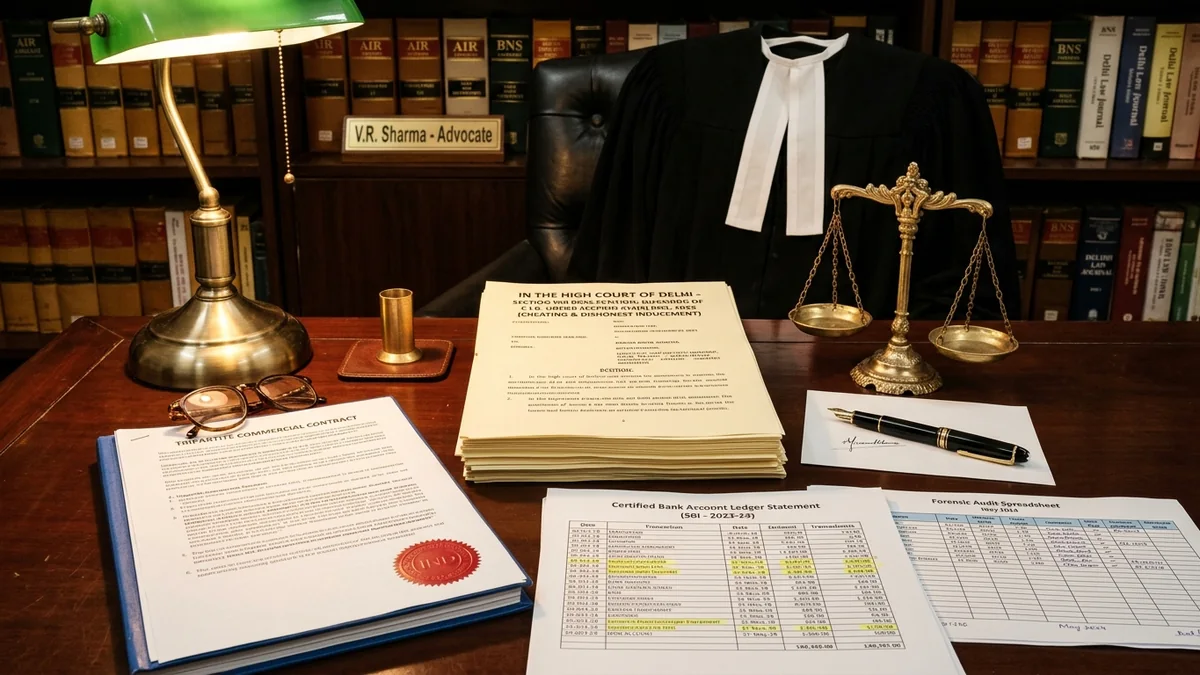
In Indian commercial life, one of the most widespread abuses of the criminal justice system is the weaponization of cheating allegations to enforce civil contractual liabilities. When business transactions sour, loans default, or delivery schedules fail, aggrieved parties routinely bypass commercial civil courts and file criminal First Information Reports (FIRs) alleging fraud and cheating under Section 318 of the Bharatiya Nyaya Sanhita, 2023 (BNS) (replacing Sections 415 and 420 of the Indian Penal Code, 1860).
The Supreme Court of India has repeatedly decried this practice as an abuse of judicial process. In authoritative rulings from Hriday Ranjan Prasad Verma (2000) to Vesa Holdings P. Ltd. v. State of Kerala (2015), the apex court firmly established that every breach of contract does not give rise to criminal cheating unless fraudulent intention existed at the very inception of the agreement.
Under Section 318 BNS, criminal cheating requires fraudulent or dishonest intention at the very inception of the transaction. A mere breach of commercial contract or subsequent failure to pay does not constitute a criminal offence, and High Courts routinely quash such FIRs under Section 528 BNSS to prevent extortion.
1. Statutory Architecture of Section 318 BNS
Section 318(1) BNS defines cheating, while Section 318(4) provides enhanced punishment for cheating and dishonestly inducing delivery of property (formerly Section 420 IPC):
"Whoever, by deceiving any person, fraudulently or dishonestly induces the person so deceived to deliver any property to any person... shall be punished with imprisonment of either description for a term which may extend to seven years, and shall also be liable to fine."
To sustain a prosecution under Section 318(4) BNS, two essential ingredients must co-exist: (1) deception of any person, and (2) fraudulently or dishonestly inducing that person to deliver property.
2. Mens Rea at Inception: The Supreme Court Test
The distinguishing line between a mere civil breach of contract and criminal cheating hinges on the precise point in time at which intention was formed:
The Supreme Court laid down the classic seven illustrative categories where the High Court must exercise inherent powers under Section 482 CrPC (Section 528 BNSS) to quash FIRs and criminal proceedings to prevent abuse of judicial process. The Bench held that where the allegations in the FIR, even if taken at face value, do not disclose the commission of any cognizable offence, or where the prosecution is manifestly attended with mala fide motives, the criminal proceedings are liable to be quashed at the threshold.
"To hold a person guilty of cheating under Section 420 IPC (now Section 318 BNS), it is necessary to show that he had fraudulent or dishonest intention at the time of making the promise. From his mere failure to keep promise subsequently such a culpable intention cannot be presumed."
— Supreme Court in Hridaya Ranjan Prasad Verma v. State of Bihar (2000 4 SCC 168)
If a businessman enters into an agreement intending to execute it, but subsequent market fluctuations, bankruptcy, or liquidity crises cause a default, the failure is a purely civil breach actionable in a civil suit, not a criminal offence.
3. High Court Quashing under Section 528 BNSS
When an FIR is registered over a commercial transaction, defense counsel should immediately approach the High Court under Section 528 BNSS (Section 482 CrPC). In Indian Oil Corporation v. NEPC India Ltd. (2006) and Prof. R.K. Vijayasarathy v. Sudha Seetharam (2019), the Supreme Court held that High Courts have an affirmative duty to quash criminal proceedings where an essentially civil dispute is cloaked with criminal flavor to exert illicit pressure.