
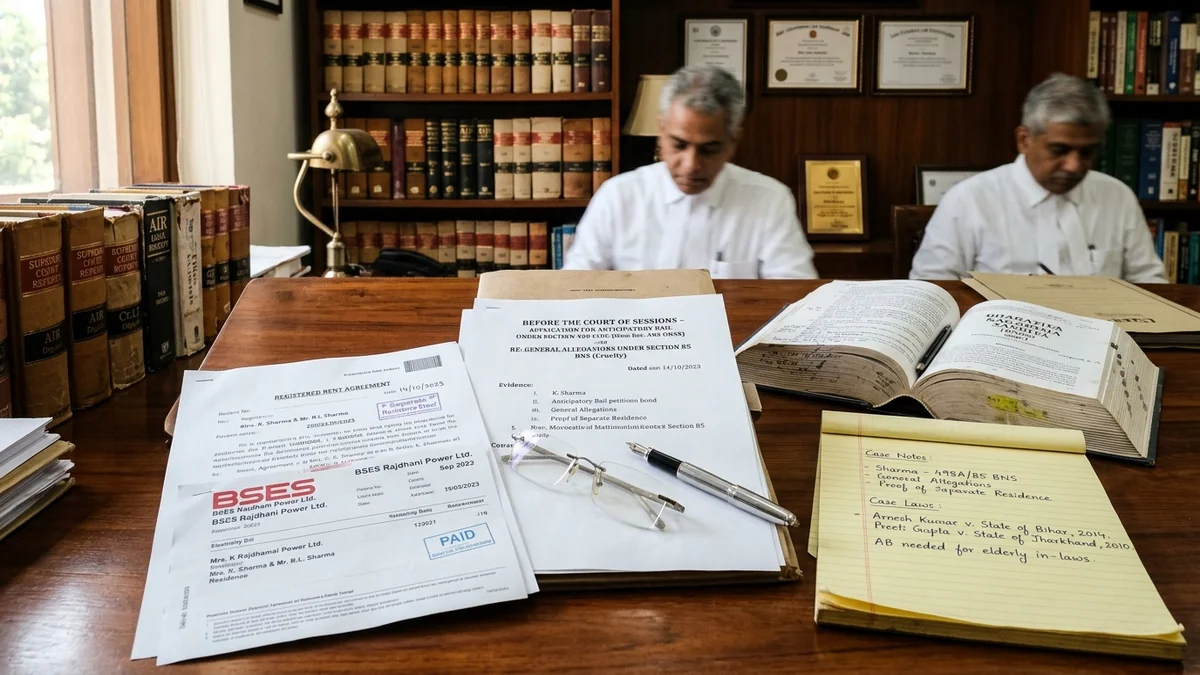
Personal liberty is the bedrock of constitutional democracy under Article 21 of the Constitution of India. Recognizing that the threat of arrest is frequently weaponized in commercial disputes, matrimonial feuds, and political rivalries, the Bharatiya Nagarik Suraksha Sanhita, 2023 (BNSS) codifies pre-arrest bail under Section 482 (formerly Section 438 of the Code of Criminal Procedure, 1973).
Anticipatory bail provides a critical statutory shield, directing that in the event of arrest, the person shall be released on bail. Guided by landmark Constitution Bench verdicts in Gurbaksh Singh Sibbia (1980) and Sushila Aggarwal v. State (NCT of Delhi) (2020), Section 482 BNSS balances the citizen’s right against unwarranted custodial humiliation with the state’s legitimate interest in unhindered crime investigation.
Under Section 482 BNSS, individuals apprehending arrest on accusation of having committed a non-bailable offence can apply to the Sessions Court or High Court for anticipatory bail. The Supreme Court in Sushila Aggarwal held that anticipatory bail should not ordinarily be limited in time and endures until trial conclusion.
1. Statutory Architecture of Section 482 BNSS
Section 482(1) BNSS states:
"Where any person has reason to believe that he may be arrested on accusation of having committed a non-bailable offence, he may apply to the High Court or the Court of Session for a direction under this section that in the event of such arrest he shall be released on bail; and that Court may, after taking into consideration, inter alia, the following factors, namely—
(i) the nature and gravity of the accusation;
(ii) the antecedents of the applicant;
(iii) the possibility of the applicant to flee from justice; and
(iv) where the accusation has been made with the object of injuring or humiliating the applicant by having him so arrested,
either reject the application forthwith or issue an interim order for the grant of anticipatory bail."
2. Life and Duration of Anticipatory Bail: Sushila Aggarwal
In Sushila Aggarwal v. State (NCT of Delhi) (2020 5 SCC 1), a 5-judge Constitution Bench settled two monumental questions regarding pre-arrest bail:
| Core Question | Supreme Court Constitution Bench Ruling |
|---|---|
| Duration / Time Limitation | Anticipatory bail should not ordinarily be limited to a fixed time period. Unless specific circumstances justify a temporal cap, the protection endures until the conclusion of the trial. |
| Effect of Filing Charge Sheet | The mere filing of a charge sheet under Section 193 BNSS / 173 CrPC does not extinguish anticipatory bail. The accused is not required to surrender and apply afresh for regular bail. |
3. Transit Anticipatory Bail Across State Borders
When an individual residing in Delhi or Mumbai apprehends arrest by police from another state (e.g. Karnataka or Assam), they can apply for Transit Anticipatory Bail before their local Sessions Court or High Court.
In Priya Indoria v. State of Karnataka (2023 SC), the Supreme Court affirmed that extraterritorial transit anticipatory bail can be granted by the High Court of the state where the applicant resides, providing limited interim protection (typically 2 to 4 weeks) enabling the applicant to travel safely to the court of competent jurisdiction in the other state.
Landmark Judicial Precedents & Statutory Authorities
Courts and appellate tribunals across Delhi NCR (Faridabad, Saket, Tis Hazari, Gurugram, High Courts) strictly apply these authoritative Supreme Court benchmarks:
The Constitution Bench settled that anticipatory bail under Section 438 CrPC (Section 482 BNSS) should not routinely be limited to a fixed time frame, reaffirming that personal liberty under Article 21 cannot be curtailed on vague apprehensions. In Satender Kumar Antil, the Supreme Court mandated that investigating agencies and magistrates strictly adhere to procedural compliance under Section 41A (Section 35 BNSS), establishing that arrests must be justified by exceptional necessity rather than mechanical executive exercise.