
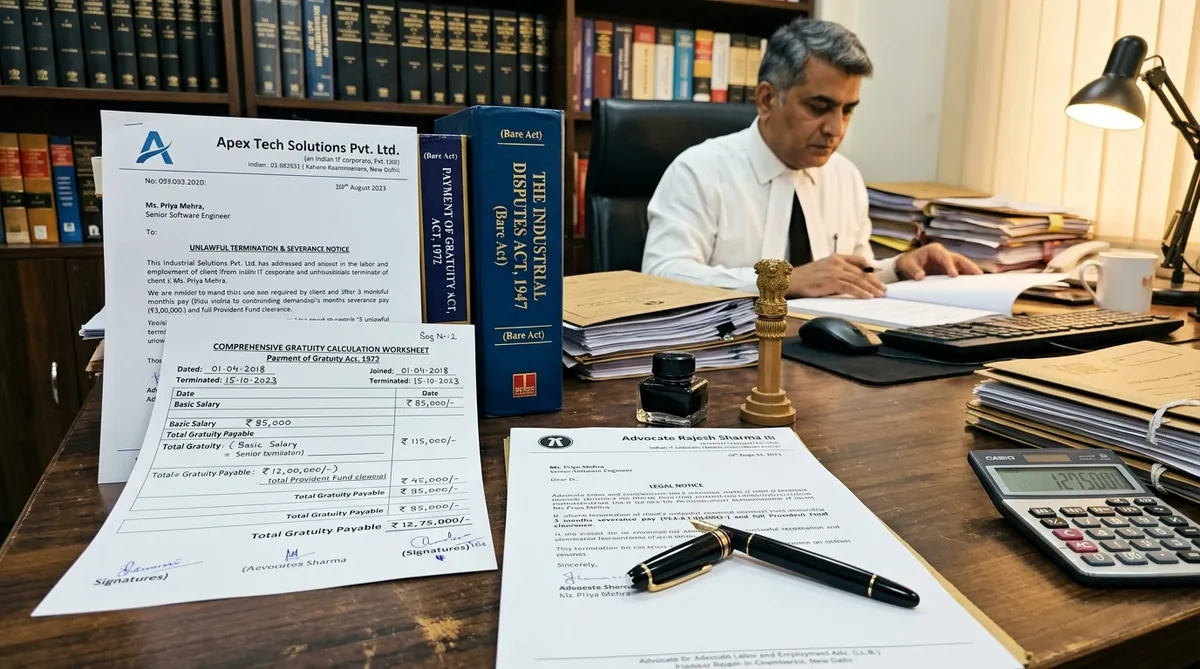
In Indian employment litigation, the preliminary jurisdictional battle between an employer and an aggrieved employee almost invariably turns on a single existential question: Is the employee a "workman" under Section 2(s) of the Industrial Disputes Act, 1947 (IDA)?
The answer dictates the entire legal battlefield. If an individual is a workman, they enjoy the formidable armor of statutory labour welfare: protection against arbitrary retrenchment under Section 25F, statutory seniority rights under Section 25G, mandatory notice of change under Section 9A, and direct access to Labour Courts with sweeping powers to order reinstatement with full back wages under Section 11A. If, however, the employee is classified as part of the "managerial, administrative, or supervisory" cadre, their rights are strictly confined to the four corners of their private employment contract, enforceable only through protracted civil suits.
In modern knowledge economies—where software developers, technical leads, data scientists, and QA analysts earn six-figure salaries while carrying sophisticated corporate titles like "Associate Director", "Vice President", or "Engineering Manager"—this classification has generated intense judicial contestation. This treatise provides an authoritative examination of the statutory definitions, the landmark Constitution Bench tests, and the judicial criteria used to distinguish a workman from managerial personnel.
Under Section 2s of the Industrial Disputes Act 1947, classification as a workman depends strictly on the dominant nature of actual duties performed, rather than formal job designations. Employees exercising managerial, administrative, or supervisory powers exceeding statutory wage ceilings fall outside workman protections, whereas software engineers often qualify absent administrative control.
1. The Statutory Architecture of Section 2(s) IDA
Section 2(s) of the Industrial Disputes Act, 1947 defines a "workman" through an inclusive opening clause followed by four specific statutory exclusions:
"'Workman' means any person (including an apprentice) employed in any industry to do any manual, unskilled, skilled, technical, operational, clerical or supervisory work for hire or reward, whether the terms of employment be express or implied..."
The Four Express Statutory Exclusions
The section explicitly excludes four categories of persons from the definition:
- Persons subject to the Air Force Act, Army Act, or Navy Act;
- Persons employed in the police service or as an officer or other employee of a prison;
- Persons employed mainly in a managerial or administrative capacity; or
- Persons employed in a supervisory capacity who draw wages exceeding ten thousand rupees (Rs. 10,000) per month, or who exercise, by the nature of duties attached to the office or by reason of powers vested in them, functions mainly of a managerial nature.
Under the new Industrial Relations Code, 2020 (Section 2(zr)), the supervisory wage ceiling has been updated from Rs. 10,000 to eighteen thousand rupees (Rs. 18,000) per month.
2. The "Dominant Nature of Duties" Doctrine: Substance over Designation
For decades, corporate employers argued that assigning senior titles ("Manager", "Leader", "Executive") or paying high compensation automatically excluded an employee from workman status. The Supreme Court has decisively rejected this argument.
The Landmark Constitution Bench Ruling: H.R. Adyanthaya (1994)
In the seminal Constitution Bench decision in H.R. Adyanthaya v. Sandoz (India) Ltd. (1994) 5 SCC 737, the Supreme Court synthesized decades of conflicting jurisprudence:
"The Supreme Court ruled: An employee does not become a workman merely because they do not fall within the exclusions. The person must affirmatively prove that they are employed to do work falling into one of the positive categories: manual, unskilled, skilled, technical, operational, clerical, or supervisory. Job designation, nomenclature, and salary quantum are irrelevant; the court must determine the 'dominant nature' of the primary duties performed."
If an employee performs incidental supervisory or administrative tasks (such as checking a junior's code or recommending leave), but the dominant, core essence of their role involves writing software code, analyzing data, or operating machinery, their true legal character remains that of a skilled or technical workman.
3. Distinguishing Managerial, Supervisory & Technical Functions
Labour Courts and High Courts apply precise empirical tests to distinguish these categories:
1. What Constitutes "Managerial" Capacity?
Managerial functions involve the power to bind the enterprise commercially and formulate executive policy. A managerial employee exercises:
- Hiring and Firing Authority: The independent power to recruit, discipline, suspend, or terminate employees;
- Financial Sanctioning Power: Unilateral authority to incur corporate capital or operational expenditure;
- Policy Direction: Formulating company-wide business strategy rather than merely executing pre-determined processes.
2. What Constitutes "Supervisory" Capacity?
Supervisory work involves directing, overseeing, and guiding the work of subordinates. As established in National Engineering Industries Ltd. v. Shri Kishan Bhageria (1988):
- A supervisor inspects and oversees the work of others to ensure accuracy and compliance;
- If an employee has no subordinates working under them, they cannot legally be classified as a supervisor;
- Under the IDA, a supervisor is excluded only if their wages exceed Rs. 10,000 per month (Rs. 18,000 under the IR Code).
3. What Constitutes "Technical" Work?
Technical work requires specialized training, scientific knowledge, or engineering proficiency. A software engineer, data analyst, structural engineer, or chemical researcher applies specialized expertise to build or troubleshoot systems. Unless they spend the majority of their time managing people, budgeting, and directing enterprise policy, they are classified as technical workmen.
4. The IT/ITES Worker Classification: Are Software Engineers "Workmen"?
The application of Section 2(s) to India's multi-billion dollar information technology sector has been crystallized in major High Court judgments:
1. Madras High Court: K. Rameshbabu v. Wipro Ltd.
In K. Rameshbabu v. Wipro Ltd. and Cognizant Technology Solutions v. Deputy Commissioner of Labour, the Madras High Court held that software engineers and programmers who write code, test software modules, and maintain technical documentation perform "technical and skilled" work. Merely earning a high salary does not strip an engineer of workman status in the absence of managerial control.
2. Karnataka and Delhi High Court Rulings
In M.C. Raju v. Executive Director, M/s Mackinnon Mackenzie and Divyashree v. Wipro, courts affirmed that employees designated as "Team Leads" or "Project Managers" are workmen if their primary responsibility is software architecture and coding, while administrative duties (such as marking team attendance) are purely incidental.
5. Evidentiary Audit: Establishing Status in Labour Court Proceedings
When an employer challenges the maintainability of an industrial dispute by claiming the claimant is a manager, the Labour Court conducts an exhaustive factual inquiry:
Evidentiary Discovery Matrix before Labour Court
| Documentary Evidence | Proves Workman Status | Proves Managerial Status |
|---|---|---|
| Job Description & KRA Sheet | Coding, testing, bug fixing, operational execution, lack of budgetary power. | Strategic planning, P&L responsibility, resource allocation authority. |
| Leave Sanction Records | Requires prior approval from superiors; has no power to sanction leaves of others. | Possesses unilateral power to approve, reject, or cancel employee leave applications. |
| Appraisal & Disciplinary Powers | Subject to appraisals; cannot initiate disciplinary inquiries against colleagues. | Writes performance reviews, issues show-cause notices, recommends promotions or dismissals. |
| Financial Delegations | No power to sign company cheques, approve vendor POs, or execute contracts. | Authorized signatory for banking, vendor contracts, and client proposals. |
Landmark Judicial Precedents & Statutory Authorities
Courts and appellate tribunals across Delhi NCR (Faridabad, Saket, Tis Hazari, Gurugram, High Courts) strictly apply these authoritative Supreme Court benchmarks:
The Constitution Bench established the landmark principles governing the abolition and absorption of contract labour under the Contract Labour (Regulation and Abolition) Act, 1970. The Court held that mere issuance of a notification prohibiting contract labour under Section 10 does not lead to automatic absorption; however, where the contract arrangement is found to be a sham or camouflage to deny statutory benefits, the industrial adjudicator is fully empowered to direct regular employment.