
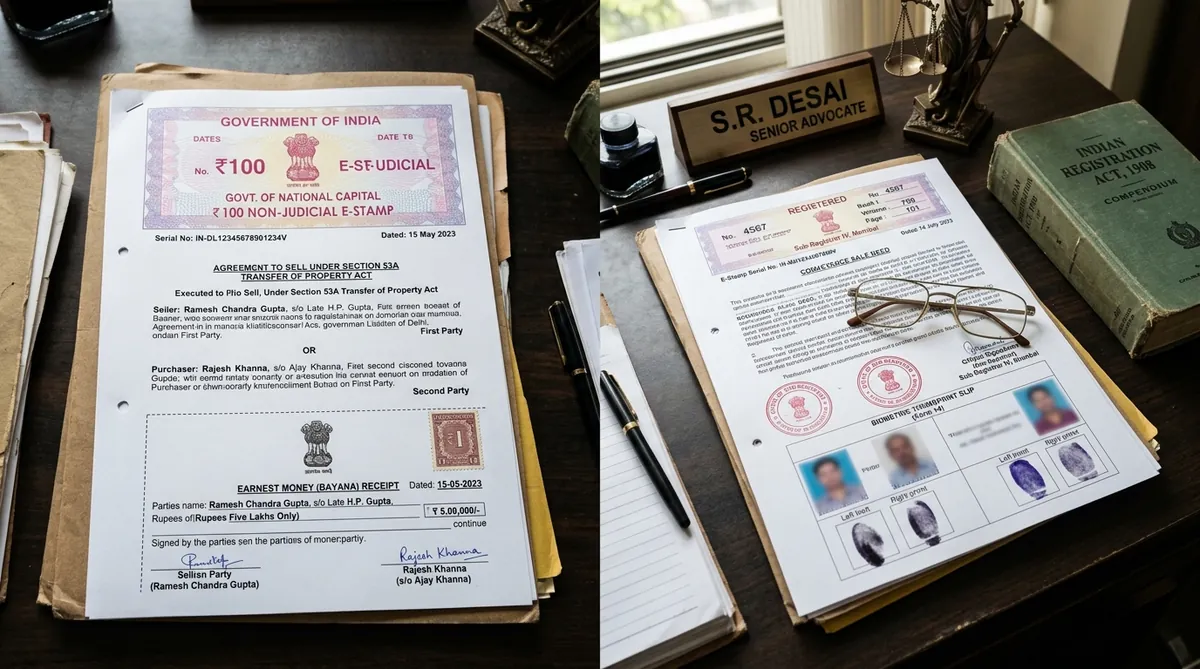
In property transactions across India, buyers routinely pay substantial earnest money, enter into written agreements to sell (Bayana agreements), and take physical possession of premises with the understanding that formal registered sale deeds will follow upon full payment.
However, when sellers subsequently backtrack, issue eviction notices, or attempt to convey the property to third parties, buyers rely heavily on the equitable doctrine of part performance codified under Section 53A of the Transfer of Property Act, 1882 (TPA). The critical legal question is whether an unregistered agreement to sell can legitimately protect physical possession, particularly after the landmark amendments to the Registration Act in 2001.
Under Section 53A of the Transfer of Property Act 1882, the doctrine of part performance protects a transferee's possession against the transferor. However, following the 2001 Registration Act amendment, an unregistered agreement cannot shield possession under Section 53A, though it remains admissible to prove a suit for specific performance.
1. The Doctrine of Part Performance: Section 53A TPA as a Shield
Section 53A of the Transfer of Property Act incorporates the English equitable doctrine of part performance into Indian statute law. To invoke this protection, a transferee must prove five strict ingredients:
- Written & Signed Contract: A contract for consideration to transfer immovable property must exist in writing, signed by the transferor or on his behalf.
- Ascertainable Terms: The terms of the transfer must be ascertainable with reasonable certainty from the document.
- Delivery of Possession: The transferee must, in part performance of the contract, have taken physical possession of the property or any part thereof, or being already in possession, continues in possession.
- Act in Furtherance: The transferee must have done some affirmative act in furtherance of the contract (such as paying consideration or making improvements).
- Willingness to Perform: The transferee must have performed or be ready and willing to perform his contractual obligations.
"Section 53A does not confer title upon the transferee in possession. It acts purely as a defensive shield, debarring the transferor or anyone claiming under him from enforcing any right of dispossession against the transferee."
— Supreme Court in Shrimant Shamrao Suryavanshi v. Pralhad Bhairoba Suryavanshi (2002)
2. The 2001 Registration Act Amendment: Section 17(1A) Mandate
Prior to September 24, 2001, even an unregistered agreement to sell was sufficient to invoke the protective shield of Section 53A.
This legal position was fundamentally overhauled by the Registration and Other Related Laws (Amendment) Act, 2001, which inserted Section 17(1A) into the Registration Act, 1908:
- Compulsory Registration for Section 53A: Section 17(1A) mandates that documents containing contracts to transfer for consideration any immovable property for the purpose of Section 53A of the TPA executed on or after September 24, 2001 must be compulsorily registered.
- Forfeiture of Part Performance Defense: If such an agreement to sell involving transfer of possession is not registered, it shall have no effect for the purposes of Section 53A. The buyer cannot resist a suit for possession or eviction filed by the legal title holder using the defense of part performance.
3. Proviso to Section 49: Admissibility in Specific Performance Suits
While an unregistered agreement to sell executed post-2001 cannot be used as a defensive shield to protect possession under Section 53A, it is far from legally useless.
Under the statutory Proviso to Section 49 of the Registration Act, 1908:
- Admissible to Prove Contract: An unregistered document affecting immovable property may still be received as evidence of a contract in a suit for specific performance under the Specific Relief Act, or as evidence of any collateral transaction not required to be effected by a registered instrument.
- Supreme Court in Ameer Minhaj: In Ameer Minhaj v. Dierdre Elizabeth (Wright) Issar (2018) 7 SCC 639, the Supreme Court confirmed that non-registration of an agreement to sell does not bar a plaintiff from seeking specific performance of the agreement to execute a sale deed.
- Stamp Duty Deficit & Impounding: Although registration is excused for specific performance, the document must be properly stamped under the Indian Stamp Act, 1899. If insufficiently stamped, the court will impound the agreement until deficit stamp duty and the statutory tenfold penalty are paid under Section 35.
Landmark Judicial Precedents & Statutory Authorities
Courts and appellate tribunals across Delhi NCR (Faridabad, Saket, Tis Hazari, Gurugram, High Courts) strictly apply these authoritative Supreme Court benchmarks:
The Supreme Court settled that plea of adverse possession under Article 65 of the Limitation Act can be used affirmatively by a plaintiff as a sword to seek a declaration of title, not merely as a defensive shield. In Suraj Lamp, the Court held that immovable property can only be legally conveyed through a registered deed of conveyance; transactions executed through General Power of Attorney (GPA), Sale Agreement, and Will do not confer legal title in immovable property.