
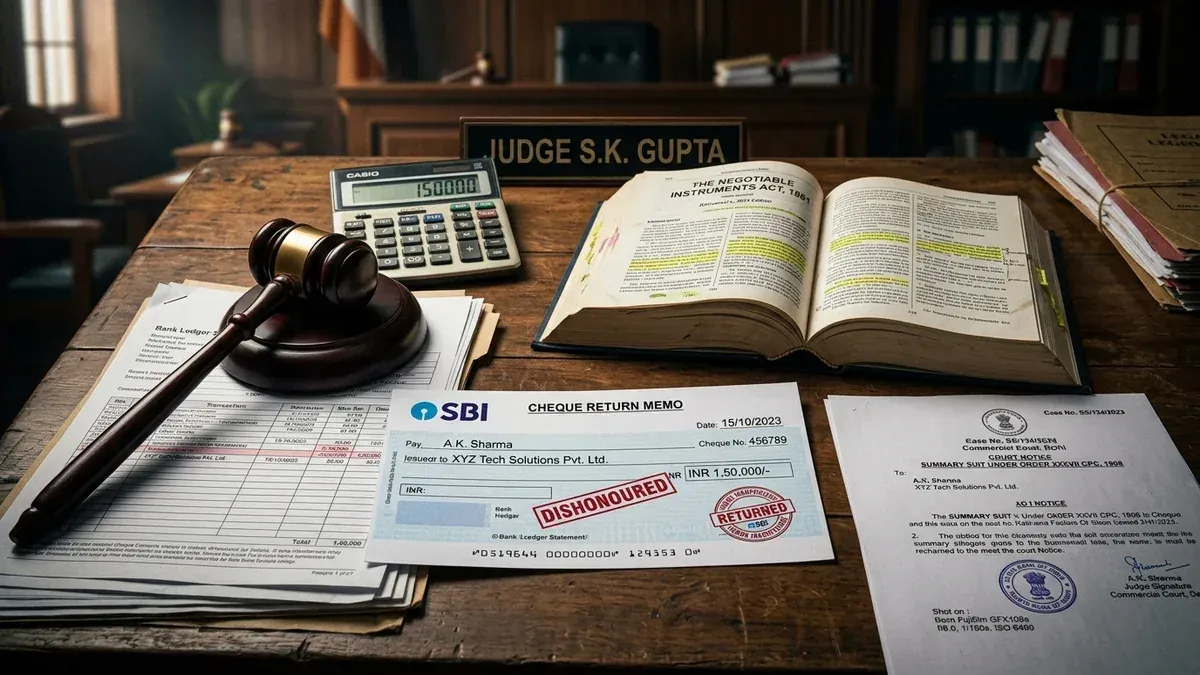
In the prosecution of cheque bounce offences under Section 138 of the Negotiable Instruments Act, 1881 (NI Act), no procedural issue has generated as much fierce litigation, conflicting judicial pronouncements, and legislative amendments as territorial jurisdiction. For over three decades, the question of which Magistrate's court possesses the lawful territorial authority to entertain, summon, and try a cheque bounce complaint has swung like a judicial pendulum between protecting commercial payees and safeguarding drawers against cross-country harassment.
In the early era governed by K. Bhaskaran v. Sankaran Vaidhyan Balan (1999) 7 SCC 510, the Supreme Court permitted a complaint to be filed in any of five alternative geographical locations where any component act occurred. This led to widespread abuse: payees deliberately posted demand notices or presented cheques in distant towns solely to harass drawers into distress settlements. In August 2014, a Three-Judge Bench in Dashrath Rupsingh Rathod v. State of Maharashtra (2014) 9 SCC 129 radically reversed the law, holding that jurisdiction lay exclusively at the place where the drawee bank branch (the drawer's bank) was situated, leading to the mass transfer of hundreds of thousands of cases across India.
Recognizing that Dashrath Rathod imposed insurmountable financial burdens on commercial creditors and financial institutions, Parliament swiftly enacted the Negotiable Instruments (Amendment) Act, 2015, inserting Section 142(2) and Section 142A into the NI Act. Affirmed by the Supreme Court in Bridgestone India Pvt. Ltd. v. Inderpal Singh (2016) 2 SCC 75, the 2015 Amendment established permanent, clear statutory rules that anchor jurisdiction at the branch where the payee maintains their bank account. Understanding these provisions is vital for both payees drafting complaints and drawers challenging improper forum shopping.
Under Section 142(2) of the Negotiable Instruments Act, territorial jurisdiction in cheque bounce cases is determined by where the payee maintains their bank account, if presented for collection through an account. Overriding Dashrath Rathod, the 2015 Amendment and Bridgestone ruling anchor jurisdiction at the payee's home bank branch location.
1. The 2015 Statutory Framework: Section 142(2) Decoded
The Negotiable Instruments (Amendment) Act, 2015 (retrospective from June 15, 2015) introduced Section 142(2), establishing an unambiguous statutory rule governing territorial jurisdiction:
Section 142(2), Negotiable Instruments Act, 1881:
"The offence under section 138 shall be inquired into and tried only by a court within whose local jurisdiction,—
(a) if the cheque is delivered for collection through an account, the branch of the bank where the payee or holder in due course, as the case may be, maintains the account, is situated; or
(b) if the cheque is presented for payment by the payee or holder in due course, otherwise through an account, the branch of the drawee bank where the drawer maintains the account, is situated."
This statutory formulation divides all cheque presentations into two distinct categories:
| Method of Cheque Presentation | Statutory Clause | Exclusive Territorial Forum |
|---|---|---|
| Account Payee / Clearing Presentation | Section 142(2)(a) | Court having local jurisdiction over the branch where the payee maintains the bank account into which the cheque was deposited. |
| Over-the-Counter (Cash) Presentation | Section 142(2)(b) | Court having local jurisdiction over the branch of the drawee bank where the drawer maintains the account. |
Since over 99% of modern commercial cheques are crossed and cleared through electronic banking channels (CTS clearing), Section 142(2)(a) governs virtually all commercial cheque bounce litigation across India.
2. The Bridgestone India Landmark: Retrospective Validation of Jurisdiction
Shortly after the 2015 Amendment was notified, the Supreme Court in Bridgestone India Pvt. Ltd. v. Inderpal Singh (2016) 2 SCC 75 delivered a definitive judgment interpreting Section 142(2)(a):
The Supreme Court affirmed that the statutory presumption under Section 139 of the Negotiable Instruments Act includes the existence of a legally enforceable debt or liability once the execution of the cheque is admitted. However, the Bench settled that the accused is not required to establish their defense beyond reasonable doubt; raising a probable defense through cross-examination or relying on the complainant's own admissions on a preponderance of probabilities is sufficient to rebut the presumption.
- Overriding Dashrath Rathod: The Supreme Court affirmed that the 2015 Amendment completely wiped out the rule in Dashrath Rupsingh Rathod. The payee is no longer compelled to travel to the drawer's home town to file a case.
- Retrospective Application to Pending Cases: The Court held that Section 142(2) applies retrospectively to all pending complaints. A complaint that had been transferred to the drawer's bank under Dashrath Rathod was ordered to be transferred back to the court having jurisdiction over the payee's bank branch.
- Payee Convenience Restored: The ruling established that a creditor residing in Delhi who maintains a bank account in Connaught Place can lawfully prosecute a drawer residing in Chennai or Kolkata directly before the New Delhi Magistrate Court, provided the cheque was cleared through the Delhi account.
3. The Core Controversy: 'Home Branch' vs. 'Any CBS Collecting Branch'
With the advent of Core Banking Solutions (CBS) and the Cheque Truncation System (CTS-2010), customers can deposit cheques at any bank branch across India. This technological evolution sparked a new jurisdictional controversy: Does Section 142(2)(a) mean the branch where the payee opened and maintains their home account, or any branch where the cheque was physically dropped into a drop-box?
The Supreme Court and multiple High Courts have resolved this controversy with decisive clarity:
The 'Maintains the Account' Rule:
The phrase in Section 142(2)(a)—"the branch of the bank where the payee... maintains the account"—refers strictly to the home base branch where the customer's account is registered and ledgered. A payee cannot travel to a distant vacation town, drop a cheque in an ATM drop-box of their bank, and file a case in that town. Dropping a cheque in an ancillary branch does NOT constitute 'maintaining an account' at that location.
In Nishant Aggarwal v. Kailash Kumar Sharma (2013) 10 SCC 72 and post-2015 High Court decisions, courts affirmed that anchoring jurisdiction to the registered home branch prevents abusive forum shopping while providing complete predictability to both parties.
4. Anti-Multiplicity Safeguard: Automatic Consolidation under Section 142A
To prevent drawers from facing multiple trials in different cities for transactions arising from the same commercial dealing, Parliament enacted Section 142A:
- Single Judicial Forum for Subsequent Cases: Under Section 142(2) proviso read with Section 142A, where a payee has filed a complaint against a drawer in a court having lawful territorial jurisdiction, all subsequent complaints against the same drawer arising out of other bounced cheques shall be filed in that exact same court.
- Mandatory Transfer of Pending Proceedings: If multiple cases between the same parties are pending across different courts or cities, Section 142A(2) mandates that upon application, all subsequent cases shall be transferred to the court that first acquired jurisdiction over the initial complaint.
- Judicial Economy and Prevention of Conflicting Rulings: This anti-multiplicity safeguard ensures that common commercial transactions, security cheque disputes, and running account reconciliations are adjudicated comprehensively before a single trial Magistrate.
5. Procedural Defenses: Challenging Impermissible Forum Shopping under Section 201 CrPC
If a complainant files a Section 138 case in an improper territorial court (e.g., in a city where the payee merely maintains a transit branch or temporary office without account maintenance), defense counsel must execute targeted procedural objections:
Action Plan for Challenging Territorial Jurisdiction:
- Application under Section 224 BNSS (Section 201 CrPC): File a preliminary application before the trial Magistrate asserting lack of territorial jurisdiction under Section 142(2) NI Act. Under Section 224 BNSS, if the Magistrate is not competent to take cognizance of the offence, the Magistrate shall return the complaint for presentation to the proper court.
- Subpoena Bank Account Opening Forms: Move an application directing the complainant to produce the certified Account Opening Form (AOF) and bank passbook under Section 61 BSA to prove the exact location of the home branch.
- Petition under Section 528 BNSS (Section 482 CrPC): If the Magistrate dismisses the preliminary objection and insists on proceeding, file a Quashing / Transfer Petition before the High Court. High Courts routinely quash summoning orders issued by courts lacking Section 142(2) territorial nexus.
6. The Mandatory Inquiry for Outstation Accused under Section 225 BNSS (Section 202 CrPC)
Whenever a complainant files a case in their home town against an accused who resides in another city or state, the trial Magistrate must comply with a vital statutory safeguard:
- Mandatory Postponement of Process: Under Section 225(1) BNSS (Old Section 202(1) CrPC), where an accused resides beyond the local jurisdiction of the Magistrate, the Magistrate shall postpone the issue of process and either inquire into the case himself or direct an investigation by police to determine whether there is sufficient ground for proceeding.
- The Constitutional Bench Landmark in Expeditious Trial: In In Re: Expeditious Trial of Cases under Section 138 of N.I. Act (2021) SCC OnLine SC 325, a Five-Judge Constitution Bench of the Supreme Court held that compliance with Section 202 CrPC is mandatory in cheque bounce trials against outstation accused.
- Evidentiary Scrutiny Required: The Magistrate cannot mechanically issue summons upon an outstation accused based solely on a boilerplate affidavit. The Magistrate must examine whether the postal acknowledgment card shows valid service of the statutory demand notice and whether the complaint falls within Section 142(2) boundaries. Summons issued without this inquiry are liable to be quashed.
By mastering the 2015 statutory rules under Section 142(2), enforcing Section 142A consolidation, and asserting mandatory Section 225 BNSS outstation safeguards, litigators can navigate territorial jurisdiction with absolute procedural mastery.
7. Digital Banking, Clearing Corporation Mechanics, and CTS-2010 Clearing Traps
Modern banking operates on centralized digital architecture, specifically the Reserve Bank of India's Cheque Truncation System (CTS-2010) and grid-based clearing houses managed by the National Payments Corporation of India (NPCI). Cheques deposited anywhere across the Northern, Southern, or Western Grid are scanned and cleared electronically without physical transmission of paper instruments. While this technological evolution has accelerated commercial transactions, it has created intricate jurisdictional confusion under Section 142(2) of the Negotiable Instruments Act.
Under Section 142(2)(a), territorial jurisdiction for account payee cheques presented through an account is pegged strictly to the branch "where the payee or holder in due course, as the case may be, maintains the account." However, predatory complainants frequently exploit Core Banking Solutions (CBS) by opening temporary, nominal savings accounts in distant jurisdictions where the drawer has no business presence, specifically to weaponize travel costs, legal expenses, and physical inconvenience into coerced settlements.
Constitutional courts have intervened decisively to curb this sophisticated form of judicial harassment:
- Doctrine of Natural Forum and Bona Fide Account: In K.S. Joseph v. Philips Carbon Black Ltd. (2016) and related High Court precedents, courts have scrutinized whether the payee's bank account in the filing jurisdiction is an active commercial account through which standard corporate transactions flow, or a shell account established solely to fabricate territorial jurisdiction.
- Inherent Powers of Transfer under Section 447 BNSS (Section 406 CrPC): When a corporate complainant distributes identical bounced cheques across multiple remote states—for instance, filing cases in Delhi, Guwahati, and Kochi against a single corporate debtor—the Supreme Court exercises its plenary powers under Article 139A and Section 406 CrPC to consolidate and transfer all complaints to the central jurisdiction where the underlying contract was executed.
- Electronic Presentation vs Physical Presentation: Where a cheque is not cleared through an account payee deposit but presented across the counter for cash payment, Section 142(2)(b) strictly confines jurisdiction to the branch where the drawer maintains the account. Attempting to disguise a counter dishonor as an account clearing to forum shop constitutes a fatal defect resulting in immediate return of the complaint under Section 224 BNSS (Section 201 CrPC).
| Mode of Presentation | Statutory Governing Clause | Determinative Jurisdictional Forum | Judicial Authority |
|---|---|---|---|
| Account Payee (Through Account) | Section 142(2)(a) NI Act | Magistrate having jurisdiction over Payee's specific Home Branch | Bridgestone India (2016) |
| Presentation Otherwise (Across Counter) | Section 142(2)(b) NI Act | Magistrate having jurisdiction over Drawer's Bank Branch | Section 142(2)(b) Text |
| Multiple Cheques Same Transaction | Section 142A NI Act | First court seized of jurisdiction hears all subsequent complaints | Section 142A Consolidation |
| Outstation Accused Summoned | Section 225 BNSS (Sec 202 CrPC) | Mandatory pre-summoning inquiry or police investigation | In Re: Expeditious Trial (2021) |