
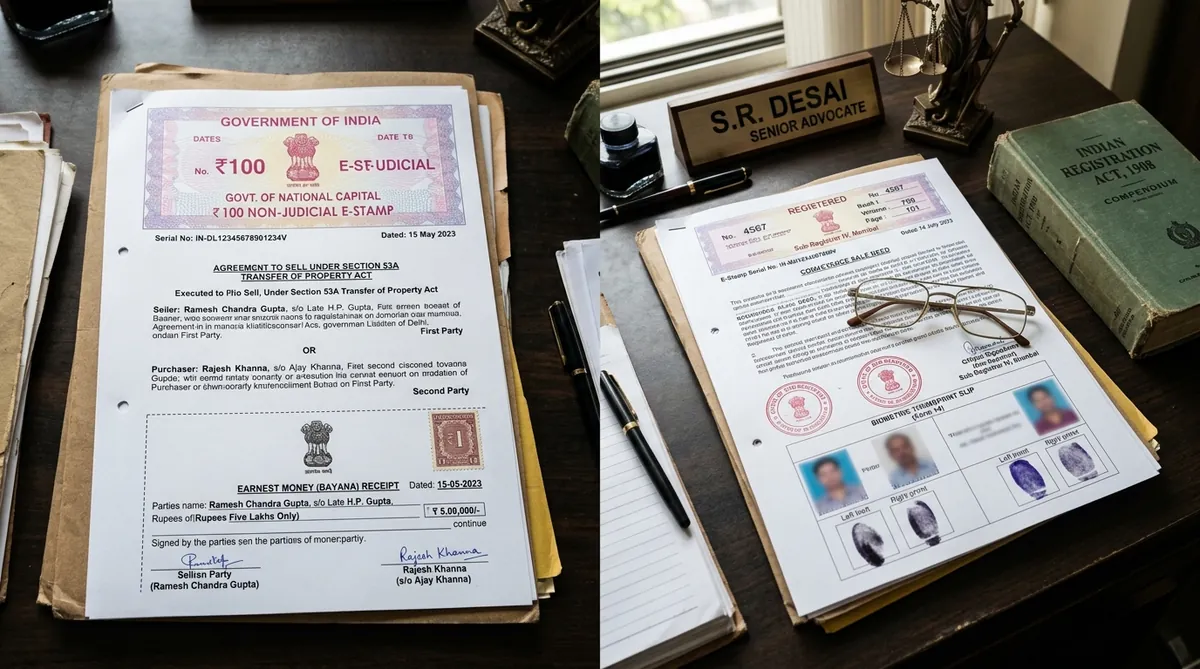
In property agreements, business transfer contracts, arbitration clauses, and partition settlements, executing documents on standard ₹100 or ₹500 non-judicial stamp papers is a widespread but hazardous business shortcut. When litigation erupts and such instruments are tendered as primary evidence in a civil or commercial suit, the adversary's primary procedural defense is immediate: objecting to the admissibility of the document for deficient stamp duty.
Under Section 33 of the Indian Stamp Act, 1899, every court or public officer has a mandatory duty to impound any insufficiently stamped instrument. The legal landscape surrounding unstamped contracts has undergone profound refinement, culminated by the historic 7-Judge Constitution Bench ruling of the Supreme Court of India in 2023.
Under Sections 33 and 35 of the Indian Stamp Act, insufficiently stamped instruments cannot be admitted in evidence or acted upon by any court. However, Section 35 provides a statutory cure: paying the deficit stamp duty along with a penalty up to ten times validates the document for all judicial proceedings.
1. Statutory Architecture of Sections 33 and 35
The Indian Stamp Act is a fiscal statute strictly designed to protect public revenue:
- Mandatory Impounding (Section 33): Any person having authority to receive evidence must impound an instrument if it appears that the instrument is not duly stamped.
- Absolute Inadmissibility (Section 35): No instrument chargeable with duty shall be admitted in evidence for any purpose, or shall be acted upon, registered or authenticated by any public officer or court, unless duly stamped.
- "For Any Purpose": The prohibition is total; an unstamped document cannot even be relied upon for collateral purposes until cured.
2. Curing the Defect: Paying Deficit Duty and Penalty
Unlike lack of registration under the Registration Act 1908 (which is fatal for conveying title), insufficient stamp duty is a curable fiscal defect:
"Under Section 35 proviso (a), the instrument can be admitted in evidence upon payment of the deficient duty, together with a penalty of five rupees, or, when ten times the amount of the proper duty or deficient portion exceeds five rupees, of a sum equal to ten times such duty."
- Court Adjudication: The trial judge calculates the deficit stamp duty and levies the statutory 10-times penalty directly.
- Collector Referral under Section 38: The court can send the impounded document to the Collector of Stamps, who possesses discretionary authority under Section 40 to reduce or waive the 10x penalty if non-payment was bona fide.
- Endorsement under Section 42: Once the duty and penalty are certified as paid, the instrument becomes fully admissible and valid as if originally stamped.
3. The 7-Judge Supreme Court Ruling on Unstamped Contracts
In the monumental 7-Judge Bench verdict In Re Interplay Between Arbitration Agreements under Arbitration and Conciliation Act 1996 and Indian Stamp Act 1899 (2023):
The Supreme Court reaffirmed the three mandatory golden tests for grant of interlocutory injunctions under Order XXXIX Rules 1 and 2 of the Code of Civil Procedure: (i) strong prima facie case, (ii) balance of convenience tilted in applicant's favor, and (iii) imminent threat of irreparable injury not compensable in monetary damages. The Court held that temporary relief cannot be granted mechanically without judicial application of mind.
- Overruling N.N. Global: The Supreme Court reversed earlier decisions holding unstamped arbitration agreements void ab initio.
- Non-Fatal Defect: The Court held that insufficiency of stamp duty is a curable defect that does not render the underlying contract void or prevent appointment of arbitrators under Section 11.
- Arbitrator Responsibility: The arbitral tribunal itself will impound the contract and direct rectification at the preliminary stage.