
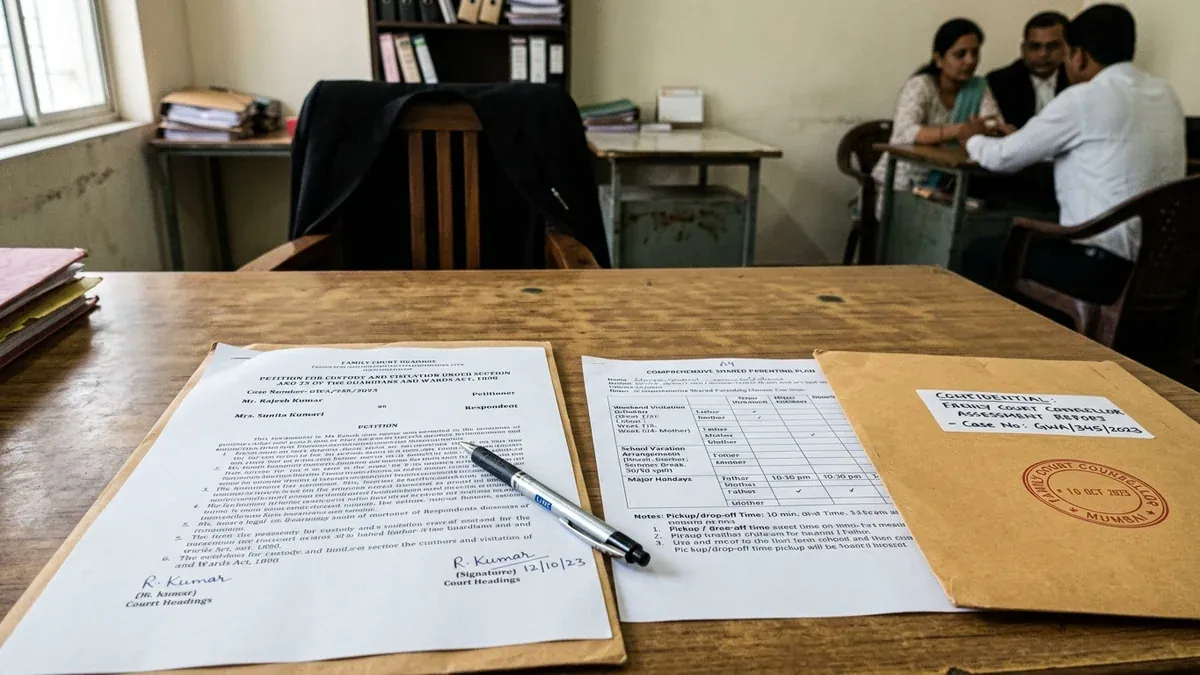
For decades, child custody litigation in India followed a winner-takes-all paradigm: one parent (traditionally the mother) was granted exclusive physical custody, while the other parent was relegated to an occasional "visiting stranger" permitted a two-hour supervised meeting in a crowded court nursery once a month.
Modern developmental psychology and progressive judicial decisions have dismantled this archaic model. Guided by the Law Commission of India's 257th Report on 'Reforms in Guardianship and Custody Laws' and groundbreaking rulings of the Supreme Court, Indian Family Courts now actively encourage structured Shared Parenting Plans and joint legal guardianship.
While Indian statutes lack express provisions for joint custody, Supreme Court jurisprudence increasingly mandates shared parenting plans to ensure a child receives love and guidance from both parents. Detailed parenting agreements establish rotating physical custody, school holiday sharing, joint educational decision-making, and digital communication schedules.
2. Core Components of a Comprehensive Parenting Plan
A robust Shared Parenting Agreement submitted to the Family Court should delineate unambiguous rules:
"Parenting plans that rely on vague phrases like 'reasonable visitation' invariably collapse into fresh litigation. Concrete time-allocation matrices specifying drop-off hours, neutral exchange venues, and holiday rotations eliminate friction."
- Weekday and Weekend Schedule: Alternating weekend overnights (Friday 6 PM to Sunday 7 PM) and midweek dinner visitations.
- Vacation and Festival Splitting: Equal division of summer, winter, and Diwali/Dussehra vacations (e.g., first half with father, second half with mother, rotating annually).
- Electronic and Video Access: Unrestricted daily or alternate-day 20-minute video calls via WhatsApp or FaceTime without monitoring or interference.
- Emergency Medical Protocol: Immediate notification within 2 hours in the event of medical emergencies or hospitalization.
3. Remedying Willful Denial of Visitation
When a custodial parent repeatedly obstructs court-ordered access:
- Contempt of Court: Filing an application under Section 12 of the Contempt of Courts Act, 1971 for deliberate violation of court undertakings.
- Modification of Custody: In Amyra Dwivedi v. Ravindra Dwivedi (2020), the Supreme Court held that persistent denial of visitation justifies transferring primary physical custody to the other parent.
- Compensatory Visitation: Seeking court orders for compensatory make-up time for lost visitations due to illness or obstruction.
Landmark Judicial Precedents & Statutory Authorities
Courts and appellate tribunals across Delhi NCR (Faridabad, Saket, Tis Hazari, Gurugram, High Courts) strictly apply these authoritative Supreme Court benchmarks:
The Supreme Court reaffirmed the three mandatory golden tests for grant of interlocutory injunctions under Order XXXIX Rules 1 and 2 of the Code of Civil Procedure: (i) strong prima facie case, (ii) balance of convenience tilted in applicant's favor, and (iii) imminent threat of irreparable injury not compensable in monetary damages. The Court held that temporary relief cannot be granted mechanically without judicial application of mind.