
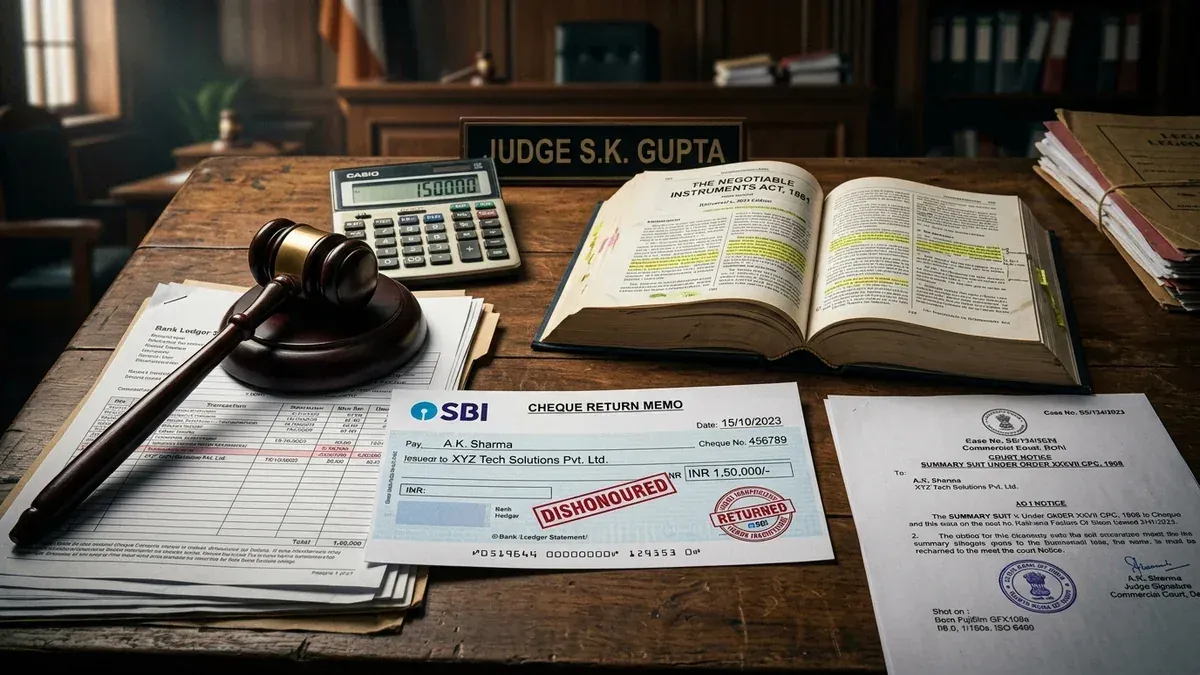
When a trial Magistrate convicts an accused under Section 138 of the Negotiable Instruments Act, 1881 (NI Act) and sentences the drawer to imprisonment and heavy financial penalties, the convict's immediate legal recourse is preferring a Criminal Appeal before the Sessions Court. Under traditional criminal procedure, an appellant filing an appeal routinely prays for suspension of sentence and grant of bail under Section 389 of the Code of Criminal Procedure, 1973 (now Section 430 of the Bharatiya Nagarik Suraksha Sanhita, 2023 - BNSS).
However, by the Negotiable Instruments (Amendment) Act, 2018, Parliament inserted Section 148 into the NI Act. Under Section 148, the Appellate Court is empowered to order the convicted drawer to deposit a sum that shall be a minimum of twenty percent (20%) of the fine or compensation awarded by the trial court. Following an early interpretation by the Supreme Court in Surinder Singh Deswal v. Virender Gandhi (2019) 11 SCC 341, Sessions Courts across India began treating this 20% deposit as an absolute, automatic, and mandatory prerequisite for suspending criminal sentences. Convicts who were bankrupt, impoverished, or had suffered commercial ruin were routinely denied suspension of sentence and jailed simply because they could not deposit 20% upfront.
This unconstitutional transformation of judicial discretion into mechanical extortion was decisively arrested on September 4, 2023, by a landmark Division Bench of the Supreme Court of India in Jamboo Bhandari v. M.P. State Industrial Development Corporation Ltd. (2023) 10 SCC 446. Justices Abhay S. Oka and Rajesh Bindal declared that the 20% deposit under Section 148 is NOT an absolute or automatic rule. Appellate courts possess inherent judicial discretion to waive or reduce the deposit condition upon demonstrable exceptional hardship or a patent defect in the trial conviction. For appellate defense counsel, mastering the Jamboo Bhandari doctrine is essential to securing unconditional bail and sentence suspension.
Section 148 of the Negotiable Instruments Act empowers appellate courts to order a minimum 20% deposit of the fine upon conviction. However, in Jamboo Bhandari v. MP State IDC (2023), the Supreme Court ruled that 20% deposit is not automatic. Appellate courts possess judicial discretion to waive deposits upon exceptional hardship.
1. Statutory Architecture: Section 148 NI Act and the 2018 Amendment
Inserted with effect from September 1, 2018, Section 148 of the Negotiable Instruments Act was designed to prevent frivolous, delay-seeking appeals by convicted drawers:
Section 148, Negotiable Instruments Act, 1881:
"(1) Notwithstanding anything contained in the Code of Criminal Procedure, 1973 (2 of 1974), in an appeal by the drawer against conviction under section 138, the Appellate Court may order the appellant to deposit such sum which shall be a minimum of twenty per cent of the fine or compensation awarded by the trial Court:
Provided that the amount payable under this sub-section shall be in addition to any interim compensation paid by the appellant under section 143A.
(2) The amount referred to in sub-section (1) shall be deposited within sixty days from the date of the order, or within such further period not exceeding thirty days as may be directed by the Court on sufficient cause being shown by the appellant.
(3) The Appellate Court may direct the release of the amount so deposited to the complainant at any time during the pendency of the appeal..."
Key statutory elements embedded in Section 148 include:
- The Word "May" vs. "Shall": Parliament consciously chose the permissive word "may" order, rather than the imperative "shall", signaling that the power was discretionary.
- Strict Sixty-Day Deposit Window: Under sub-section (2), the deposit must be made within 60 days, extendable by an absolute maximum of 30 days (total 90 days) on sufficient cause. No further extension is statutorily permissible.
- Provisional Release to Payee: Under sub-section (3), the Sessions Court can release the deposited 20% to the complainant during the appeal, subject to repayment with interest if the appellant is ultimately acquitted.
2. The Surinder Singh Deswal Precedent and Its Systemic Misapplication
Shortly after Section 148 was enacted, the Supreme Court in Surinder Singh Deswal v. Virender Gandhi (2019) 11 SCC 341 held that the provision applied retrospectively to complaints filed prior to September 1, 2018. However, in interpreting the word "may", the Court observed:
The Supreme Court affirmed that the statutory presumption under Section 139 of the Negotiable Instruments Act includes the existence of a legally enforceable debt or liability once the execution of the cheque is admitted. However, the Bench settled that the accused is not required to establish their defense beyond reasonable doubt; raising a probable defense through cross-examination or relying on the complainant's own admissions on a preponderance of probabilities is sufficient to rebut the presumption.
"The word 'may' used in Section 148 NI Act is generally to be construed as a rule, and directing deposit of a minimum of 20% is the normal rule, while not directing deposit would be an exception."
Following this observation, subordinate Sessions Courts across India completely abandoned judicial discretion. Appellate judges began treating the 20% deposit condition as mandatory and non-negotiable. Whenever an appeal was admitted, Sessions Courts issued mechanical, pre-printed template orders: "Sentence suspended subject to depositing 20% of compensation within 60 days, failing which bail stands automatically cancelled." Appellants facing severe insolvency or fraudulent convictions were routinely remanded to prison without any examination of merits.
3. The Breakthrough: Jamboo Bhandari v. M.P. State IDC (2023)
The Supreme Court decisively corrected this judicial misdirection in Jamboo Bhandari v. M.P. State Industrial Development Corporation Ltd. (2023) 10 SCC 446:
Supreme Court Doctrine in Jamboo Bhandari (Paras 6-9):
"1. When an Appellate Court considers an application for suspension of sentence under Section 389 CrPC (Section 430 BNSS) in an appeal against a Section 138 conviction, the condition of depositing a minimum of 20% under Section 148 is NOT an absolute, mandatory rule.
2. Normally, the Appellate Court will be justified in imposing the condition of 20% deposit. However, if the Appellate Court is satisfied that imposing such a condition will be unjust, oppressive, or will amount to denial of the statutory right of appeal to an indigent or severely aggrieved appellant, the Court has full discretion to waive or reduce the deposit condition.
3. The Appellate Court must consider whether exceptional circumstances exist that warrant an exception from the normal rule, and must record reasons in writing."
The Supreme Court set aside the High Court orders and remanded the matter to the Sessions Court, directing the appellate judge to re-hear the suspension application and specifically evaluate the appellant's grounds for waiver.
4. Legitimate Legal Grounds for Claiming Waiver or Reduction of 20% Deposit
Following Jamboo Bhandari, appellate litigators must actively plead specific, documented grounds to justify an exception from the 20% deposit rule:
| Waiver Ground | Evidentiary Material Required | Legal Standard Established by Courts |
|---|---|---|
| 1. Total Indigence & Commercial Ruin | Income Tax Returns, attached bank account statements, insolvency proceedings, civil bankruptcy filings. | Under Jolly George Varghese and Jamboo Bhandari, conditioning liberty on impossible monetary deposits violates Article 21. |
| 2. Patent Jurisdictional Flaw in Trial Order | Certified trial record demonstrating: non-service of legal demand notice, complaint filed beyond 30 days limitation, or time-barred debt. | Where the conviction is patently unsustainable on the face of the record, imposing a 20% deposit amounts to penalizing an innocent appellant. |
| 3. Prior Substantial Deposit under Section 143A | Receipts proving drawer already deposited 20% interim compensation before the trial Magistrate during trial. | Appellate court can adjust earlier deposits and reduce or eliminate additional appellate deposit requirements. |
| 4. Disputed Signature / Stolen Security Cheque | Forensic FSL handwriting report confirming forged signature or prior police FIR for theft of cheque book. | Strong prima facie case on merits warrants unconditional suspension of sentence pending appeal. |
5. Consequences of Non-Deposit: Does Default Automatically Cancel Bail?
A recurring controversy in criminal appellate practice is what occurs if an appellant fails to deposit the directed 20% within the maximum 90-day window:
- No Automatic Cancellation of Bail: High Courts (including the Bombay, Punjab & Haryana, and Delhi High Courts) have held that failure to deposit the Section 148 amount does NOT lead to the automatic dismissal of the criminal appeal or immediate cancellation of bail.
- Recovery as a Fine under Section 421 CrPC / Section 461 BNSS: By virtue of Section 148(1) proviso read with Section 143A(5), the primary statutory remedy available to the complainant is recovering the unpaid deposit as a fine under Section 421 CrPC (Section 461 BNSS)—through the issuance of a warrant for levy by attachment and sale of movable or immovable property.
- Re-examination by Appellate Court: Before issuing non-bailable warrants or remanding the convict to custody for non-deposit, the Sessions Court must grant an opportunity of hearing and examine whether the default was willful or occasioned by genuine, unavoidable insolvency under Jamboo Bhandari guidelines.
6. Procedural Roadmap: Filing for Suspension of Sentence and Deposit Waiver
Appellate defense counsel should follow an exacting procedural strategy when preferring a Criminal Appeal before the Sessions Court:
Action Plan for Appellate Sentence Suspension:
- Dual Prayer Application: Draft an application under Section 430 BNSS (Section 389 CrPC) for suspension of sentence, accompanied by a specific, dedicated paragraph praying for the waiver or reduction of appellate deposit under Section 148 NI Act citing Jamboo Bhandari (2023) 10 SCC 446.
- Attach Documentary Proof of Exceptional Hardship: File a supporting affidavit detailing financial liabilities, frozen bank accounts, medical emergency bills, or corporate insolvency orders demonstrating inability to pay 20% upfront.
- Demonstrate Flaws in Trial Conviction: Highlight patent errors of law in the trial judgment (e.g., failure of trial court to draw statutory presumption rebuttal despite unimpeachable defense witnesses).
- Challenge Mechanical 20% Orders in High Court Revision: If the Sessions Judge passes a boilerplate order directing 20% deposit without considering the waiver grounds or recording reasons, immediately file a Criminal Revision Petition under Section 438/442 BNSS (Section 397/401 CrPC) before the High Court. High Courts routinely set aside mechanical orders and remand with directions to apply Jamboo Bhandari.
By deploying the Jamboo Bhandari doctrine, documenting genuine commercial hardship, and challenging mechanical template orders in revision, convicted drawers can secure suspension of sentence without being forced into financial liquidation.
7. Constitutional Dimensions & Right of Appeal: Article 21 Safeguards Against Onerous Pre-Conditions
The right of appeal in Indian jurisprudence is not merely a statutory privilege; it is an intrinsic component of fair, just, and reasonable procedure guaranteed under Article 21 of the Constitution. In Anita Kushwaha v. Pushap Sudan (2016) 8 SCC 509, a Constitution Bench of the Supreme Court affirmed that access to justice is a fundamental right. When appellate courts impose mechanical conditions requiring an accused to deposit 20% of an exorbitant compensation order as a sine qua non for hearing an appeal or suspending sentence, it constructs an insurmountable economic barrier that effectively penalizes poverty and denies justice.
The landmark ruling in Jamboo Bhandari (2023) directly harmonizes Section 148 of the Negotiable Instruments Act with constitutional guarantees. Section 148 was enacted to curb dilatory tactics by recalcitrant debtors; it was never intended to coerce innocent litigants who possess valid legal defenses into insolvency. The Supreme Court recognized that an unfettered, non-discretionary pre-deposit rule would violate Article 14 by treating genuinely aggrieved appellants with unassailable defenses on par with habitual fraudsters.
To successfully invoke constitutional safeguards and secure an order waiving or minimizing the pre-deposit, the appellant's counsel must structure the Section 148 reply or waiver petition around three core constitutional pillars:
- Substantive Demonstration of Prima Facie Illegality: The appellant must demonstrate that the trial court judgment suffers from patent jurisdictional errors—such as ignoring proven repayment receipts, miscalculating limitation under Section 142, or convicting on time-barred debt contrary to Section 25(3) of the Contract Act.
- Severe Financial Distress and Insolvency Threat: Affidavits demonstrating bank account freezes, corporate restructuring, or lack of liquid assets should be presented to show that a 20% deposit requirement would extinguish the appellant's enterprise or livelihood.
- Balancing Equities with Alternative Security: Offering non-encumbered immovable property title deeds, third-party solvent surety bonds, or corporate guarantees as alternative security demonstrates bona fides while preserving the appellant's liquid working capital.
| Procedural Parameter | Conventional Surinder Singh Deswal Approach | Modern Jamboo Bhandari (2023) Standard |
|---|---|---|
| Interpretation of "May" in Sec 148 | Treated as mandatory "shall" in routine practice | Held strictly directory; confers judicial discretion |
| Requirement of Reasoned Order | No specific reasons needed for imposing 20% | Mandatory judicial duty to record exceptional reasons |
| Consideration of Accused's Defense | Appellate court ignored trial court record | Prima facie evaluation of conviction merits is required |
| Default on Deposit | Automatic cancellation of bail and jail remand | Sentence suspension may lapse, but bail protected under Sec 430 BNSS |