
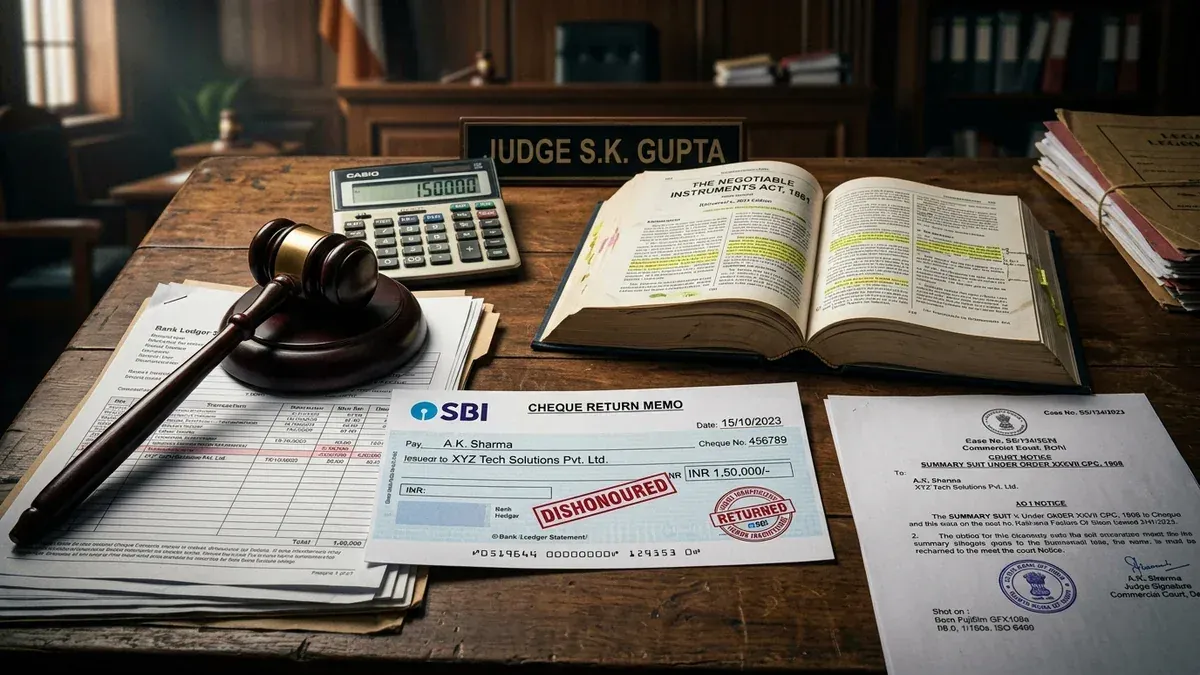
Cheque bounce litigation in India under Section 138 of the Negotiable Instruments Act, 1881 (NI Act) was envisioned by Parliament as a rapid summary trial mechanism to be concluded within six months. In practice, however, heavy judicial dockets and delaying tactics by accused drawers frequently drag trials for five to ten years across metropolitan magistrate courts. To address the acute financial distress suffered by payees while trials crawl forward, Parliament enacted the Negotiable Instruments (Amendment) Act, 2018, introducing Section 143A into the NI Act.
Section 143A empowers the trial Magistrate to direct the drawer of the dishonored cheque to pay interim compensation not exceeding twenty percent (20%) of the cheque amount to the complainant during the pendency of the trial itself, upon the drawer pleading not guilty. Following the amendment, trial courts began treating Section 143A as an automatic, mandatory recovery tool—awarding 20% interim compensation as a matter of routine the moment a notice of accusation was framed, without evaluating the merits of the defense or the drawer's financial capacity.
This aggressive, mechanical practice was comprehensively examined and struck down on March 15, 2024, by a landmark Division Bench of the Supreme Court of India in Rakesh Ranjan Shrivastava v. State of Jharkhand (2024) 4 SCC 719. Justices Abhay S. Oka and Ujjal Bhuyan declared that Section 143A is directory and discretionary, NOT mandatory. The apex court formulated exhaustive, binding guidelines that trial Magistrates must strictly evaluate before ordering interim compensation. Understanding these parameters is essential for defense counsel seeking to defeat predatory interim compensation applications during trial.
Under Section 143A of the Negotiable Instruments Act, a trial court can order interim compensation up to 20% of the cheque amount. In Rakesh Ranjan Shrivastava (2024), the Supreme Court established that this power is discretionary, not mandatory. Magistrates must evaluate prima facie merits and financial capacity before directing interim deposits.
1. Statutory Mandate of Section 143A NI Act
Section 143A was inserted into the Negotiable Instruments Act with effect from September 1, 2018:
Section 143A, Negotiable Instruments Act, 1881:
"(1) Notwithstanding anything contained in the Code of Criminal Procedure, 1973 (2 of 1974), the Court trying an offence under section 138 may order the drawer of the cheque to pay interim compensation to the complainant—
(a) in a summary trial or a summons case, where he pleads not guilty to the accusation made in the complaint; and
(b) in any other case, upon framing of charge.
(2) The interim compensation under sub-section (1) shall not exceed twenty per cent of the amount of the cheque.
(3) The interim compensation shall be paid within sixty days from the date of the order, or within such further period not exceeding thirty days as may be directed by the Court on sufficient cause being shown by the drawer.
(4) If the drawer of the cheque is acquitted, the Court shall direct the complainant to repay to the drawer the amount of interim compensation, with interest at the bank rate...
(5) The interim compensation payable under this section may be recovered as if it were a fine under section 421 of the Code of Criminal Procedure, 1973."
Key statutory characteristics of Section 143A include:
- Stage of Application: An application under Section 143A can be entertained ONLY after the accused appears and pleads not guilty to the notice under Section 251 CrPC / Section 274 BNSS. It cannot be awarded at the pre-summoning stage.
- Ceiling of 20%: The statute prescribes an upper limit of 20% ("shall not exceed twenty per cent"). The Magistrate possesses full discretion to award 5%, 10%, 15%, or zero compensation based on the facts.
- Restitution with Interest on Acquittal: Sub-section (4) provides an essential safeguard: if the drawer is ultimately acquitted after trial, the complainant is legally bound to repay the entire interim compensation plus bank-rate interest within 60 days.
2. Substantive Nature & Strict Prospective Applicability: G.J. Raja Landmark
A pivotal constitutional question surrounding Section 143A was whether it applied to cheque bounce complaints filed prior to September 1, 2018. In G.J. Raja v. Tejraj Sharma (2019) 19 SCC 469, the Supreme Court delivered an authoritative ruling:
The Supreme Court affirmed that the statutory presumption under Section 139 of the Negotiable Instruments Act includes the existence of a legally enforceable debt or liability once the execution of the cheque is admitted. However, the Bench settled that the accused is not required to establish their defense beyond reasonable doubt; raising a probable defense through cross-examination or relying on the complainant's own admissions on a preponderance of probabilities is sufficient to rebut the presumption.
- Substantive Liability, Not Mere Procedure: The Supreme Court held that Section 143A imposes an entirely new pecuniary disability and creates a substantive obligation on an accused who is presumed innocent until proven guilty.
- Strictly Prospective Application: Unlike Section 148 (which applies at the appellate stage to pending appeals), Section 143A operates strictly prospectively. It applies ONLY to offences committed and complaints instituted after September 1, 2018. Applying Section 143A to pre-2018 complaints violates Article 20(1) of the Constitution against retrospective penal laws.
3. The Landmark Guidelines in Rakesh Ranjan Shrivastava (2024)
In Rakesh Ranjan Shrivastava v. State of Jharkhand (2024) 4 SCC 719, the Supreme Court addressed the widespread abuse of Section 143A by subordinate trial courts. Resolving conflicting High Court opinions, the apex court laid down the definitive legal doctrine:
Supreme Court Principles in Rakesh Ranjan Shrivastava (Para 19):
"1. The word 'may' in Section 143A(1) is directory and discretionary, NOT mandatory. The power cannot be exercised mechanically as a matter of course.
2. Before exercising discretion, the trial court must evaluate the prima facie merits of the complaint and whether the complainant has satisfied the foundational ingredients of Section 138.
3. The court must examine the nature of the defence disclosed by the accused (e.g., whether the accused has raised a plausible defense regarding lost cheques, time-barred debt, or absence of legal consideration).
4. The court must consider the financial capacity and economic status of the accused, ensuring that the direction to deposit 20% does not crush the accused's ability to defend themselves.
5. The court must assess whether the complainant would be capable of repaying the amount with interest under Section 143A(4) in the event of an eventual acquittal.
6. The trial court MUST record clear, speaking reasons in writing for awarding interim compensation and for fixing the specific quantum (up to 20%)."
The Supreme Court set aside the Jharkhand High Court and trial court orders that had mechanically directed a 20% deposit, reiterating that judicial discretion cannot be surrendered to automated statutory templates.
4. Substantive Defenses to Defeat Section 143A Interim Compensation
To defeat a Section 143A application filed by a complainant, defense counsel must present specific, documented defenses showing that the trial involves serious triable issues:
| Plausible Defense | Supporting Documentary Evidence | Impact on Section 143A Discretion |
|---|---|---|
| 1. Time-Barred Debt | Loan agreement or ledger showing debt arose more than 3 years prior without written acknowledgment under Section 18 Limitation Act. | Under Dashrathbhai Trikambhai Patel, a time-barred debt is not a legally enforceable liability; interim compensation must be denied. |
| 2. Blank Security Cheque Misuse | Prior emails, delivery challans, or contract clauses proving the cheque was handed over as un-dated security for a cancelled supply order. | Establishes a genuine triable dispute, disincentivizing the Magistrate from imposing interim financial penalties. |
| 3. Complainant's Inability to Repay | Proof that the complainant is unemployed, bankrupt, or has multiple insolvency proceedings pending. | Violates the mandatory Rakesh Ranjan test: the court cannot order deposit if the complainant cannot repay under sub-section (4) upon acquittal. |
| 4. Disputed Signature / Stolen Cheque | Prior police complaint or written stop-payment letter to bank sent prior to cheque date alleging theft. | Shakes the foundational presumption of Section 139 NI Act, disentitling complainant to interim compensation. |
5. Enforcement Mechanics: How is Section 143A Compensation Recovered?
If a Magistrate awards interim compensation and the drawer fails to deposit within the 60-to-90 day window, what are the legal consequences?
- Recovery Strictly as a Fine under Section 421 CrPC (Section 461 BNSS): Under Section 143A(5), the unpaid interim compensation can ONLY be recovered as if it were a fine: (a) by issuing a warrant for the levy of the amount by attachment and sale of movable property, or (b) by issuing a warrant to the District Collector authorizing realization as arrears of land revenue from immovable property.
- No Power of Immediate Imprisonment for Non-Deposit: A Magistrate cannot cancel bail or commit the accused to jail simply for failure to pay Section 143A interim compensation during trial. In Kailash Verma v. Punjab State Civil Supplies Corp., courts affirmed that non-payment of an interim civil deposit during ongoing trial cannot be punished with imprisonment prior to final conviction.
- Trial Must Continue on Merits: The trial cannot be stayed or defense evidence closed merely because the accused failed to pay the interim sum. The drawer retains their full constitutional right to cross-examine the complainant and lead defense witnesses under Section 315 CrPC (Section 353 BNSS).
6. Procedural Roadmap: Challenging Mechanical 143A Orders in Sessions Court
When a Magistrate passes an unreasoned order awarding 20% interim compensation, defense counsel should execute the following appellate strategy:
Litigation Action Plan Against Adverse 143A Orders:
- Interlocutory vs. Intermediate Order Jurisprudence: Complainants routinely argue that an order under Section 143A is an "interlocutory order" and that a revision is barred under Section 397(2) CrPC (Section 438(2) BNSS). Counter this argument using the Supreme Court ruling in Madhu Limaye v. State of Maharashtra and High Court precedents establishing that an order determining substantial monetary liability is an intermediate order amenable to revision.
- File Criminal Revision Petition: File a Criminal Revision Petition before the Sessions Judge under Section 438 BNSS (Section 397 CrPC) within 90 days, asserting that the Magistrate failed to follow the mandatory five-point evaluation test laid down in Rakesh Ranjan Shrivastava (2024).
- Petition under Section 528 BNSS (Section 482 CrPC): If the Sessions Court declines revision, move the High Court under its inherent powers. High Courts routinely quash unreasoned 143A orders and remand them for fresh consideration.
- Stay Recovery Warrants: Pray for an immediate interim stay on the execution of Section 421 CrPC warrants pending disposal of the revision petition.
By anchoring replies in the Rakesh Ranjan Shrivastava doctrine, demonstrating plausible defense merits, and challenging mechanical orders in revision, drawers can successfully insulate themselves from premature financial extortion during cheque bounce trials.
7. Interlocutory Orders and the Bar on Criminal Revision: Section 438 BNSS (Section 397(2) CrPC)
A crucial jurisdictional battleground surrounding Section 143A orders is determining the appropriate appellate or supervisory remedy when a Magistrate mechanically imposes the 20% interim compensation. Section 438(2) of the Bharatiya Nagarik Suraksha Sanhita, 2023 (re-enacting Section 397(2) CrPC) imposes a statutory bar prohibiting the Sessions Court or High Court from entertaining revision petitions against purely "interlocutory orders." Complainants routinely argue that an interim compensation order is purely interlocutory, leaving the accused remediless until the final judgment.
However, constitutional courts have decisively rejected this restrictive interpretation. Relying on the seminal Supreme Court Constitution Bench ruling in Madhu Limaye v. State of Maharashtra (1977) 4 SCC 551 and Asian Resurfacing of Road Agency, High Courts across Delhi, Bombay, and Punjab & Haryana have established that an order under Section 143A is not purely interlocutory; it is an "intermediate order." Because a Section 143A direction creates an immediate, enforceable legal liability that can be recovered as a land revenue fine through property attachment and sale, it severely affects substantive proprietary rights and finalizes a vital issue at the pre-trial stage.
Consequently, an accused subjected to an unreasoned or mechanical 20% interim compensation order can pursue two distinct statutory pathways:
- Criminal Revision before the Sessions Court (Section 438 BNSS): The accused can challenge the Magistrate's order on grounds of non-application of mind, lack of prima facie evaluation under Rakesh Ranjan Shrivastava, or failure to consider the accused's bona fide defense disclosed at the stage of framing notice under Section 274 BNSS (Section 251 CrPC).
- Inherent Powers Quashing before High Court (Section 528 BNSS): Where the Magistrate has acted without jurisdiction—such as applying Section 143A retrospectively to a pre-September 2018 complaint in violation of G.J. Raja—the High Court will directly exercise its powers to set aside the order and prevent abuse of judicial process.
- Restitution and Safeguards under Section 143A(4): If the accused complies with a compensation deposit and is ultimately acquitted at trial, the complainant is statutorily mandated to repay the entire amount with bank interest within 60 days. To safeguard against irrecoverable default, accused persons should request the trial court to keep the deposited sum in an interest-bearing fixed deposit rather than disbursing it directly to the complainant.
| Evidentiary Threshold | Permissible under Section 143A | Fatal Error under Rakesh Ranjan (2024) |
|---|---|---|
| Determination of Percentage | Calibrated between 1% to 20% based on financial equities | Automatic, unreasoned flat imposition of maximum 20% |
| Plea of Not Guilty | Merely triggers the jurisdictional power to consider | Treated as automatic justification for granting interim relief |
| Stolen or Security Cheque | Precludes immediate award until basic trial scrutiny | Ignored in favor of mechanical Section 139 presumption |
| Disbursement Mechanics | Retained in court FDR or disbursed against bank guarantee | Unconditional cash handover without solvency verification |