
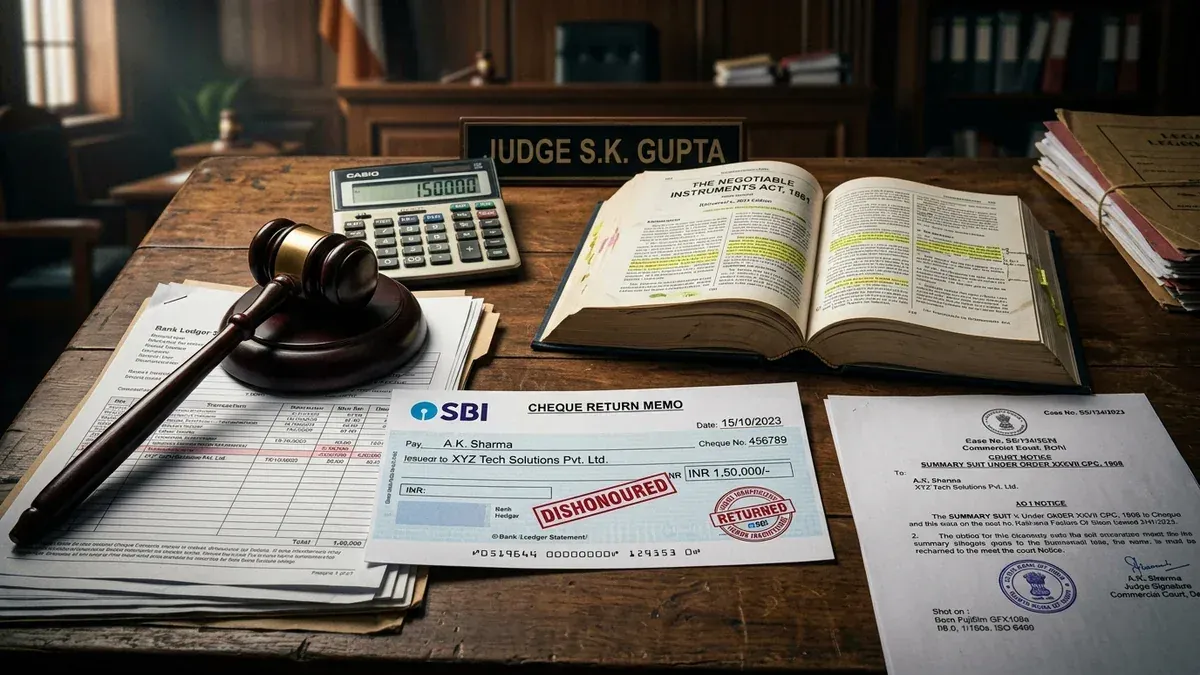
When a corporate borrower issues a commercial cheque that is dishonored upon presentation, the payee frequently initiates aggressive criminal prosecution under Section 138 of the Negotiable Instruments Act, 1881 (NI Act). In a calculated effort to exert maximum coercive settlement pressure, complainants routinely adopt an indiscriminate "dragnet" approach: they array every single individual listed on the Ministry of Corporate Affairs (MCA) portal as an accused in the complaint, indiscriminately summoning non-executive directors, independent directors, nominee directors, and even sleeping family partners.
However, criminal liability under Indian penal jurisprudence is strictly personal. The concept of vicarious criminal liability—holding one individual criminally responsible for an offence committed by a separate juristic entity—is an extraordinary statutory creation codified under Section 141 of the NI Act. Section 141 does not create blanket, automatic criminal exposure for every person who holds the corporate title of 'Director'.
The Supreme Court of India in the foundational Three-Judge Bench landmark of SMS Pharmaceuticals Ltd. v. Neeta Bhalla (2005) 5 SCC 733 and the modern ruling in Sunita Palita v. Panchami Stone Quarry (2022) 10 SCC 152 firmly established that non-executive and independent directors cannot be prosecuted without specific, contemporaneous factual averments proving direct, active responsibility for the company's day-to-day business conduct and the issuance of the bounced instrument. Litigators representing non-executive directors possess powerful legal mechanisms to quash such frivolous summoning orders at the threshold under Section 528 of the Bharatiya Nagarik Suraksha Sanhita, 2023 (BNSS) (formerly Section 482 of the Code of Criminal Procedure, 1973 - CrPC).
Under Section 141 of the Negotiable Instruments Act, non-executive and independent directors cannot be held vicariously liable for corporate cheque bounce without specific allegations proving active day-to-day managerial involvement. In Sunita Palita (2022) and SMS Pharma, the Supreme Court quashed summoning orders against non-signatory directors lacking direct transactional control.
1. Statutory Anatomy of Vicarious Liability under Section 141 NI Act
To hold any individual liable for an offence committed by a corporate entity, the complainant must strictly satisfy the statutory prerequisites of Section 141:
Section 141(1), Negotiable Instruments Act, 1881:
"If the person committing an offence under section 138 is a company, every person who, at the time the offence was committed, was in charge of, and was responsible to the company for the conduct of the business of the company, as well as the company, shall be deemed to be guilty of the offence and shall be liable to be proceeded against and punished accordingly:
Provided that nothing contained in this sub-section shall render any person liable to punishment if he proves that the offence was committed without his knowledge, or that he had exercised all due diligence to prevent the commission of such offence."
The statutory architecture establishes three distinct classes of corporate accused:
| Category of Accused | Legal Presumption of Liability | Pleading Requirement in Complaint |
|---|---|---|
| 1. Signatory of the Cheque | Strict direct liability under Section 138 read with Section 141(2). | Mere averment of signature on the dishonored instrument is legally sufficient to summon. |
| 2. Managing Director / Whole-Time Director | Presumed by virtue of executive office to be in charge of overall business conduct. | Averment of holding executive office (Managing Director) suffices under K.K. Ahuja. |
| 3. Non-Executive / Independent Director | ZERO Legal Presumption. Protected by Companies Act, 2013 and Sunita Palita. | Must plead specific factual role showing active day-to-day managerial control over the transaction. Boilerplate repetitions fail. |
2. The Foundation: SMS Pharmaceuticals v. Neeta Bhalla (2005)
The constitutional and procedural boundary of vicarious liability was established by a Three-Judge Bench of the Supreme Court in SMS Pharmaceuticals Ltd. v. Neeta Bhalla (2005) 5 SCC 733:
- Mere Directorship Does Not Create Liability: The Supreme Court answered three specific reference questions, holding that it is NOT sufficient for a complainant to merely state that the accused is a director of the company. A person cannot be summoned merely because their name appears on the company's letterhead.
- Mandatory Twin Conditions: The complainant must specifically aver and prove two distinct cumulative facts: (i) that the person was in charge of the company's business, AND (ii) that the person was responsible to the company for the conduct of its business at the material time when the offence was committed.
- Rejection of Generic Boilerplate Averments: The Court cautioned trial Magistrates against issuing process mechanically. If a complaint merely copies the statutory words of Section 141 without narrating specific transactional facts, the complaint is defective and summoning orders are liable to be quashed.
3. The Modern Landmark: Sunita Palita v. Panchami Stone Quarry (2022)
In Sunita Palita v. Panchami Stone Quarry (2022) 10 SCC 152, the Supreme Court delivered an emphatic victory for non-executive and independent directors:
The Supreme Court affirmed that the statutory presumption under Section 139 of the Negotiable Instruments Act includes the existence of a legally enforceable debt or liability once the execution of the cheque is admitted. However, the Bench settled that the accused is not required to establish their defense beyond reasonable doubt; raising a probable defense through cross-examination or relying on the complainant's own admissions on a preponderance of probabilities is sufficient to rebut the presumption.
Supreme Court Holding in Sunita Palita (2022) 10 SCC 152 (Paras 42-45):
"A Magistrate is not a post office to issue summons blindly upon every name arrayed in a complaint... Non-executive directors, independent directors, and professional directors are not involved in the day-to-day financial operations of a company. When unimpeachable public records (such as MCA Form DIR-11/12) establish that an accused was merely a non-executive director and not a signatory to the cheque, the High Court must exercise its inherent powers under Section 482 CrPC to quash the proceedings against them to prevent abuse of the process of the court."
The apex court reaffirmed the principles in Pooja Ravinder Devidasani v. State of Maharashtra (2014) 16 SCC 1 and Ashok Shewakramani v. State of Andhra Pradesh (2023) 8 SCC 473, establishing that the phrase "was in charge of and was responsible to the company" requires actual functional control, not honorary board membership.
4. Statutory Immunities under Section 149(12) Companies Act, 2013
Non-executive and independent directors are shielded not only by judicial precedents but also by express parliamentary enactment under the Companies Act, 2013:
- Section 149(12), Companies Act, 2013: Parliament enacted an explicit statutory safe harbor: an independent director and a non-executive director not being promoter or key managerial personnel (KMP) shall be held liable ONLY in respect of such acts of omission or commission by a company which had occurred with their knowledge, attributable through board processes, and with their consent or connivance, or where they had not acted diligently.
- Ministry of Corporate Affairs (MCA) Circular No. 1/2020: On March 2, 2020, the MCA issued binding circular directions to all Registrars of Companies and law enforcement agencies instructing that independent and non-executive directors should NOT be arrayed in criminal or civil prosecutions initiated for defaults of the company unless explicit evidence of direct participation exists.
- Harmonious Reading with NI Act: Criminal courts interpreting Section 141 NI Act are legally bound to read Section 141 harmoniously with Section 149(12) of the Companies Act, recognizing that modern corporate governance separates policy oversight from executive financial signing authority.
5. Quashing Petitions under Section 528 BNSS (Section 482 CrPC): Relying on MCA Public Records
When a non-executive director receives a summoning order from a Judicial Magistrate in a Section 138 complaint, their primary procedural remedy is filing a Quashing Petition under Section 528 of the Bharatiya Nagarik Suraksha Sanhita, 2023 (BNSS) (Old Section 482 CrPC) before the jurisdictional High Court:
Litigation Strategy for High Court Quashing Petitions:
- Relying on Unimpeachable MCA Public Records: Under the rule in Anita Malhotra v. Apparel Export Promotion Council (2012) 1 SCC 520, the High Court under Section 482 CrPC / 528 BNSS is fully entitled to look into certified public documents of sterling quality. Counsel should annex certified copies of Form DIR-12 from the MCA portal proving that the petitioner was designated strictly as an "Independent Director" or "Non-Executive Director".
- Exposing Resignation Prior to Cheque Issuance: If the director resigned from the company prior to the date the cheque was drawn or presented, annex the certified Form DIR-11/DIR-12 showing the effective date of cessation. In Harshendra Kumar D. v. Rebatilata Koley (2011) 3 SCC 351, the Supreme Court held that once a director resigns and Form 32 / DIR-12 is accepted by the Registrar of Companies, they cannot be prosecuted for cheques issued subsequent to their resignation.
- Highlighting Vague Boilerplate Allegations: Point out to the High Court that the complainant failed to plead any specific meeting, email, transaction, or conversation linking the petitioner to the debt or cheque issuance, violating the SMS Pharma and Sunita Palita mandates.
- Securing Immediate Stay of Trial Court Proceedings: Move an urgent application for an interim stay of trial court summons and exemption from personal appearance under Section 228 BNSS (Section 205 CrPC), sparing the director from arduous cross-state travel.
6. The S.P. Mani & Mohan Dairy Landmark (2023): Defining Strict Pleading Thresholds
The Supreme Court in S.P. Mani and Mohan Dairy v. Snehalatha Elangovan (2023) 10 SCC 685 conducted an exhaustive historical survey of Section 141 jurisprudence, synthesizing four decades of case law into clear judicial directives:
- The Primary Pleading Burden: The Court reiterated that the initial burden rests entirely on the complainant to make specific averments in the complaint as to how and in what manner the accused director was responsible for the conduct of the company's business. Vague, omnibus assertions that "all directors are in charge" are legally fatal.
- Distinction Between Managing Directors and Ordinary Directors: While a Managing Director or signatory cannot escape summoning because their statutory role inherently involves business operations, ordinary non-executive directors are presumed innocent of operational management unless specific transactional involvement is documented.
- Abuse of Process Protection: The Supreme Court affirmed that criminal proceedings cannot be used as an engine of oppression to arm-twist unrelated board members into settling commercial corporate debts. High Courts must exercise vigilant superintendence to weed out frivolous corporate prosecutions.
By leveraging the Sunita Palita and SMS Pharma doctrines, presenting certified MCA public records, and moving expeditiously under Section 528 BNSS, non-executive and independent directors can secure complete quashing of unjustified cheque bounce proceedings.
7. Costs, Perjury and Abuse of Process Sanctions Against Vexatious Complainants
A systemic dysfunction in commercial litigation across India is the routine practice of roping in every director listed on the Ministry of Corporate Affairs (MCA) portal—including women, non-executive independent directors, nominee directors, and elderly relatives—regardless of whether they had any role in the cheque transaction. This deliberate harassment strategy is designed to coerce settlements through criminal intimidation. However, constitutional courts have progressively deployed statutory powers to penalize such vexatious impleadment.
In Pepsi Foods Ltd. v. Special Judicial Magistrate (1998) 5 SCC 749, the Supreme Court delivered an enduring caution that summoning an individual as an accused in a criminal case is a serious matter that directly infringes upon their personal liberty under Article 21 of the Constitution. Magistrates cannot issue process mechanically as a mere post-office or tool of civil recovery. Building upon this doctrine, the Supreme Court in Dayle De'Souza v. Government of India (2021) SCC OnLine SC 1002 held that invoking criminal vicarious liability without strict factual substantiation constitutes a gross abuse of judicial process.
When an independent or non-executive director successfully secures quashing under Section 528 BNSS (Old Section 482 CrPC), they possess actionable legal remedies against the unscrupulous complainant:
- Imposition of Exemplary Costs: High Courts frequently exercise inherent powers to impose substantial punitive costs on complainants who implead non-signatory directors despite clear MCA filings indicating their non-executive status.
- Perjury Proceedings under Section 379 BNSS (Old Section 340 CrPC): If the complainant filed a sworn pre-summoning verification affidavit falsely deposing that the independent director was "actively managing day-to-day affairs" without an iota of documentary proof, the aggrieved director can file an application to initiate criminal prosecution for false statements under oath.
- Civil Suit for Malicious Prosecution: An exonerated director whose commercial reputation, credit rating, or professional directorships were impaired by reckless criminal summoning can institute a tortious claim for damages and compensation against the complainant company and its promoters.
| Director Category | Presumption of Managerial Role | Required Evidentiary Threshold in Complaint | Supreme Court Governing Authority |
|---|---|---|---|
| Managing Director / Joint MD | Statutory Presumption Exists | General averment of holding office suffices | SMS Pharmaceuticals (2005) |
| Signatory Director | Direct Personal Knowledge | Proof of drawing and signing the cheque | K.K. Ahuja v. V.K. Vora (2009) |
| Independent / Non-Executive | No Presumption (Exempt under Sec 149(12)) | Specific, granular role in transaction must be pleaded | Sunita Palita (2022); Pooja Ravinder (2014) |
| Nominee Director (Banks/PSUs) | Complete Immunity under Law | Immune from prosecution for corporate defaults | Section 141 Proviso NI Act |