
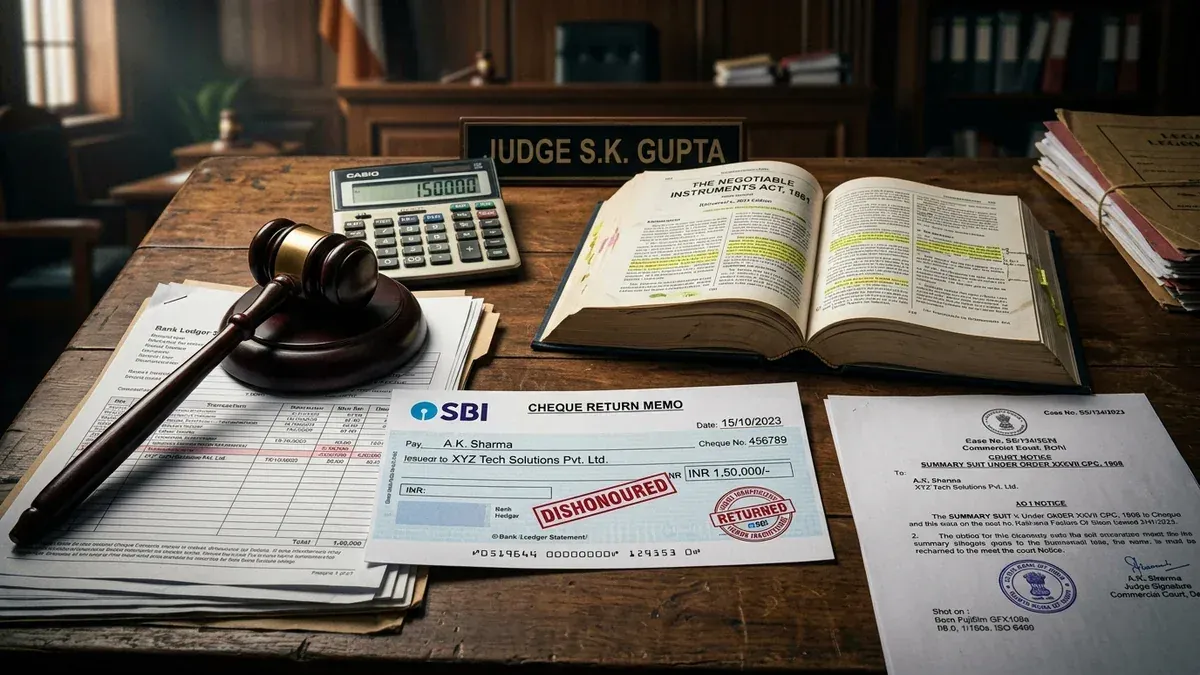
The prosecution of a cheque bounce complaint under Section 138 of the Negotiable Instruments Act, 1881 (NI Act) hinges upon strict adherence to statutory timelines and jurisdictional prerequisites. Historically, dishonest drawers avoided liability by refusing to accept postal demand notices or questioning the territorial jurisdiction of the complainant's court. The Supreme Court of India dismantled both evasive tactics in its seminal decision in K. Bhaskaran v. Sankaran Vaidhyan Balan (1999) 7 SCC 510.
Delivered by Justice K.T. Thomas, K. Bhaskaran established two pillars of NI Act litigation: first, the decomposition of Section 138 into five constituent acts; and second, the doctrine of "deemed service" under Section 27 of the General Clauses Act. While Parliament later amended the territorial jurisdiction rules via the Negotiable Instruments (Amendment) Act, 2015 (introducing Section 142(2)), K. Bhaskaran remains the bedrock authority governing statutory notice service, cause of action computation, and trial maintainability.
"The offence under Section 138 can be completed only with the concatenation of a number of acts. The following are the acts which are components of the said offence: (1) Drawing of the cheque; (2) Presentation of the cheque to the bank; (3) Returning of the cheque unpaid by the drawee bank; (4) Giving notice in writing to the drawer of the cheque demanding payment; (5) Failure of the drawer to make payment within 15 days of the receipt of notice."
1. The Evolution of Territorial Jurisdiction: From Bhaskaran to Section 142(2)
Few procedural provisions have experienced such dramatic judicial and legislative evolution as the question of where a Section 138 complaint must be filed:
| Legal Epoch | Governing Legal Authority | Territorial Forum Mandated |
|---|---|---|
| 1999 – 2014 | K. Bhaskaran (1999 SC) | Complainant could file in any court having jurisdiction over any of the 5 acts (e.g. where notice was issued, where cheque was deposited, where bank was situated). Led to forum shopping. |
| 2014 – 2015 | Dashrath Rupsingh Rathod (2014 SC) | 3-judge bench overruled Bhaskaran; held that jurisdiction lies strictly and solely where the drawer's drawee bank is located. Led to transfer of 400,000 cases overnight. |
| 2015 – Present | Parliamentary Amendment: Section 142(2) NI Act | Payee's Home Branch Rule: If cheque is deposited into an account, jurisdiction lies where the payee / holder maintains their account branch. Reaffirmed in Bridgestone India (2016). |
2. Deemed Service of Demand Notice under Section 27 General Clauses Act
The most enduring contribution of K. Bhaskaran is the rejection of the drawer's plea that "I never received the notice." Drawers frequently maneuvered postal agents into returning notices with endorsements such as "door locked," "unclaimed," "refused," or "not met."
The Supreme Court held that Section 138 requires the payee to "give a notice in writing"—it does not state that the payee must ensure physical receipt into the hands of an unwilling recipient. Reading Section 27 of the General Clauses Act, 1897 and Section 114 Illustration (e) of the Evidence Act (now Bharatiya Sakshya Adhiniyam, 2023), the court held:
- Correct Address Presumption: If a statutory demand notice is dispatched by Registered Post AD / Speed Post to the correct and known address of the drawer with prepaid postage, valid service is legally presumed.
- Endorsements of Refusal or Non-Claim: An endorsement stating "unclaimed," "refused," or "absent" constitutes valid deemed service on the date of tender by the postal carrier.
- The C.C. Alavi Haji (2007) 15-Day Cure Rule: In Dalmia Cement (2001) and C.C. Alavi Haji v. Palapetty Muhammed (2007), a 3-judge bench held that any drawer who claims non-receipt of notice must tender the cheque amount within 15 days of receiving court summons. If he fails to pay upon summons service, he cannot plead lack of notice.
3. Statutory Checklist for Complainants & Defense Counsel
To avoid dismissal under Section 204 CrPC / Section 227 BNSS, trial counsel must audit five non-negotiable documentary dates:
- Presentation Period: Cheque presented within 3 months of date of issuance (or validity period).
- Return Memo Receipt: Demand notice dispatched within exactly 30 days of receiving the cheque return memo from the bank.
- Clear 15-Day Grace Period: The drawer must be afforded clear 15 days from the date of receipt/deemed service to make payment.
- The 30-Day Limitation Window: The criminal complaint must be instituted within exactly 30 days following the expiry of the 15-day grace period under Section 142(1)(b) NI Act.
- Account Payee Presentation Proof: Bank statement or deposit counterfoil showing deposit in the complainant's branch to establish Section 142(2)(a) territorial jurisdiction.
Ready Averment in Complaint: Proving Deemed Service under K. Bhaskaran
IN THE COURT OF THE LEARNED METROPOLITAN MAGISTRATE (NI ACT DIGITAL COURT),
SAKET DISTRICT COURTS, NEW DELHI

CC NI NO. ________ OF 2026

IN THE MATTER OF:
[Complainant Payee]                                   ...COMPLAINANT
                                VERSUS
[Accused Drawer]                                      ...ACCUSED

STATUTORY AVERMENTS: COMPLIANCE WITH SECTION 138 PROVISO (b) & DEEMED SERVICE

1. That upon dishonour of the subject cheque bearing No. [__] dated [Date] for Rs. [__] vide Bank Return Memo dated [Date] with remarks "Funds Insufficient", the Complainant issued a statutory Demand Notice dated [Date] through Speed Post vide Postal Receipt No. [__].

2. That the said Demand Notice was correctly addressed to the Accused at his permanent / residential address, as registered with the drawer's bank.

3. That the postal tracking consignment report reflects the postal endorsement "Unclaimed / Refused / Left without Address" dated [Date].

4. That as authoritatively established by the Hon'ble Supreme Court of India in K. Bhaskaran v. Sankaran Vaidhyan Balan (1999) 7 SCC 510 and C.C. Alavi Haji v. Palapetty Muhammed (2007) 6 SCC 555, a statutory notice dispatched by registered post to the correct address is deemed to be duly served under Section 27 of the General Clauses Act, 1897.

5. That despite deemed receipt of the notice on [Date], the Accused failed to make payment of the cheque amount within the statutory period of 15 days, which expired on [Date]. The present complaint is instituted on [Date], well within the statutory period of limitation of 30 days prescribed under Section 142(1)(b) NI Act.

COMPLAINANT
THROUGH COUNSEL
NEW DELHI | DATED: [Date]
Official Landmark Case Brief
Read our primary analysis: K. Bhaskaran v. Sankaran Vaidhyan Balan (1999) Case Brief and companion briefs on Dalmia Cement (2001) and Dashrath Rupsingh Rathod (2014). Our NI Act defense practice prosecutes and defends cheque bounce trials across all Delhi NCR District Courts.

Advocate Kishan Kumar
Criminal, Civil & Debt Recovery Advocate • Bar Council of Delhi