
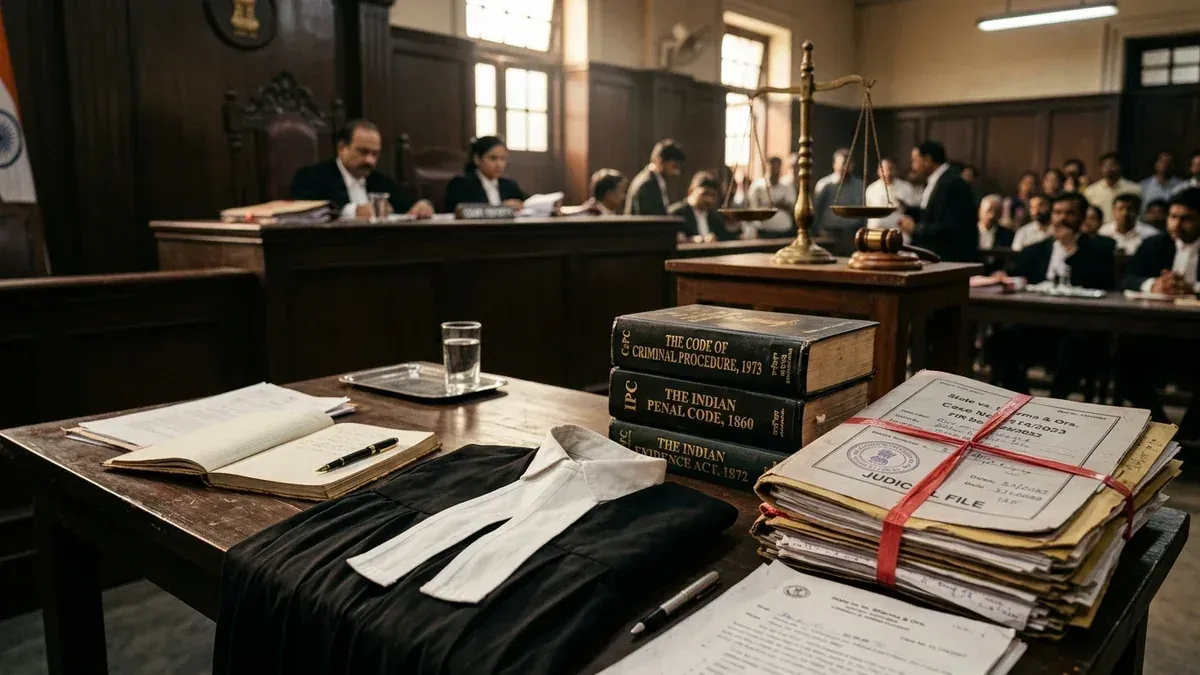
In the Indian criminal justice system, the process itself frequently operates as the punishment. Thousands of undertrial prisoners—overwhelmingly from marginalized, indigent backgrounds—spend years behind bars awaiting trial, often for durations far exceeding the maximum term of imprisonment prescribed for their alleged crimes. The foundational judicial revolt against this unconstitutional tragedy began with Hussainara Khatoon v. Home Secretary, State of Bihar (1979) 5 SCC 572.
Initiated through a historic public interest writ petition arguing before Justice P.N. Bhagwati, the Supreme Court declared for the first time in Indian legal history that the right to a speedy trial is an inalienable fundamental right under Article 21 of the Constitution. Decades later, this principle has culminated in the transformative statutory mandates of Section 479 of the Bharatiya Nagarik Suraksha Sanhita, 2023 (BNSS).
"Speedy trial is an essential ingredient of 'reasonable, fair and just' procedure guaranteed by Article 21 and it is the constitutional obligation of the State to devise such a procedure as would ensure speedy trial to the accused. The State cannot be permitted to deny the constitutional right of speedy trial to the accused on the ground that the State has no adequate financial resources to incur the necessary expenditure."
1. The Four Critical Principles of Hussainara Khatoon
The six successive interim orders in Hussainara Khatoon established core doctrines of modern bail jurisprudence:
- Article 21 Encompasses Speedy Trial: Procedure established by law under Article 21 must be "right, just, and fair" (affirming the doctrine in Maneka Gandhi). An endless, protracted trial without guilt determination violates human dignity.
- Right to Free Legal Aid (Article 39A): The court held that legal representation is not a luxury or charity; it is an essential ingredient of a fair trial. The state must provide free counsel to indigent accused from the moment of arrest.
- Rejection of Discriminatory Financial Bail: Requiring heavy monetary surety bonds from poor accused who cannot afford them discriminates against the poor. The court directed release on personal bonds (PR bonds) without sureties for minor offences.
- Release on Exceeding Maximum Sentence: An undertrial prisoner who has been in custody for a period longer than the maximum sentence that could be awarded upon conviction must be released unconditionally.
2. The Revolutionary Shift: CrPC Section 436A vs. BNSS Section 479
While Parliament introduced Section 436A into the CrPC in 2005 to codify undertrial release, the provision was hindered by bureaucratic inertia. Section 479 of the BNSS 2023 radically enhances these protections:
| Statutory Feature | Section 436A CrPC (Old) | Section 479 BNSS (New 2023 Law) |
|---|---|---|
| Standard Release Threshold | Detention exceeding 50% (half) of the maximum punishment. | Detention exceeding 50% of the maximum sentence. |
| First-Time Offender Benefit | No distinct benefit; 50% applied across all accused. | Revolutionary 1/3rd Rule: Accused with no prior convictions must be released after serving one-third (33.3%) of maximum term. |
| Duty to Apply for Bail | Accused or private defense counsel had to move application. | Mandatory Jail Authority Duty: Jail Superintendent must immediately make a formal bail application to the court upon date eligibility. |
| Exclusions from Benefit | Offences punishable with death penalty. | Offences punishable with death penalty or life imprisonment, or multiple consecutive sentences. |
3. Procedural Checklist for Filing a Section 479 BNSS Bail Application
For trial practitioners representing undertrials in Tihar, Rohini, Mandoli, Bhondsi, or Dasna jails, follow this strategic litigation roadmap:
- Obtain the Custody Certificate: Secure an official custody certificate from the Senior Superintendent of the concerned Central Jail certifying the exact number of days spent in judicial custody without remission.
- Verify Prior Criminal Records: Secure a nominal roll or police verification report demonstrating zero prior convictions to qualify for the beneficial 1/3rd detention threshold under Section 479(1) Proviso 1 BNSS.
- Demonstrate Prosecution-Caused Delays: Contrast witness summonses, absent IOs, and prolonged forensics delays with the defense's willingness to proceed, citing the 11 propositions of A.R. Antulay v. R.S. Nayak (1992).
- Argue Absence of Exceptional Bar: Remind the court that refusal to grant bail under Section 479 requires the Judge to record extraordinary written reasons under the second proviso.
Ready Bail Application Format: Statutory Release under Section 479 BNSS
IN THE COURT OF THE LEARNED SESSIONS JUDGE, PATIALA HOUSE COURTS, NEW DELHI

BAIL APPLICATION NO. ________ OF 2026

IN THE MATTER OF:
[Accused Name]                                           ...APPLICANT
(Currently detained at Central Jail No. 4, Tihar)
                                VERSUS
STATE (NCT OF DELHI)                                     ...RESPONDENT

APPLICATION UNDER SECTION 479 BNSS FOR STATUTORY MANDATORY BAIL

MOST RESPECTFULLY SHOWETH:

1. That the Applicant was arrested on [Date] in connection with FIR No. [__]/2023 registered at P.S. [__] under Sections 318(4) and 336(3) of BNS, 2023.

2. That the maximum sentence prescribed for the said alleged offence is seven years imprisonment.

3. That as per the Custody Certificate issued by the Superintendent, Central Jail, Tihar, the Applicant has undergone continuous actual custody of [__] years and [__] months, which exceeds one-third (33.3%) of the maximum prescribed period.

4. That the Applicant has no prior criminal convictions and is a first-time offender entitled to the absolute benefit of the First Proviso to Section 479(1) BNSS.

5. That as held by the Hon'ble Supreme Court in Hussainara Khatoon v. Home Secretary, State of Bihar (1979) 5 SCC 572 and In Re: Inhuman Conditions in 1382 Prisons (2016) 3 SCC 700, prolonged pre-trial incarceration without completion of trial violates the core fundamental right guaranteed under Article 21 of the Constitution.

PRAYER: It is therefore prayed that this Hon'ble Court may be pleased to release the Applicant on personal bond and reasonable surety in terms of Section 479 BNSS.

APPLICANT
THROUGH COUNSEL
NEW DELHI | DATED: [Date]
Official Landmark Case Brief
Read our in-depth analysis: Hussainara Khatoon v. Home Secretary, State of Bihar (1979) Case Brief. Our criminal defense practice assists undertrials, families, and detainees in securing bail under Section 479 BNSS across Delhi NCR courts.

Advocate Kishan Kumar
Criminal, Civil & Debt Recovery Advocate • Bar Council of Delhi