
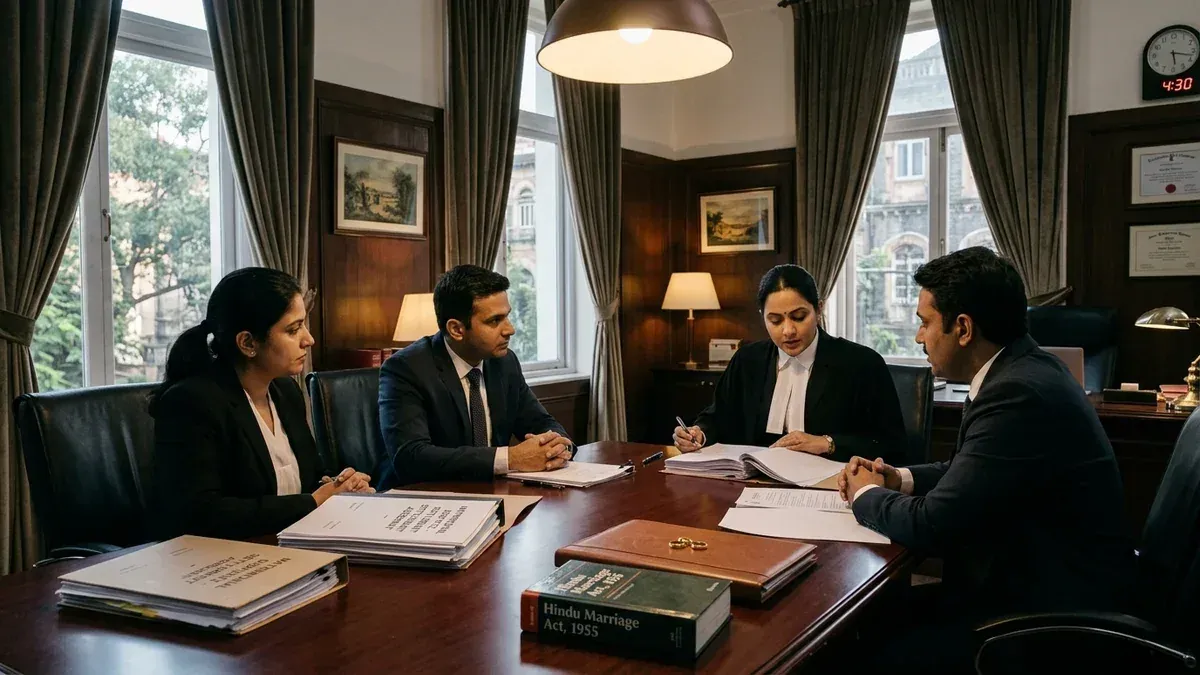
Among the statutory remedies available under Indian matrimonial personal laws, few provisions generate as much complex tactical maneuvering, emotional turmoil, and constitutional controversy as the decree for Restitution of Conjugal Rights (RCR) codified under Section 9 of the Hindu Marriage Act, 1955 (HMA). Conceived historically in English ecclesiastical courts as an instrument to compel estranged spouses to resume cohabitation and preserve the sanctity of marriage, Section 9 allows an aggrieved spouse to petition the Family Court for a judicial order compelling the other spouse to return to the matrimonial home.
In contemporary matrimonial litigation, however, Section 9 HMA is rarely filed out of unadulterated affection or a romantic desire for reconciliation. Instead, it is predominantly deployed as a preemptive tactical shield. Husbands facing impending matrimonial disputes routinely rush to file Section 9 petitions to create a paper defense against anticipated maintenance claims under Section 144 BNSS (old Section 125 CrPC), domestic violence complaints under the PWDVA, 2005, or cruelty allegations under Section 85 BNS (old Section 498A IPC). The petitioner spouse seeks to paint the respondent as a deserter who withdrew from society without cause.
This legal maneuvering raises profound legal and constitutional dilemmas. Can a sovereign court order an adult citizen to live with a spouse against their will? Can a decree of restitution be physically enforced by the police or civil arrest? How does a spouse effectively defend against a Section 9 petition by establishing a "reasonable excuse" under law? And how does the non-execution of a restitution decree for one year pave the statutory pathway to an absolute divorce under Section 13(1A)(ii) HMA?
This comprehensive legal treatise unpacks the constitutional scrutiny surrounding Section 9 HMA following the Supreme Court's right to privacy jurisprudence in Puttaswamy, the evidentiary standards for establishing reasonable excuse, the absolute execution limits imposed by Order 21 Rules 32 and 33 of the Code of Civil Procedure, 1908 (CPC), and the practical litigation strategies for both petitioners and respondents in Indian Family Courts.
Section 9 of the Hindu Marriage Act empowers an aggrieved spouse to petition for restitution of conjugal rights. Under Order 21 Rule 32 CPC, an RCR decree cannot be enforced by physical coercion or arrest. Non-resumption of cohabitation for one year converts the decree into a statutory ground for divorce.
1. The Statutory Architecture of Section 9 HMA and Constitutional Scrutiny
The statutory foundation of restitution of conjugal rights under the Hindu Marriage Act, 1955 is framed as follows:
Section 9, Hindu Marriage Act, 1955:
"When either the husband or the wife has, without reasonable excuse, withdrawn from the society of the other, the aggrieved party may apply, by petition to the district court, for restitution of conjugal rights and the court, on being satisfied of the truth of the statements made in such petition and that there is no legal ground why the application should not be granted, may decree restitution of conjugal rights accordingly.
Explanation: Where a question arises whether there has been reasonable excuse for withdrawal from the society, the burden of proving reasonable excuse shall be on the person who has withdrawn from the society."
To sustain a decree under Section 9, three essential conditions must be established:
- Withdrawal from Society: One spouse must have physically separated from the other and completely withdrawn from matrimonial cohabitation, companionship, and consortium.
- Absence of Reasonable Excuse: The withdrawal must have occurred without any valid, legally justifiable reason or excuse.
- Shifting Burden of Proof: The initial burden lies on the petitioner spouse to prove that the respondent has withdrawn from society. Once that physical withdrawal is established, the statutory Explanation shifts the legal burden onto the respondent spouse to prove that they had a "reasonable excuse" for leaving.
The constitutionality of Section 9 has witnessed intense judicial debate. In T. Sareetha v. T. Venkata Subbaiah (AIR 1983 AP 356), the Andhra Pradesh High Court struck down Section 9 as unconstitutional, holding that forcing a woman into cohabitation violates her bodily autonomy, human dignity, and privacy under Article 21. However, the Supreme Court in Saroj Rani v. Sudarshan Kumar Chadha (1984) 4 SCC 90 reversed this stance, upholding the constitutionality of Section 9 and observing that the primary objective of the decree is to facilitate reconciliation and prevent hasty divorces.
Following the Nine-Judge Constitution Bench judgment in K.S. Puttaswamy v. Union of India (2017) 10 SCC 1—which declared the right to privacy and bodily integrity to be inalienable fundamental rights—the constitutional validity of Section 9 HMA has been challenged anew before the Supreme Court in Ojaswa Pathak v. Union of India (pending before a Three-Judge Bench), with petitioners arguing that compelling conjugal cohabitation is an archaic Victorian relic that cannot survive modern constitutional scrutiny.
2. Establishing "Reasonable Excuse": Legitimate Defenses Against Section 9
In daily Family Court litigation, the battlefield of Section 9 centers squarely upon the statutory phrase "reasonable excuse." If the respondent spouse establishes that they left the matrimonial home due to reasonable excuse, the petition MUST be dismissed.
Courts have firmly established that "reasonable excuse" does not require proof of cruelty of such a degree as would be necessary to obtain an immediate divorce. Any conduct by the petitioner spouse or their family that renders it intolerable, unsafe, or mentally agonizing for the other spouse to continue cohabitation constitutes a valid reasonable excuse:
| Category of Defense | Factual Matrix Establishing "Reasonable Excuse" | Judicial Impact on Section 9 Petition |
|---|---|---|
| 1. Physical or Mental Cruelty | Acts of physical assault, verbal abuse, constant insults regarding family background, or humiliation in front of relatives. | Complete defense; court cannot compel a spouse to return to a violent or hostile environment. |
| 2. Dowry Demands & Harassment | Persistent financial demands, coercion to transfer parental property, or taunts regarding inadequate wedding gifts. | Immediate ground for dismissal; dowry harassment is an unlawful and criminal coercive act. |
| 3. Adultery / Extramarital Affair | Proof or reasonable suspicion that the petitioner spouse is maintaining an intimate relationship with a third party. | Absolute defense; no spouse is required to cohabit where the other spouse is committing adultery. |
| 4. Failure to Provide Separate Residence | Severe friction with in-laws where the husband refuses to provide a peaceful shared household or independent accommodation. | Recognized by various High Courts as a legitimate reasonable excuse where joint family cohabitation is toxic. |
| 5. Career Relocation / Employment | A working wife residing in another city for bona fide professional employment, willing to maintain marital visits. | High Courts have held that a working woman living near her workplace does not withdraw from society without cause. |
In Suman Kapur v. Sudhir Kapur (2009) 1 SCC 422 and Rajani v. Subramonian (AIR 1990 Ker 1), courts held that where a husband's conduct creates reasonable apprehension in the mind of the wife that it would be injurious or hazardous to her life or health to live with him, she is fully justified in living separately.
3. Strategic Interplay: Section 9 HMA vs Maintenance under Section 144 BNSS
The most pervasive tactical motivation for filing a Section 9 petition by a husband is to defeat or stall a wife's maintenance claim. Under Section 144(4) BNSS (old Section 125(4) CrPC):
Section 144(4), BNSS, 2023 (Old Section 125(4) CrPC):
"No wife shall be entitled to receive an allowance for the maintenance or interim maintenance and expenses of proceeding from her husband under this section if she is living in adultery, or if, without any sufficient reason, she refuses to live with her husband, or if they are living separately by mutual consent."
Husbands routinely argue before Criminal Magistrates that because they have filed an RCR petition under Section 9 HMA offering to take the wife back, her refusal to return proves that she is living separately "without sufficient reason," thereby disqualifying her from maintenance.
However, Indian courts have thoroughly rejected this mechanical ploy. In a consistent line of precedents, including Babulal v. Sunita (Rajasthan HC), Sunita Kachwaha v. Anil Kachwaha (2014) 16 SCC 715, and Rajnesh v. Neha (2021) 2 SCC 324, the Supreme Court and High Courts established:
- Mere Pendency of Section 9 Does Not Bar Maintenance: The filing of a Section 9 petition by the husband does not automatically extinguish the wife's right to maintenance under Section 144 BNSS or the Protection of Women from Domestic Violence Act, 2005 (PWDVA). The Magistrate must independently evaluate whether her refusal to live with the husband is justified by sufficient cause.
- Interim Maintenance during Section 9 Proceedings: Under Section 24 of the Hindu Marriage Act, the respondent wife can move an application for maintenance pendente lite directly inside the husband's Section 9 petition. The Family Court will compel the husband to pay monthly interim maintenance and litigation expenses before proceeding with his RCR trial.
- Exposing Mala Fide RCR Petitions: If a husband files a Section 9 petition only after receiving a summons in a maintenance case or FIR, courts readily infer that the RCR petition is a counter-blast afterthought designed to evade financial obligations, rather than a genuine desire for restitution.
4. Execution Limits: Order 21 Rules 32 & 33 CPC and the Ban on Physical Coercion
A widespread misconception among litigants is that obtaining a decree for restitution of conjugal rights empowers the court or police to physically force the estranged spouse to return to the matrimonial home. This is completely false.
The execution of a decree for restitution of conjugal rights is governed strictly by the Code of Civil Procedure, 1908 (CPC):
Order XXI Rule 32(1), Code of Civil Procedure, 1908:
"Where the party against whom a decree for the restitution of conjugal rights, or for an injunction, has been passed, has had an opportunity of obeying the decree and has wilfully failed to obey it, the decree may be enforced in the case of a decree for restitution of conjugal rights by the attachment of his property."
Order XXI Rule 33(1), CPC:
"Notwithstanding anything in rule 32, the Court, either at the time of passing a decree against a husband for the restitution of conjugal rights or at any time afterwards, may order that the decree shall be executed in the manner provided in this rule; and may order that, in the event of the decree not being obeyed within such period as may be specified in the decree, the husband shall make to the wife such periodical payments as may be just..."
The statutory execution framework reveals definitive limits:
- Absolute Prohibition of Arrest and Detention: Under Order 21 Rule 32 CPC, while decrees for injunction can be enforced by detention in civil prison, Parliament intentionally omitted civil imprisonment for decrees of restitution of conjugal rights. A court CANNOT issue an arrest warrant, nor can police escort an estranged spouse back into the matrimonial bed.
- Enforcement Restricted to Property Attachment: The sole coercive mechanism available under Rule 32 is the temporary attachment of the judgment debtor's property. If the spouse does not obey within the period fixed by the court, the property attached may be sold to satisfy costs. However, in practice, property attachment is rarely invoked against wives who have no independent estate.
- Sanction against Defaulter Husbands: Under Rule 33, if a husband fails to obey an RCR decree obtained by the wife, the court can order him to make continuous periodical maintenance payments to her, secured as a charge upon his estate.
5. The One-Year Bridge to Divorce under Section 13(1A)(ii) HMA
Why do litigants persistently fight for or against Section 9 decrees if they cannot be physically enforced? The true strategic value of an RCR decree lies in its operation as a direct statutory bridge to an absolute divorce.
Under Section 13(1A)(ii) of the Hindu Marriage Act, 1955:
Section 13(1A)(ii), Hindu Marriage Act, 1955:
"Either party to a marriage, whether solemnized before or after the commencement of this Act, may also present a petition for the dissolution of the marriage by a decree of divorce on the ground—
that there has been no restitution of conjugal rights as between the parties to the marriage for a period of one year or upwards after the passing of a decree for restitution of conjugal rights in a proceeding to which they were parties."
In the landmark Three-Judge Bench decision in Dharmendra Kumar v. Usha Kumar (1977) 4 SCC 12, the Supreme Court made a revolutionary pronouncement:
- Either Party Can Petition for Divorce: Section 13(1A)(ii) uses the words "Either party to a marriage". Therefore, not only the spouse who obtained the RCR decree, but even the spouse against whom the decree was passed and who refused to resume cohabitation can lawfully file for divorce upon the expiration of one year!
- Refusal to Cohabit is Not 'Wrong' under Section 23(1)(a): The Supreme Court held that merely failing to comply with an RCR decree does not amount to "taking advantage of one's own wrong" within the meaning of Section 23(1)(a) HMA. In order to bar a divorce petition under Section 23(1)(a), there must be some additional misconduct or overt act of obstruction.
- Accelerating Marital Dissolution: Consequently, spouses who are trapped in dead marriages frequently allow an RCR decree to be passed, wait out the mandatory statutory period of one year without resuming cohabitation, and then file an uncontestable petition for divorce under Section 13(1A)(ii) HMA, bypassing the onerous evidentiary burden of proving cruelty or desertion.
Understanding this one-year statutory bridge is essential for family law practitioners when structuring settlement agreements or advising clients on long-term matrimonial litigation strategy.
Landmark Judicial Precedents & Statutory Authorities
Courts and appellate tribunals across Delhi NCR (Faridabad, Saket, Tis Hazari, Gurugram, High Courts) strictly apply these authoritative Supreme Court benchmarks:
The Supreme Court formulated authoritative parameters governing mental cruelty under Section 13(1)(ia) of the Hindu Marriage Act, holding that sustained reprehensible conduct, prolonged separation, baseless character assassination, and total destruction of the matrimonial bond constitute actionable cruelty. The Bench held that where a marriage is irretrievably broken down, forcing estranged spouses to remain legally bound constitutes protracted mental cruelty.