
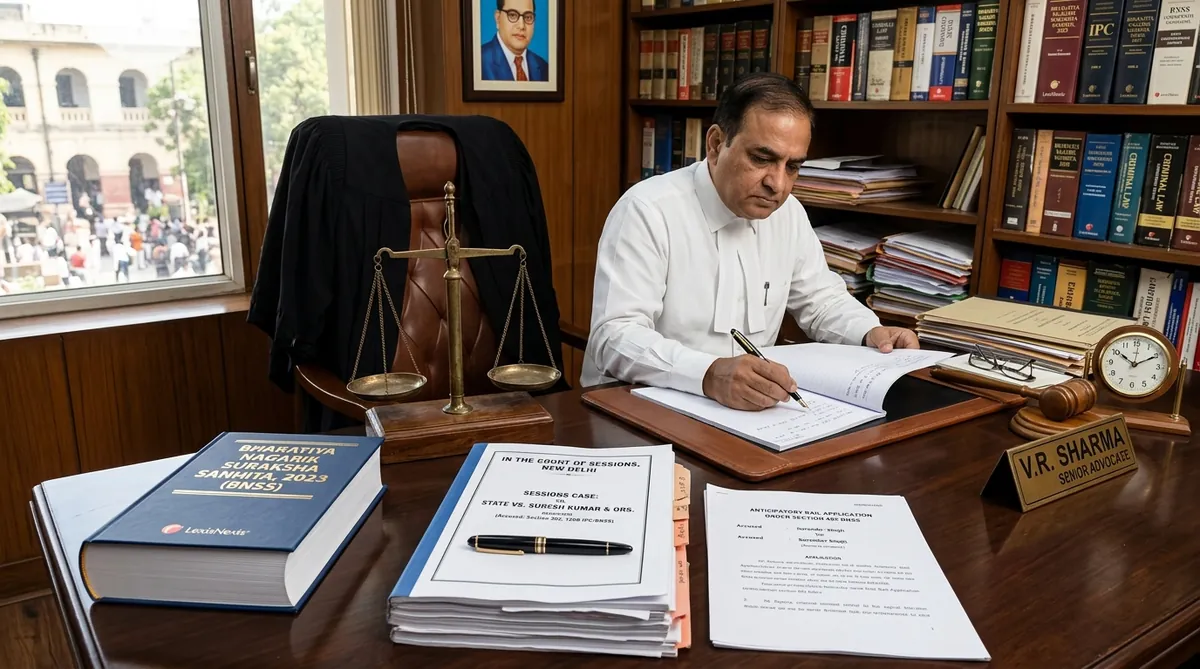
Securing bail in money laundering prosecutions initiated by the Directorate of Enforcement (ED) is among the most challenging litigation tasks in Indian criminal jurisprudence. Section 45 of the Prevention of Money Laundering Act, 2002 (PMLA) erects stringent statutory negative covenants—commonly known as the "Twin Conditions"—which substantially invert traditional criminal bail principles. While regular bail under Section 480 or Section 483 of the Bharatiya Nagarik Suraksha Sanhita, 2023 (BNSS) presumes innocence and treats bail as the rule, Section 45 PMLA mandates that the court must be prima facie satisfied of the accused's innocence before ordering release.
However, the legal landscape surrounding Section 45 has evolved dramatically following landmark rulings of the Supreme Court of India in Vijay Madanlal Choudhary (2022), Pavana Dibbur (2023), and the historic 2024 verdicts in Manish Sisodia and Senthil Balaji. Understanding the statutory thresholds, the medical and humanitarian provisos, and constitutional bail overrides is indispensable for defense counsel and litigants facing Enforcement Directorate proceedings.
Under Section 45 PMLA, regular bail requires the court to find reasonable grounds that the accused is not guilty and unlikely to reoffend. However, statutory provisos exempt women, sick, or infirm individuals, while prolonged pre-trial incarceration and delayed trial empower constitutional courts to grant bail under Article 21.
1. The Statutory Architecture of Section 45(1) PMLA
Section 45(1) of the PMLA imposes mandatory fetters on the judicial discretion of Special PMLA Courts and High Courts when considering bail applications for offences punishable under Section 4 of the Act. The provision reads:
"Notwithstanding anything contained in the Code of Criminal Procedure, 1973 (now BNSS 2023), no person accused of an offence under this Act shall be released on bail or on his own bond unless—
(i) the Public Prosecutor has been given an opportunity to oppose the application for such release; and
(ii) where the Public Prosecutor opposes the application, the court is satisfied that there are reasonable grounds for believing that he is not guilty of such offence and that he is not likely to commit any offence while on bail."
The core challenge in PMLA bail litigation stems from sub-clause (ii): the requirement of "reasonable grounds for believing that the accused is not guilty." As clarified by the Supreme Court in Ranjitsing Brahmajeetsing Sharma v. State of Maharashtra (applied to PMLA in Vijay Madanlal), this standard does not demand a conclusive finding of innocence at the bail stage—which can only occur after full trial—but requires substantial, objective material demonstrating that the accused has a probable defence disproving laundering.
2. Judicial Evolution: From Nikesh Tarachand to Vijay Madanlal
The constitutional journey of Section 45 has undergone three distinct judicial phases:
The Constitution Bench settled that anticipatory bail under Section 438 CrPC (Section 482 BNSS) should not routinely be limited to a fixed time frame, reaffirming that personal liberty under Article 21 cannot be curtailed on vague apprehensions. In Satender Kumar Antil, the Supreme Court mandated that investigating agencies and magistrates strictly adhere to procedural compliance under Section 41A (Section 35 BNSS), establishing that arrests must be justified by exceptional necessity rather than mechanical executive exercise.
| Judicial Phase | Landmark Precedent | Core Legal Holding |
|---|---|---|
| Phase 1: Striking Down (2017) | Nikesh Tarachand Shah v. UOI (2018) 11 SCC 1 | Declared twin conditions unconstitutional for discriminating based on Part A scheduled offences punishable by 3+ years imprisonment. |
| Phase 2: Statutory Revival & Validation (2022) | Vijay Madanlal Choudhary v. UOI (2022) SCC OnLine SC 929 | Upheld 2018 Finance Act amendment curing defects; ruled twin conditions applicable across all PMLA offences uniformly. |
| Phase 3: Article 21 Primacy (2024) | Manish Sisodia v. ED (2024) & Senthil Balaji (2024) | Ruled statutory bail restrictions cannot override the fundamental right to speedy trial and personal liberty under Article 21. |
3. Statutory Exceptions: The First Proviso to Section 45(1)
Parliament specifically created humane carve-outs within the first proviso to Section 45(1), granting Special Courts discretion to release certain categories of persons on bail without satisfying the rigorous twin conditions:
- Minors: Any person under the age of sixteen years.
- Women: Female accused persons irrespective of age or marital status (reaffirmed in Saumya Chaurasia v. ED and Kavitha Kalvakuntla v. ED 2024).
- Sick or Infirm: Accused persons suffering from severe, acute, or debilitating physical ailments requiring medical intervention unavailable in custodial institutions.
- De Minimis Laundering: Accused persons charged with money laundering where the proceeds of crime involved are less than ₹1,00,00,000 (one crore rupees).
Routine ailments, lifestyle diseases (hypertension, mild diabetes), or conditions treatable within specialized referral government hospitals (like AIIMS or Safdarjung) do not entitle an applicant to the proviso. The medical condition must be life-threatening or require constant personalized nursing care.
4. The Constitutional Bail Override: Article 21 and Delayed Trial
The most significant jurisprudential breakthrough for defense counsel in recent years is the Supreme Court's declaration that statutory hurdles under Section 45 PMLA must yield to Article 21 of the Constitution of India when pre-trial detention becomes punitive.
In Manish Sisodia v. Directorate of Enforcement (Criminal Appeal No. 3295 of 2024), a three-judge bench of the Supreme Court held:
"Where the trial is not likely to conclude in a reasonable period and the undertrial has spent substantial incarceration, statutory conditions such as Section 45 of PMLA cannot stand as an absolute barrier to the grant of bail. The fundamental right to speedy trial under Article 21 takes precedence over statutory restrictions."
This constitutional principle was reinforced in Prem Prakash v. Union of India (2024) and V. Senthil Balaji v. Deputy Director, ED (2024), establishing that where the prosecution cites hundreds of witnesses and tens of thousands of pages of documentary evidence, pre-trial incarceration without trial commencement violates basic constitutional norms.
5. The Predicate Offence Linkage: Pavana Dibbur Principle
An accused cannot be convicted of money laundering under Section 3 PMLA in the absence of "proceeds of crime" derived from a scheduled offence. In Pavana Dibbur v. Directorate of Enforcement (2023 SCC OnLine SC 1586), the Supreme Court delivered two crucial holdings:
- A person who is not named as an accused in the predicate scheduled offence FIR/charge sheet can still be prosecuted under PMLA if they knowingly assisted in laundering or possessing proceeds of crime.
- However, if the scheduled offence itself is quashed by the High Court under Section 528 BNSS (Section 482 CrPC), compounded between parties, or ends in complete discharge/acquittal, the PMLA case automatically collapses, because there can be no "proceeds of crime" without an existing scheduled offence.
Consequently, securing discharge, quashing, or compounding in the predicate police or CBI case provides an immediate, unassailable pathway to bail and discharge in the PMLA Special Court.
6. Strategic Checklist for PMLA Bail Petitions
Essential Evidentiary Elements for Bail Applications
- ✔ Demonstrate Untainted Asset Traceability: File forensic audit reports proving assets were acquired using legitimate commercial income prior to the alleged scheduled offence period.
- ✔ Highlight Non-Fulfillment of Section 19 Arrest Mandates: Scrutinize whether the arresting officer complied with Pankaj Bansal v. UOI (2023) by serving written "reasons to believe" to the arrestee at the time of arrest.
- ✔ Quantify Pre-Trial Delay & Document Volume: Calculate total witnesses cited by ED (e.g. 50+ witnesses) and total documentary pages (10,000+ pages) to argue trial impossibility under Manish Sisodia.
- ✔ Compile Independent Medical Board Reports: When invoking the sick/infirm proviso, obtain comprehensive diagnostic records from premier government medical institutions rather than private clinics.
- ✔ Prove Low Flight Risk & Cooperation: Document continuous appearance pursuant to Section 50 summons and voluntary surrender of passport/travel documents.