
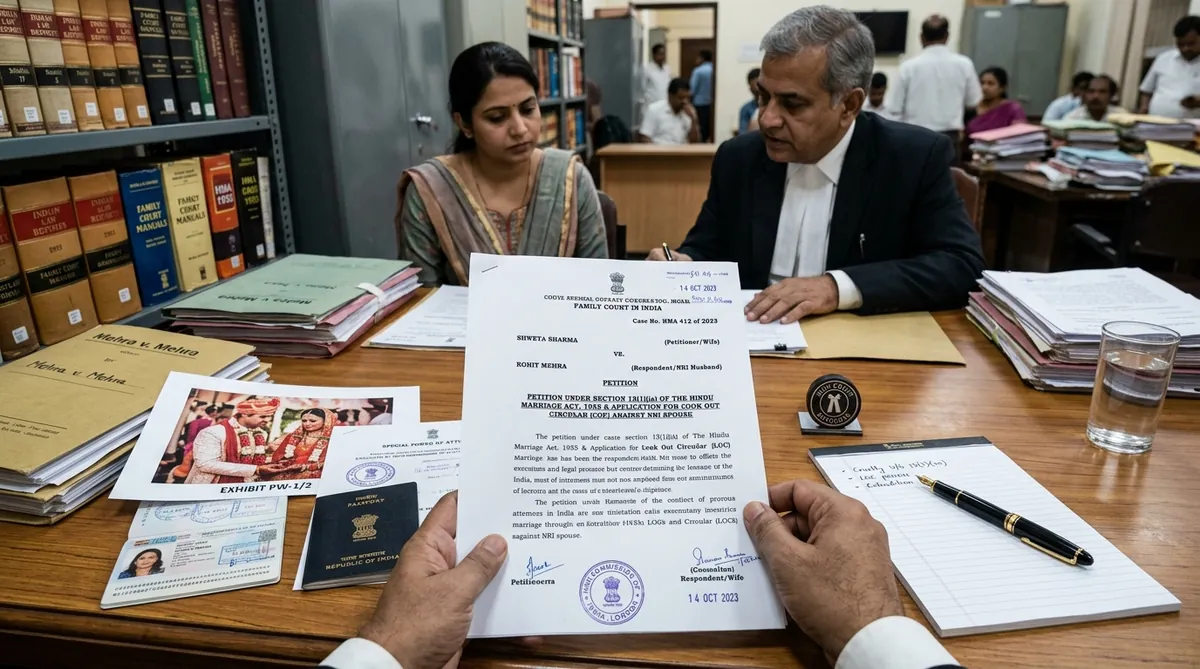
Cross-border matrimonial desertion, commonly termed "NRI wife abandonment", represents one of the most agonizing crises in contemporary Indian family law. In hundreds of cases every year, women married to Non-Resident Indians (NRIs) or Persons of Indian Origin (PIOs) are either forcibly stranded in India after their travel documents are withheld, or left destitute abroad without legal status, maintenance, or social support.
Indian criminal and matrimonial jurisprudence has evolved powerful extraterritorial enforcement mechanisms to ensure that geographical distance does not become an asylum from statutory obligations. Through coordinated action across Family Courts, Judicial Magistrates, the Ministry of External Affairs (MEA), and the Bureau of Immigration (BOI), abandoned spouses can invoke Look Out Circulars, passport revocation, and extradition measures.
When an NRI spouse abandons an Indian wife abroad or flees India during matrimonial disputes, the aggrieved spouse can initiate criminal proceedings leading to Look Out Circulars (LOC) and passport impounding under Section 10(3)(h) of the Passports Act. Non-bailable warrants and proclaimed offender declarations compel the husband's return to India.
1. Look Out Circulars (LOC): Ground Rules and Procedure
A Look Out Circular (LOC) is an administrative alert maintained by the Bureau of Immigration (Ministry of Home Affairs) at all international airports and sea ports to monitor or intercept individuals evading criminal process.
- Requesting Originator: An LOC in matrimonial desertion can be initiated by the Investigating Officer (IO) through the Superintendent of Police (SP) or by the National Commission for Women (NCW) NRI Cell.
- Cognizable Offences: An FIR must typically be registered under Sections 85 (Cruelty), 86 (Harassment for Dowry), 316 (Criminal Breach of Trust for Stridhan), or 318 (Cheating) of the Bharatiya Nyaya Sanhita, 2023 (BNS).
- Detention & Handover: Upon arrival or attempted departure at any Indian port of entry, the immigration authorities detain the NRI husband and hand him over to the local police having jurisdiction.
2. Passport Impounding under Section 10(3) Passports Act, 1967
The Regional Passport Office (RPO) and Ministry of External Affairs hold statutory authority to revoke or impound an Indian passport under Section 10(3) of the Passports Act, 1967:
"Under Section 10(3)(e) and 10(3)(h) of the Passports Act, 1967, the Passport Authority may impound or revoke a passport if proceedings in respect of an offence alleged to have been committed by the holder are pending before a criminal court in India, or if a warrant or summons for his appearance has been issued by a court and he has failed to respond."
Once the passport is impounded or revoked, foreign visa authorities are notified, rendering the NRI spouse's residence status precarious in destination countries such as the United States, Canada, the United Kingdom, or Australia, compelling his submission to Indian judicial proceedings.
3. Proclamation and Property Attachment under BNSS
Where the NRI husband willfully refuses to respond to summons or bailable warrants:
- Section 84 BNSS (Proclamation): The Magistrate issues a proclamation requiring the accused to appear at a specified place and time within not less than thirty days.
- Section 85 BNSS (Attachment): Simultaneous attachment of his ancestral, joint, or self-acquired movable and immovable properties in India can be ordered to satisfy interim maintenance awards.
- Service through MEA: Summons can be officially transmitted through the Ministry of Home Affairs and Ministry of External Affairs under reciprocal mutual legal assistance treaties (MLAT).
Landmark Judicial Precedents & Statutory Authorities
Courts and appellate tribunals across Delhi NCR (Faridabad, Saket, Tis Hazari, Gurugram, High Courts) strictly apply these authoritative Supreme Court benchmarks:
The Supreme Court reaffirmed the three mandatory golden tests for grant of interlocutory injunctions under Order XXXIX Rules 1 and 2 of the Code of Civil Procedure: (i) strong prima facie case, (ii) balance of convenience tilted in applicant's favor, and (iii) imminent threat of irreparable injury not compensable in monetary damages. The Court held that temporary relief cannot be granted mechanically without judicial application of mind.