NDPS Section 37 Commercial Quantity Bail: Overcoming Stringent Twin Conditions in Trial

Strategic Executive Summary
Direct Answer: Section 37 of the NDPS Act bars bail in commercial quantity seizures unless the court finds reasonable grounds that the accused is not guilty. However, fatal non-compliance with statutory search mandates under Section 50, defective sampling under Section 52A, and prolonged incarceration without trial secure bail.
- Reversing the Statutory Burden: Understanding the twin conditions under Section 37(1)(b) NDPS Act and demonstrating "reasonable grounds" of innocence without undergoing a full-scale trial.
- Critical Threshold Distinctions: How statutory categorization (small, intermediate, commercial) dictates whether the Section 37 embargo applies or ordinary bail rules prevail under Section 483 BNSS.
- Mandatory Procedural Safeguards: Weaponizing strict non-compliance with personal search mandates (Section 50) and Magistrate inventory protocols (Section 52A) to dismantle the prosecution's foundation.
- Constitutional Supremacy of Article 21: Invoking landmark Supreme Court rulings (Mohd. Muslim and Rabi Prakash) where inordinate pre-trial delay overrides statutory bail prohibitions.
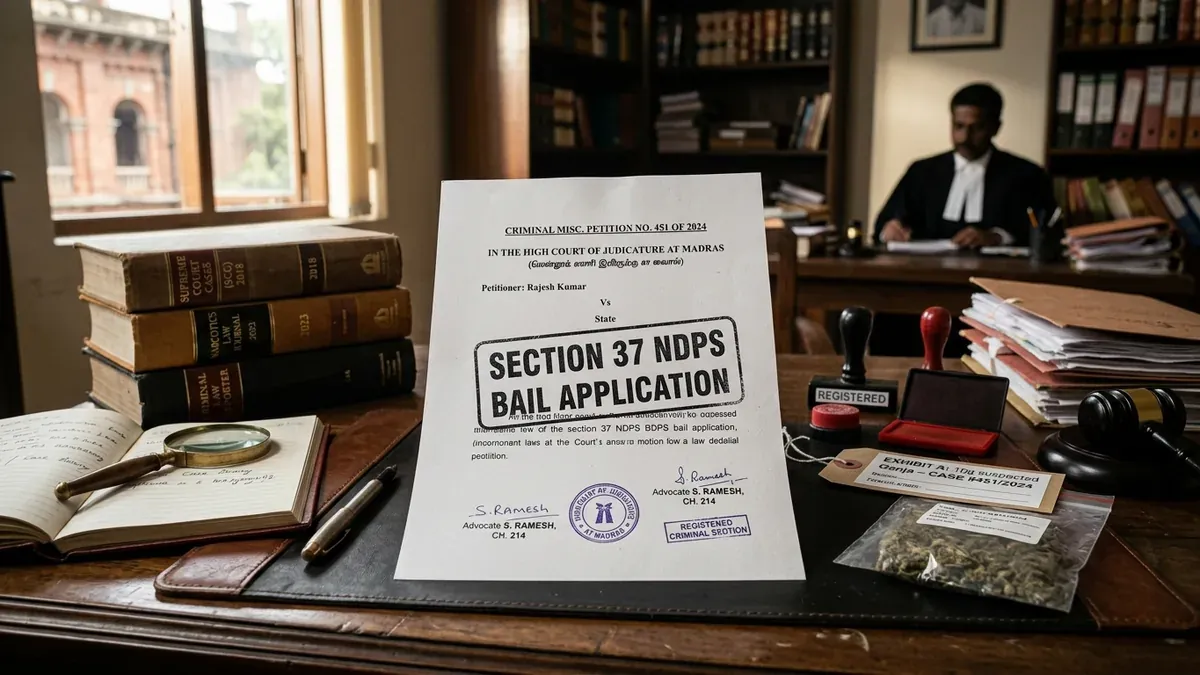
The Narcotic Drugs and Psychotropic Substances Act, 1985 (NDPS Act) represents one of the most punitive legislative frameworks in Indian criminal jurisprudence. Enacted to suppress illicit trafficking in narcotic drugs, the statute introduces an extraordinary statutory barrier to personal liberty under Section 37 whenever a commercial quantity seizure is alleged. By imposing a negative burden upon the accused—demanding judicial satisfaction that the prisoner is prima facie not guilty and unlikely to reoffend—Section 37 transforms judicial custody into an indefinite pre-trial ordeal. However, because statutory penalties under the Act are draconian, the Supreme Court of India has consistently ruled that procedural protections guaranteed to the accused must be observed by enforcement agencies with immaculate strictness. When prosecuting bodies such as the Narcotics Control Bureau (NCB), Special Cell, State Police, or Directorate of Revenue Intelligence (DRI) commit fatal procedural infractions—including violating personal search safeguards under Section 50, executing illegal spot sampling in defiance of Section 52A, or relying entirely on inadmissible Section 67 confessional statements—or where chronic institutional delays infringe upon the constitutional guarantee of a speedy trial under Article 21, the formidable statutory wall of Section 37 can be dismantled.
1. Understanding Section 37 NDPS Act: Negative Burden of Proof on the Accused
In standard criminal proceedings governed by the Bharatiya Nagarik Suraksha Sanhita, 2023 (BNSS) or Code of Criminal Procedure, 1973 (CrPC), personal liberty is the guiding constitutional baseline. The cardinal presumption of innocence remains intact, and bail is granted unless there exists a tangible risk of flight, evidence tampering, or witness intimidation. Under Section 37(1)(b) of the NDPS Act, however, this paradigm is radically inverted through a non-obstante clause that explicitly overrides ordinary bail provisions under Section 483 BNSS (Section 439 CrPC).
Section 37 dictates that no person accused of an offence punishable under Section 19 (embezzlement of opium by cultivator), Section 24 (external dealings in narcotics), Section 27A (financing illicit traffic and harbouring offenders), or offences involving commercial quantity shall be released on bail unless two cumulative statutory twin conditions are met:
The Mandatory Twin Conditions of Section 37(1)(b)
- Mandatory Opportunity to the Public Prosecutor: The Court must afford the Public Prosecutor a full and fair opportunity to oppose the application for bail.
- Judicial Satisfaction of Twin Prongs: Where the Public Prosecutor opposes the application, the Court must record a categorical satisfaction that:
- There are reasonable grounds for believing that the accused is not guilty of such offence; and
- The accused is not likely to commit any offence while on bail.
The phrase "reasonable grounds for believing" has been interpreted through a long line of constitutional rulings, notably Collector of Customs v. Ahmadalieva Nodira (2004) 3 SCC 549, Union of India v. Shiv Shanker Kesari (2007) 7 SCC 798, and State of Kerala v. Rajesh (2020) 12 SCC 122. The Supreme Court has held that "reasonable grounds" mean something more than a mere prima facie assertion, yet something substantially less than proof beyond reasonable doubt required for an acquittal at the conclusion of trial.
The Supreme Court clarified the standard of judicial inquiry under Section 37:
"The court while dealing with the application for bail is not called upon to record a finding of not guilty. It is only required to see whether there are reasonable grounds for believing that the accused is not guilty. What is required is the existence of reasonable grounds for believing that the accused has not committed the offence... The court at this stage cannot conduct a roving inquiry or a mini-trial."
Consequently, the criminal defence advocate is not required to establish conclusive innocence at the interlocutory stage. Rather, the defence must demonstrate that the foundational evidence assembled by the investigating agency suffers from irremediable legal infirmities, statutory breaches, or procedural falsities so grave that they extinguish the probability of conviction. The following comparative matrix outlines the operational parameters separating standard bail from Section 37 scrutiny:
| Core Parameter | Standard Bail (Section 483 BNSS / 439 CrPC) | Commercial Quantity Bail (Section 37 NDPS Act) |
|---|---|---|
| Presumption Baseline | Presumption of innocence operates in favor of the accused; bail is the general rule. | Statutory embargo operates against release; custody is the statutory presumption. |
| Burden of Proof | Prosecution must prove flight risk, witness tampering, or gravity of punishment. | Accused bears negative burden to demonstrate reasonable grounds of innocence. |
| Prosecutorial Opposition | Prosecution's objection is weighed against general judicial discretion. | Prosecutorial opposition triggers mandatory satisfaction of twin statutory prongs. |
| Likelihood of Reoffending | Considered as an ancillary factor based on criminal antecedent records. | Mandatory statutory condition: Court must find accused unlikely to reoffend. |
| Procedural Impact | Procedural irregularities are generally tested at the stage of trial. | Fatal procedural defects immediately establish reasonable grounds of innocence. |
2. Statutory Definition: Small Quantity vs. Intermediate vs. Commercial Quantity
The application of Section 37 is not universal across all narcotics charges. The legislative architecture of the NDPS Act bifurcates punishment and bail admissibility strictly on the basis of the quantity of the illicit substance recovered. Understanding the exact statutory classifications is critical because Section 37 twin conditions do not apply to intermediate or small quantity recoveries.
Small Quantity [Sec 2(xxiiia)]
Defined as any quantity lesser than the quantity specified by Central Government notification. Punishable with rigorous imprisonment up to 1 year, or fine up to ₹10,000, or both. Bailable as a matter of right under Section 37(1)(a).
Intermediate Quantity
Quantities falling between small quantity and commercial quantity. Section 37 bar DOES NOT apply. Governed by ordinary bail jurisprudence under Section 483 BNSS / 439 CrPC (Sami Ullaha v. NCB).
Commercial Quantity [Sec 2(viia)]
Any quantity greater than the quantity specified in the Official Gazette notification. Minimum 10 years up to 20 years rigorous imprisonment, plus mandatory fine. Section 37 twin conditions strictly apply.
The Central Government, vide Notification S.O. 1055(E) dated 19th October 2001 (as amended periodically), has prescribed specific weight thresholds for illicit narcotics and psychotropic substances. The following table illustrates the operational statutory lines for common contraband:
| Substance / Chemical Name | Small Quantity (Grams) | Commercial Quantity (Grams / Kg) | Applicability of Section 37 Embargo |
|---|---|---|---|
| Heroin (Diacetylmorphine / Smack) | Up to 5 grams | 250 grams or more | Strictly applies at ≥ 250 grams |
| Ganja (Cannabis Herb) | Up to 1,000 grams (1 kg) | 20,000 grams (20 kg) or more | Strictly applies at ≥ 20 kg |
| Charas / Hashish / Resin | Up to 100 grams | 1,000 grams (1 kg) or more | Strictly applies at ≥ 1 kg |
| Cocaine | Up to 2 grams | 100 grams or more | Strictly applies at ≥ 100 grams |
| Opium (Papaver Somniferum) | Up to 25 grams | 2,500 grams (2.5 kg) or more | Strictly applies at ≥ 2.5 kg |
| MDMA (Ecstasy) | Up to 0.5 grams | 10 grams or more | Strictly applies at ≥ 10 grams |
| Methamphetamine / Crystal Meth | Up to 2 grams | 50 grams or more | Strictly applies at ≥ 50 grams |
| Tramadol | Up to 5 grams | 250 grams or more | Strictly applies at ≥ 250 grams |
| Codeine (Syrup / Formulation) | Up to 10 grams | 1,000 grams (1 kg) or more | Strictly applies at ≥ 1 kg gross content |
For over a decade, conflicting judicial opinions existed regarding whether the pure narcotic content or the total gross mixture should determine commercial quantity. Resolving the controversy in Hira Singh, a Three-Judge Bench of the Supreme Court held:
"In the case of seizure of a mixture of narcotic drugs or psychotropic substances with one or more neutral substance(s), the quantity of neutral substance(s) is not to be excluded and to be taken into consideration along with the actual content by weight of the narcotic drug, while determining whether it is a small, intermediate or commercial quantity."
Defence Caveat: In cases involving botanical cannabis (Ganja), the statutory definition under Section 2(iii)(b) restricts contraband to the flowering or fruiting tops. Where the police unlawfully weigh stalks, stems, and leaves lacking fruiting tops to artificially inflate an intermediate seizure into a commercial quantity, defence counsel can successfully dispute the commercial threshold at the bail stage.
3. Section 50 Mandatory Personal Search Protocol (State of Punjab v. Baldev Singh)
Because the consequences of an NDPS arrest are life-altering, Parliament incorporated vital statutory checks against police fabrication. Among these, Section 50 of the NDPS Act is pre-eminent. Section 50 mandates that when an authorized officer is about to search any suspect, the officer is legally obligated to inform the person of their statutory right to be searched in the presence of a Gazetted Officer or a Magistrate.
The constitutional contours of this requirement were solidified by a Five-Judge Constitution Bench of the Supreme Court in the historic ruling of State of Punjab v. Baldev Singh (1999) 6 SCC 172, and subsequently reinforced in Vijaysinh Chandubha Jadeja v. State of Gujarat (2011) 1 SCC 609.
- Mandatory Apprisal of Right: The officer must inform the suspect that they have a statutory right under law to be searched before a Gazetted Officer or a Magistrate. Mere substantial compliance is not enough; the communication must be clear and unequivocal.
- No "Third Option" Permitted: Offering the suspect an option to be searched by the investigating officer himself, or stating "if you desire, we can search you or we can take you to an officer", violates Section 50. Informing the suspect is a duty, not an inquiry.
- Vitiation of Recovery: Failure to inform the suspect of this statutory right renders the recovery suspect and inadmissible in law. While it may not automatically quash the entire trial if independent offences exist, it completely invalidates the recovery memo for the purpose of proving possession—thereby entitling the accused to bail under Section 37.
In Pawan Kumar, the Supreme Court held that Section 50 applies exclusively to the search of the "person" of the accused—such as body cavities, pockets, and clothes worn on the body—and does not apply to standalone baggage, briefcases, or motor vehicles.
The Composite Search Doctrine (State of Rajasthan v. Parmanand, 2014): However, the Supreme Court carved out a crucial exception. Where the police search both the bag AND the physical person of the accused simultaneously as part of the same transaction, compliance with Section 50 becomes mandatory for the entire search. If the officer fails to offer a proper Section 50 notice before searching the suspect, the search of the bag is also poisoned by the illegality, entitling the accused to bail.
4. Section 52A Inventory & Magistrate Certification Protocol (Union of India v. Mohanlal)
Perhaps the most devastating evidentiary weapon available to criminal defence counsel in contemporary NDPS trials arises under Section 52A of the NDPS Act. Enacted to curb widespread police corruption, evidence swapping, and tampering with seized narcotics, Section 52A establishes a strict judicial protocol for the inventorying, photography, and sampling of seized contraband.
Under Section 52A(2), upon seizing contraband, the investigating officer must immediately prepare an inventory containing details of quantity, purity, markings, and origin, and present an application to the nearest Judicial Magistrate for:
- Certifying the correctness of the inventory prepared;
- Taking photographs of the contraband in the presence of the Magistrate and certifying the photographs as true; and
- Drawing representative samples of the seized substances in the physical presence and supervision of the Magistrate, and certifying the correctness of the list of samples so drawn.
The Supreme Court delivered an authoritative mandate regarding the sampling process:
"No sooner the seizure of any narcotic drug or psychotropic substance is effected, the officer in charge must make an application to the Magistrate for certification and drawing of samples... There is no provision under the Act that permits the investigating officer to draw samples at the spot of seizure. The drawing of samples must take place in the presence and under the supervision of the Magistrate."
Despite this binding declaration, police stations and anti-narcotics units across India routinely draw samples directly at the spot of seizure, seal them in departmental plastic packets, and only present the seized lot to the Magistrate weeks or months later. The Supreme Court has repeatedly held that such spot sampling is a flagrant illegality that destroys the prosecution's case:
Mangilal v. State of M.P. (2023 SC)
The Supreme Court ruled that when sampling is conducted without a Magistrate, the FSL chemical examination report loses all evidentiary validity under Section 52A(4). Such a defective report cannot be admitted as primary evidence, dismantling the prosecution's commercial quantity allegations.
Simarnjit Singh v. State of Punjab (2023 SC)
A Two-Judge Bench held that drawing samples at the time of seizure rather than in the presence of the Magistrate constitutes a fatal procedural violation that vitiates the trial and establishes clear reasonable grounds for bail.
Yusuf @ Asif v. State (2023 SC)
The Court held that an unexplained delay between the seizure and the Section 52A Magistrate proceedings completely breaks the chain of custody. The benefit of this evidentiary void must accrue to the accused at the bail stage.
When drafting an emergent bail application under Section 483 BNSS / 439 CrPC, counsel must demand inspection of the Malkhana Register No. 19 and the Section 52A Magisterial Certificate. If samples were drawn on the spot or if the FSL received packets drawn outside the Magistrate's presence, Section 37 ceases to be an obstacle.
5. Delay in Trial as Ground for Bail Overriding Section 37 (Mohd. Muslim v. State)
One of the most persistent injustices in narcotics litigation is the indefinite detention of undertrials. Due to heavy docket backlogs in District & Sessions Courts across Delhi NCR and other metropolitan centres, NDPS trials routinely take four to eight years to conclude. State prosecutors historically argued that regardless of the duration of pre-trial incarceration, Section 37 constitutes an impenetrable barrier preventing courts from granting bail.
This regressive interpretation was decisively struck down by the Supreme Court in the landmark ruling of Mohd. Muslim @ Hussain v. State (NCT of Delhi), 2023 SCC OnLine SC 352, authored by Justice S. Ravindra Bhat.
The Supreme Court confronted the severe friction between the statutory embargo of Section 37 and the constitutional mandate of Article 21:
"A hyper-technical interpretation of Section 37 of the NDPS Act would completely undermine the right to personal liberty guaranteed under Article 21. Incarceration of an undertrial for years without the prospect of an early conclusion of trial is punitive in nature and turns the procedure into a punishment. When the trial cannot conclude within a reasonable period, the harsh conditions of Section 37 must be tempered by constitutional mandates."
- Harmonious Realignment: The Court established that where an accused has undergone substantial custody (such as two to three years) and only a fraction of the listed prosecution witnesses have been examined, the court can grant bail.
- Redefining "Reasonable Grounds": Prolonged delay itself, coupled with the absence of active prosecution fault attributable to the accused, constitutes a legitimate legal ground to satisfy the court under Section 37.
- Pre-trial Incarceration Must Not Become Sentence: The state cannot utilize Section 37 as a license for indefinite preventive detention without trial.
6. Rabi Prakash v. State of Odisha: Constitutional Primacy of Article 21
Building upon the foundational jurisprudence of Mohd. Muslim, the Supreme Court established an even more direct, uncompromising constitutional benchmark in Rabi Prakash v. State of Odisha, 2023 SCC OnLine SC 1109. Here, the Supreme Court unequivocally declared that statutory non-obstante clauses enacted by Parliament must unconditionally yield to Part III of the Constitution of India.
"The prolonged incarceration, generally militant against the most precious fundamental right guaranteed under Article 21 of the Constitution and in such a situation, the conditional liberty must override the statutory embargo created under Section 37(1)(b)(ii) of the NDPS Act."
The profound significance of Rabi Prakash lies in its clarity: trial courts and High Courts do not need to hunt for technical evidentiary defects if prolonged custody and trial delay are established. If the State cannot deliver a speedy trial, it loses the moral and legal authority to demand pre-trial incarceration under Section 37.
This constitutional primacy has been consistently enforced across a constellation of landmark Supreme Court rulings:
Satender Kumar Antil v. CBI (2022) 10 SCC 51
The Supreme Court ruled that while dealing with special enactments containing stringent bail provisions (NDPS, PMLA, UAPA), courts cannot lose sight of Article 21. Protracted delays in trial automatically enliven the right to bail.
Shariful Islam @ Sarif v. State of W.B. (2022)
The Supreme Court granted bail to an accused facing commercial quantity allegations (Phensedyl / Codeine syrup) after 1 year and 6 months of custody, noting that trial completion was nowhere in sight.
Dheeraj Kumar Shukla v. State of U.P. (2023)
Bail was granted in a commercial quantity seizure involving 65 kg of Ganja. The Supreme Court held that custody exceeding two and a half years with only preliminary witnesses examined justified overriding Section 37.
To successfully argue a delay-based bail petition before the Sessions Court or High Court, criminal defence counsel must prepare an exact chronological audit documenting:
- Total Incarceration Period: Exact duration of pre-trial custodial detention (days, months, years).
- Trial Examination Ratio: Total prosecution witnesses cited in the chargesheet versus witnesses examined to date (e.g., 2 out of 38 witnesses examined over 30 months).
- Order Sheet Analysis: Certified order sheets proving that the delay was caused by prosecutorial adjournments, absent police witnesses, or delayed FSL reports—and not by defence dilatory tactics.
- Clean Antecedent Record: Demonstrating that the applicant has no prior convictions under the NDPS Act, establishing that release will not endanger society.
7. Section 67 NDPS Inadmissibility of Statements to NCB/Police (Tofan Singh)
In countless narcotics crackdowns, enforcement agencies intercept a primary courier carrying contraband and subsequently arrest upstream distributors, financiers, or acquaintances solely on the strength of a confessional statement recorded under Section 67 of the NDPS Act. For decades, investigating agencies treated Section 67 statements as admissible confessions, exploiting them to circumvent Section 25 of the Indian Evidence Act, 1872 (now Section 23 of the Bharatiya Sakshya Adhiniyam, 2023 - BSA).
This oppressive investigative shortcut was conclusively struck down by a Five-Judge Constitution Bench of the Supreme Court in the epochal ruling of Tofan Singh v. State of Tamil Nadu (2021) 4 SCC 1.
The Constitution Bench, by an overwhelming majority, answered reference questions regarding the legal status of NCB/DRI officers and Section 67 statements:
- Officers Invested with Police Powers: Officers invested with powers under Section 53 of the NDPS Act (including NCB, DRI, Customs, and Excise officials) are "police officers" within the meaning of Section 25 of the Evidence Act (Section 23 BSA 2023).
- Inadmissibility of Confessions: Any confessional statement recorded under Section 67 NDPS Act is hit by Section 25 Evidence Act / Section 23 BSA and is completely inadmissible against the maker or any co-accused.
- Section 67 is for Inquiry, Not Confession: Section 67 only empowers officers to call for information during an inquiry; it does not authorize the recording of a self-incriminating confessional deposition for court trial.
The post-Tofan Singh jurisprudence creates an immediate entitlement to bail in "disclosure statement" arrests. Where an individual is implicated purely on the confessional disclosure of a co-accused, or where the only material against the applicant is a custodial statement under Section 67 without independent physical contraband recovery, Section 37 does not operate as an embargo.
The Supreme Court affirmed the grant of bail to multiple accused persons arrested in commercial narcotics conspiracies, holding that:
"Statements recorded under Section 67 of the NDPS Act cannot be taken into account in order to establish the guilt of an accused, even at the stage of bail, as per the law laid down by the Constitution Bench in Tofan Singh... Mere call detail records (CDRs) showing contact between the accused and co-accused, without actual recovery of contraband from the person or premises of the accused, cannot justify continued detention under Section 37."
Therefore, when challenging an arrest based on phone records, WhatsApp chats, or co-accused disclosures without physical seizure, defense counsel should immediately file for bail, citing Tofan Singh and Pallulabid Ahmad. In the absence of primary recovery, there exist undeniable "reasonable grounds" to believe the accused is not guilty.
Statutory Authorities & Landmark Legal Citations
- The Narcotic Drugs and Psychotropic Substances Act, 1985: Sections 2(viia), 2(xxiiia), 37, 42, 50, 52A, 53, and 67.
- The Constitution of India: Article 21 (Fundamental Right to Life, Personal Liberty & Speedy Trial) & Article 22.
- Bharatiya Nagarik Suraksha Sanhita, 2023 (BNSS): Section 483 (High Court / Sessions Court Special Powers regarding Bail).
- Bharatiya Sakshya Adhiniyam, 2023 (BSA): Section 23 (Inadmissibility of Confessions to Police Officers) & Section 63 (Electronic Evidence).
- Landmark Supreme Court Authorities:
- State of Punjab v. Baldev Singh (1999) 6 SCC 172 (Constitution Bench - Section 50 Personal Search).
- Vijaysinh Chandubha Jadeja v. State of Gujarat (2011) 1 SCC 609 (Constitution Bench - Section 50 Right Apprisal).
- Union of India v. Mohanlal (2016) 3 SCC 379 (Section 52A Magisterial Sampling Protocol).
- Hira Singh v. Union of India (2020) 20 SCC 793 (Constitution Bench - Mixture Weight Determination).
- Tofan Singh v. State of Tamil Nadu (2021) 4 SCC 1 (Constitution Bench - Inadmissibility of Section 67 Statements).
- State by (NCB) Bengaluru v. Pallulabid Ahmad Arimutta (2022) 12 SCC 633 (CDRs & Disclosure Statements).
- Mohd. Muslim @ Hussain v. State (NCT of Delhi), 2023 SCC OnLine SC 352 (Trial Delay Overriding Section 37).
- Rabi Prakash v. State of Odisha, 2023 SCC OnLine SC 1109 (Article 21 Supremacy over Section 37 Embargo).
Disclaimer: This legal analysis is published strictly for academic and educational purposes under the Advocates Act, 1961. It does not constitute formal legal advice, solicitation, or advertisement under Rule 36 of the Bar Council of India Rules, nor does it create an advocate-client relationship. For case-specific legal representation, parties should consult an independent Senior Criminal Defence Advocate.
Frequently Asked Questions
Authoritative statutory answers and procedural guidance curated by Senior NDPS Defence Advocates in Delhi NCR.
Can bail be granted in commercial quantity cases under Section 37 NDPS Act?
Yes, bail can be granted under Section 37(1)(b) if the court finds reasonable grounds for believing that the accused is not guilty and unlikely to commit an offence while on bail. Bail is routinely granted where there is fatal non-compliance with mandatory search protocols under Section 50, defective spot sampling in violation of Section 52A, reliance solely on inadmissible Section 67 statements (Tofan Singh), or prolonged pre-trial incarceration violating Article 21 (Mohd. Muslim and Rabi Prakash).
What is the legal difference between intermediate quantity and commercial quantity bail in NDPS?
For intermediate quantities (quantities above small quantity but below commercial quantity, such as between 5g and 250g of heroin, or between 1kg and 20kg of ganja), the stringent twin conditions under Section 37 NDPS Act do not apply. Bail in intermediate quantity matters is governed by regular judicial discretion under Section 483 BNSS (Section 439 CrPC), where the accused is not required to prove prima facie innocence. For commercial quantities, Section 37 imposes a reverse burden on the accused.
How does non-compliance with Section 52A NDPS Act assist in securing bail?
As authoritatively established by the Supreme Court in Union of India v. Mohanlal and Mangilal v. State of MP, investigating officers have no legal authority to draw samples at the spot of seizure. Samples drawn without a Judicial Magistrate's physical presence and inventory certification under Section 52A(2) cannot be treated as valid primary evidence. Such procedural failure vitiates the seizure and invalidates the FSL report, establishing substantial reasonable grounds to believe the accused is not guilty for the purpose of bail.
How does prolonged incarceration override the Section 37 NDPS bail embargo under Article 21?
The Supreme Court in Mohd. Muslim @ Hussain v. State (NCT of Delhi) (2023) and Rabi Prakash v. State of Odisha (2023) established that statutory restrictions under Section 37 must yield to the fundamental right to personal liberty and speedy trial under Article 21 of the Constitution. Where an accused has undergone substantial pre-trial detention (typically 1.5 to 3 years or more) and the trial is unlikely to conclude soon due to numerous prosecution witnesses, conditional liberty overrides the statutory embargo.